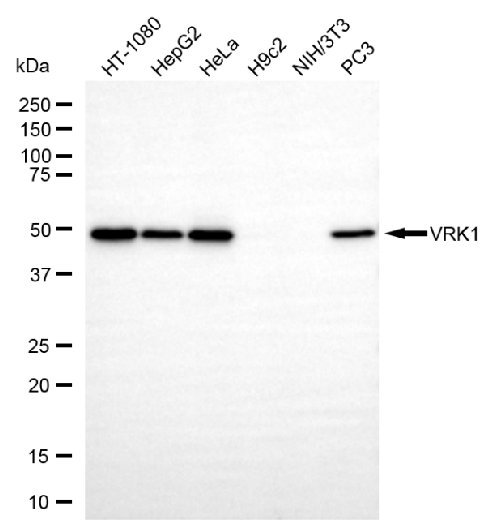
Mouse anti-Human sapiens (Human) VRK1 Monoclonal Antibody

Mouse anti-Human sapiens (Human) VRK1 Monoclonal Antibody — Serine/threonine kinase involved in the regulation of key cellular processes including the cell cycle, nuclear condensation, transcription regulation, and DNA damage response.

SKU: BCREC-000863MA Category:

Product Specifications

Uniprot No.Q99986
Target NamesVRK1
Species ReactivityMouse
ImmunogenRecombinant Human VRK1 protein
Immunogen SpeciesHomo sapiens (Human)
ConjugateNon-conjugated
IsotypeMouse IgG1
ClonalityMonoclonal
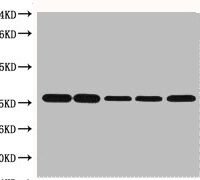
ApplicationsELISA, WB
BufferPBS, 50% glycerol, 0.05% Proclin 300, 0.05%BSA
StorageUpon receipt, store at -20°C or -80°C. Avoid repeated freeze.

Function

Serine/threonine kinase involved in the regulation of key cellular processes including the cell cycle, nuclear condensation, transcription regulation, and DNA damage response. Controls chromatin organization and remodeling by mediating phosphorylation of histone H3 on 'Thr-4' and histone H2AX (H2aXT4ph). It also phosphorylates KAT5 in response to DNA damage, promoting KAT5 association with chromatin and histone acetyltransferase activity.

Biological Context

Subcellular Location: Nucleus; Cytoplasm; Nucleus, Cajal body
Tissue Specificity: Widely expressed. Highly expressed in fetal liver, testis and thymus
Disease Association: Pontocerebellar hypoplasia 1A (PCH1A) : A form of pontocerebellar hypoplasia, a disorder characterized by structural defects of the pons and cerebellum, evident upon brain imaging. PCH1A is an autosomal recessive form characterized by an abnormally small cerebellum and brainstem, central and peripheral motor dysfunction from birth, gliosis and spinal cord anterior horn cells degeneration resembling infantile spinal muscular atrophy. Additional features include muscle hypotonia, congenital contractures and respiratory insufficiency that is evident at birth. [The disease is caused by variants affecting the gene represented in this entry] | Neuronopathy, distal hereditary motor, autosomal recessive 10 (HMNR10) : A form of distal hereditary motor neuronopathy, a heterogeneous group of neuromuscular diseases caused by selective degeneration of motor neurons in the anterior horn of the spinal cord, without sensory deficit in the posterior horn. HMNR10 is a slowly progressive form characterized by distal muscle weakness and atrophy predominantly affecting the lower limbs, and resulting in gait abnormalities. Upper limb involvement is seen in some patients. HMNR10 has mostly juvenile or adult onset, although symptoms may manifest in infancy or childhood in some patients. [The disease is caused by variants affecting the gene represented in this entry]

Product Specifications

Mouse anti-Human sapiens (Human) VRK1 Monoclonal Antibody is a recombinant protein. Suitable for ELISA and Western Blot applications.

SDS-PAGE: Single band at expected molecular weight confirming purity.

ELISA: Suitable as coating antigen or detection standard.

Western Blot: Compatible with standard Western Blot protocols.

Protein Interaction: Validated for SPR (Surface Plasmon Resonance) and BLI (Bio-Layer Interferometry) studies.

Shipping: Shipped at ambient temperature. Lyophilized protein is stable during transit.

Storage: Store lyophilized protein at -20°C to -80°C. Reconstituted protein should be aliquoted and stored at -80°C. Avoid repeated freeze-thaw cycles.

Shelf Life: 12 months from date of receipt when stored as recommended.

Shipping Time: Orders placed before 2 PM EST ship same day. International orders typically deliver within 5-10 business days.

Protein Biology

Function

Serine/threonine kinase involved in the regulation of key cellular processes including the cell cycle, nuclear condensation, transcription regulation, and DNA damage response (PubMed:14645249, PubMed:18617507, PubMed:19103756, PubMed:33076429). Controls chromatin organization and remodeling by mediating phosphorylation of histone H3 on 'Thr-4' and histone H2AX (H2aXT4ph) (PubMed:31527692, PubMed:37179361). It also phosphorylates KAT5 in response to DNA damage, promoting KAT5 association with chromatin and histone acetyltransferase activity (PubMed:33076429). Is involved in the regulation of cell cycle progression of neural progenitors, and is required for proper cortical neuronal migration (By similarity). Is involved in neurite elongation and branching in motor neurons, and has an essential role in Cajal bodies assembly, acting through COIL phosphorylation and the control of coilin degradation (PubMed:21920476, PubMed:31090908, PubMed:31527692). Involved in Golgi disassembly during the cell cycle: following phosphorylation by PLK3 during mitosis, it is required to induce Golgi fragmentation (PubMed:19103756). Phosphorylates BANF1: disrupts its ability to bind DNA, reduces its binding to LEM domain-containing proteins and causes its relocalization from the nucleus to the cytoplasm (PubMed:16495336). Phosphorylates TP53BP1 and p53/TP53 on 'Thr-18', preventing the interaction between p53/TP53 and MDM2 (PubMed:10951572, PubMed:31527692). Phosphorylates ATF2 which activates its transcriptional activity (PubMed:15105425). Phosphorylates JUN (PubMed:31527692)

Subcellular Location

Nucleus; Cytoplasm; Nucleus, Cajal body

Disease Association

Pontocerebellar hypoplasia 1A (PCH1A) : A form of pontocerebellar hypoplasia, a disorder characterized by structural defects of the pons and cerebellum, evident upon brain imaging. PCH1A is an autosomal recessive form characterized by an abnormally small cerebellum and brainstem, central and peripheral motor dysfunction from birth, gliosis and spinal cord anterior horn cells degeneration resembling infantile spinal muscular atrophy. Additional features include muscle hypotonia, congenital contractures and respiratory insufficiency that is evident at birth. [The disease is caused by variants affecting the gene represented in this entry] | Neuronopathy, distal hereditary motor, autosomal recessive 10 (HMNR10) : A form of distal hereditary motor neuronopathy, a heterogeneous group of neuromuscular diseases caused by selective degeneration of motor neurons in the anterior horn of the spinal cord, without sensory deficit in the posterior horn. HMNR10 is a slowly progressive form characterized by distal muscle weakness and atrophy predominantly affecting the lower limbs, and resulting in gait abnormalities. Upper limb involvement is seen in some patients. HMNR10 has mostly juvenile or adult onset, although symptoms may manifest in infancy or childhood in some patients. [The disease is caused by variants affecting the gene represented in this entry]

Tissue Specificity

Widely expressed. Highly expressed in fetal liver, testis and thymus

Subunit

(Microbial infection) Interacts with vaccinia protein B12; this interaction inhibits the repressive activity of the vaccinia virus B12 pseudokinase on viral replication factory formation

Gene: VRK1  |  Organism: Homo sapiens  |  Synonyms: Vaccinia-related kinase 1
Key Publications

Frequently Asked Questions

How do I order or inquire about this product?

Fill out the Online Inquiry form with your required quantity and specifications. You can also email sales@biocrestsci.com. Our team typically responds within 4 business hours with a quote and availability confirmation.

What is the shipping and delivery time?

Orders placed before 2 PM EST ship the same day. Domestic (US) delivery typically takes 2-3 business days. International orders deliver within 5-10 business days. All products are shipped at ambient temperature with appropriate packaging to ensure stability.

How should I store this recombinant protein?

Lyophilized proteins should be stored at -20°C to -80°C upon receipt. After reconstitution, aliquot and store at -80°C. Avoid repeated freeze-thaw cycles. Shelf life is 12 months from date of receipt when stored as recommended.

What quality controls are performed on your products?

Each product undergoes SDS-PAGE purity analysis (typically >85-95%), endotoxin testing, and bioactivity validation. Products are validated for ELISA, Western Blot, and SPR/BLI applications as specified on this product page. A Certificate of Analysis (CoA) is available upon request.

Shopping Cart
Scroll to Top