Recombinant Bovine Beta-arrestin-2 (ARRB2), partial

Recombinant Bovine Beta-arrestin-2 (ARRB2), partial — Functions in regulating agonist-mediated G protein-coupled receptor (GPCR) signaling by mediating both receptor desensitization and resensitization processes. Purity >90%.

SKU: BCRECP-002143 Category:

Product Specifications

Product SkuBCRECP-002143
Product DescriptionRecombinant Bovine Beta-arrestin-2 (ARRB2) Protein is expressed from E.coli with N-terminal 6xHis-GST-tagged. It contains 240-420aa. [Accession | P32120].
Uniprot No.P32120
Gene NamesARRB2
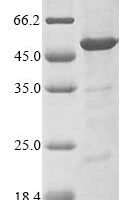
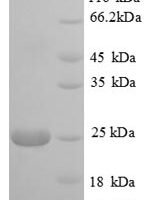
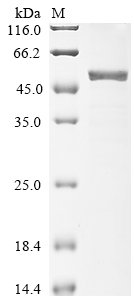
PurityGreater than 90% as determined by SDS-PAGE.
Expression SystemE.coli
Expression Region240-420aa
SpeciesBos taurus (Bovine)
Tag InfoN-terminal 6xHis-GST-tagged
Molecular weight51.5kDa
ActivityPlease contact us to obtain bioactivity data.
BufferIf the delivery form is liquid, the default storage buffer is Tris/PBS-based buffer, 5%-50% glycerol. If the delivery form is lyophilized powder, the buffer before lyophilization is Tris/PBS-based buffer, 6% Trehalose.
StorageStore at -20°C/-80°C upon receipt, aliquoting is necessary for mutiple use. Avoid repeated freeze-thaw cycles.
Research AreasSignal Transduction

Function

Functions in regulating agonist-mediated G protein-coupled receptor (GPCR) signaling by mediating both receptor desensitization and resensitization processes. During homologous desensitization, beta-arrestins bind to the GPCR-phosphorylated receptor and sterically preclude its coupling to the cognate G protein; the binding appears to require additional receptor determinants exposed only in the active receptor conformation. The beta-arrestins target many receptors for internalization by acting as endocytic adapters (CLASPs, clathrin-associated sorting proteins) and recruiting the GPRCs to the adapter protein 2 complex 2 (AP-2) in clathrin-coated pits (CCPs).

Biological Context

Subcellular Location: Cytoplasm; Nucleus; Cell membrane; Membrane, clathrin-coated pit; Cytoplasmic vesicle
Tissue Specificity: Found in a variety of tissues. The short isoform is the most abundant form in all tissues

Product Specifications

Recombinant Bovine Beta-arrestin-2 (ARRB2), partial is a recombinant protein from Bos taurus (Bovine), expressed in E.coli, covering amino acids 240-420aa, with N-terminal 6xHis-GST-tagged tag, molecular weight 51.5kDa, purity Greater than 90% as determined by SDS-PAGE.. Suitable for ELISA and Western Blot applications.
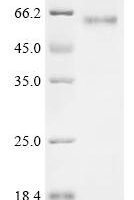
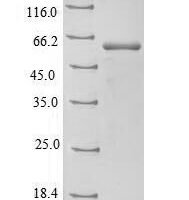
SDS-PAGE: Single band at expected molecular weight confirming purity.

ELISA: Suitable as coating antigen or detection standard.

Western Blot: Compatible with standard Western Blot protocols.

Protein Interaction: Validated for SPR (Surface Plasmon Resonance) and BLI (Bio-Layer Interferometry) studies.

Shipping: Shipped at ambient temperature. Lyophilized protein is stable during transit.

Storage: Store lyophilized protein at -20°C to -80°C. Reconstituted protein should be aliquoted and stored at -80°C. Avoid repeated freeze-thaw cycles.

Shelf Life: 12 months from date of receipt when stored as recommended.

Shipping Time: Orders placed before 2 PM EST ship same day. International orders typically deliver within 5-10 business days.

Protein Biology

Function

Functions in regulating agonist-mediated G protein-coupled receptor (GPCR) signaling by mediating both receptor desensitization and resensitization processes (PubMed:37209686, PubMed:38175886). During homologous desensitization, beta-arrestins bind to the GPCR-phosphorylated receptor and sterically preclude its coupling to the cognate G protein; the binding appears to require additional receptor determinants exposed only in the active receptor conformation. The beta-arrestins target many receptors for internalization by acting as endocytic adapters (CLASPs, clathrin-associated sorting proteins) and recruiting the GPRCs to the adapter protein 2 complex 2 (AP-2) in clathrin-coated pits (CCPs). However, the extent of beta-arrestin involvement appears to vary significantly depending on the receptor, agonist and cell type. Internalized arrestin-receptor complexes traffic to intracellular endosomes, where they remain uncoupled from G proteins. Two different modes of arrestin-mediated internalization occur. Class A receptors, like ADRB2, OPRM1, ENDRA, D1AR and ADRA1B dissociate from beta-arrestin at or near the plasma membrane and undergo rapid recycling. Class B receptors, like AVPR2, AGTR1, NTSR1, TRHR and TACR1 internalize as a complex with arrestin and traffic with it to endosomal vesicles, presumably as desensitized receptors, for extended periods of time. Receptor resensitization then requires that receptor-bound arrestin is removed so that the receptor can be dephosphorylated and returned to the plasma membrane. Mediates endocytosis of CCR7 following ligation of CCL19 but not CCL21. Involved in internalization of P2RY1, P2RY4, P2RY6 and P2RY11 and ATP-stimulated internalization of P2RY2. Involved in phosphorylation-dependent internalization of OPRD1 and subsequent recycling or degradation. Involved in ubiquitination of IGF1R. Beta-arrestins function as multivalent adapter proteins that can switch the GPCR from a G protein signaling mode that transmits short-lived signals from the plasma membrane via small molecule second messengers and ion channels to a beta-arrestin signaling mode that transmits a distinct set of signals that are initiated as the receptor internalizes and transits the intracellular compartment. Acts as a signaling scaffold for MAPK pathways such as MAPK1/3 (ERK1/2) and MAPK10 (JNK3). ERK1/2 and JNK3 activated by the beta-arrestin scaffold are largely excluded from the nucleus and confined to cytoplasmic locations such as endocytic vesicles, also called beta-arrestin signalosomes. Acts as a signaling scaffold for the AKT1 pathway. GPCRs for which the beta-arrestin-mediated signaling relies on both ARRB1 and ARRB2 (codependent regulation) include ADRB2, F2RL1 and PTH1R. For some GPCRs the beta-arrestin-mediated signaling relies on either ARRB1 or ARRB2 and is inhibited by the other respective beta-arrestin form (reciprocal regulation). Increases ERK1/2 signaling in AGTR1- and AVPR2-mediated activation (reciprocal regulation). Involved in CCR7-mediated ERK1/2 signaling involving ligand CCL19. Is involved in type-1A angiotensin II receptor/AGTR1-mediated ERK activity. Is involved in type-1A angiotensin II receptor/AGTR1-mediated MAPK10 activity. Is involved in dopamine-stimulated AKT1 activity in the striatum by disrupting the association of AKT1 with its negative regulator PP2A. Involved in AGTR1-mediated chemotaxis. Appears to function as signaling scaffold involved in regulation of MIP-1-beta-stimulated CCR5-dependent chemotaxis. Involved in attenuation of NF-kappa-B-dependent transcription in response to GPCR or cytokine stimulation by interacting with and stabilizing CHUK. Suppresses UV-induced NF-kappa-B-dependent activation by interacting with CHUK. The function is promoted by stimulation of ADRB2 and dephosphorylation of ARRB2. Involved in p53/TP53-mediated apoptosis by regulating MDM2 and reducing the MDM2-mediated degradation of p53/TP53. May serve as nuclear messenger for GPCRs. Upon stimulation of OR1D2, may be involved in regulation of gene expression during the early processes of fertilization. Also involved in regulation of receptors other than GPCRs. Involved in endocytosis of TGFBR2 and TGFBR3 and down-regulates TGF-beta signaling such as NF-kappa-B activation. Involved in endocytosis of low-density lipoprotein receptor/LDLR. Involved in both localization to primary cilium and endocytosis of smoothened (SMO) in a GRK2-dependent process. Involved in endocytosis of SLC9A5. Involved in endocytosis of ENG and subsequent TGF-beta-mediated ERK activation and migration of epithelial cells. Involved in Toll-like receptor and IL-1 receptor signaling through the interaction with TRAF6 which prevents TRAF6 autoubiquitination and oligomerization required for activation of NF-kappa-B and JUN. Involved in insulin resistance by acting as insulin-induced signaling scaffold for SRC, AKT1 and INSR. Involved in regulation of inhibitory signaling of natural killer cells by recruiting PTPN6 and PTPN11 to KIR2DL1. Involved in IL8-mediated granule release in neutrophils. Involved in the internalization of the atypical chemokine receptor ACKR3 (By similarity). Acts as an adapter protein coupling FFAR4 receptor to specific downstream signaling pathways, as well as mediating receptor endocytosis. During the activation step of NLRP3 inflammasome, directly associates with NLRP3 leading to inhibition of pro-inflammatory cytokine release and inhibition of inflammation

Subcellular Location

Cytoplasm; Nucleus; Cell membrane; Membrane, clathrin-coated pit; Cytoplasmic vesicle

Tissue Specificity

Found in a variety of tissues. The short isoform is the most abundant form in all tissues

Subunit

Homooligomer; the self-association is mediated by InsP6-binding (Probable). Heterooligomer with ARRB1; the association is mediated by InsP6-binding. Interacts with ADRB2 and CHRM2. Interacts with PDE4A. Interacts with PDE4D. Interacts with MAPK10, MAPK1 and MAPK3. Interacts with DRD2. Interacts with FSHR. Interacts with CLTC. Interacts with HTR2C. Interacts with CRR5. Interacts with CXCR4. Interacts with SRC. Interacts with DUSP16; the interaction is interrupted by stimulation of AGTR1 and activation of MAPK10. Interacts with CHUK; the interaction is enhanced stimulation of ADRB2. Interacts with RELA. Interacts with MDM2; the interaction is enhanced by activation of GPCRs. Interacts with SLC9A5. Interacts with TRAF6. Interacts with IGF1R. Interacts with ENG. Interacts with KIR2DL1, KIR2DL3 and KIR2DL4. Interacts with LDLR. Interacts with AP2B1. Interacts with C5AR1. Interacts with RAF1. Interacts with MAP2K1. Interacts with MAPK1. Interacts with MAPK10; the interaction enhances MAPK10 activation by MAP3K5. Interacts with MAP2K4; the interaction is enhanced by presence of MAP3K5 and MAPK10. Interacts with MAP3K5. Interacts with AKT1. Interacts with IKBKB and MAP3K14. Interacts with SMO (activated). Interacts with GSK3A and GSK3B. Associates with protein phosphatase 2A (PP2A). Interacts with CXCR4; the interaction is dependent on C-terminal phosphorylation of CXCR4 and allows activation of MAPK1 and MAPK3. Interacts with GPR143. Interacts with HCK and CXCR1 (phosphorylated) (By similarity). Interacts with ACKR3 and ACKR4 (By similarity). Interacts with ARRDC1; the interaction is direct (By similarity). Interacts with GPR61, GPR62 and GPR135 (By similarity). Interacts (via NACHT and LRR domains) with NLRP3; this interaction is direct and inducible by omega-3 polyunsaturated fatty acids (PUFAs) (By similarity). Interacts with FFAR4 (via C-terminus); this interaction is stimulated by long-chain fatty acids (LCFAs) (By similarity). Interacts with GPR35 (By similarity). Interacts with GPR84 (By similarity). Interacts with TIGIT; this interaction inhibits the NF-kappa-B pathway (By similarity). Interacts with TGFBR3 (By similarity). Interacts with (phosphorylated) GPR161; promoting ciliary export of GPR161 in a BBSome and IFT-B complexes-dependent mechanism (By similarity)

Gene: ARRB2  |  Organism: Bos taurus  |  Synonyms: Arrestin beta-2; Arrestin-3
Key Publications

Frequently Asked Questions

How do I order or inquire about this product?

Fill out the Online Inquiry form with your required quantity and specifications. You can also email sales@biocrestsci.com. Our team typically responds within 4 business hours with a quote and availability confirmation.

What is the shipping and delivery time?

Orders placed before 2 PM EST ship the same day. Domestic (US) delivery typically takes 2-3 business days. International orders deliver within 5-10 business days. All products are shipped at ambient temperature with appropriate packaging to ensure stability.

How should I store this recombinant protein?

Lyophilized proteins should be stored at -20°C to -80°C upon receipt. After reconstitution, aliquot and store at -80°C. Avoid repeated freeze-thaw cycles. Shelf life is 12 months from date of receipt when stored as recommended.

What quality controls are performed on your products?

Each product undergoes SDS-PAGE purity analysis (typically >85-95%), endotoxin testing, and bioactivity validation. Products are validated for ELISA, Western Blot, and SPR/BLI applications as specified on this product page. A Certificate of Analysis (CoA) is available upon request.

Shopping Cart
Scroll to Top