,

Recombinant Bovine Protein S100-B (S100B)

Recombinant Bovine Protein S100-B (S100B) — Small zinc- and- and calcium-binding protein that is highly expressed in astrocytes and constitutes one of the most abundant soluble proteins in brain. Purity >90%.

SKU: BCRECP-004352 Categories: ,

Product Specifications

Product SkuBCRECP-004352
Product DescriptionRecombinant Bovine Protein S100-B (S100B) Protein is expressed from E.coli with N-terminal 6xHis-Avi-tagged. It contains 2-92aa. [Accession | P02638].
Uniprot No.P02638
Gene NamesS100B
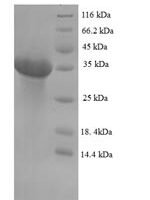
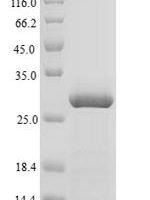
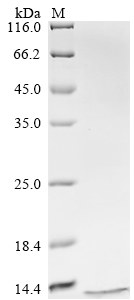
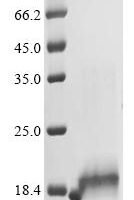
PurityGreater than 90% as determined by SDS-PAGE.
Expression SystemE.coli
Expression Region2-92aa
SpeciesBos taurus (Bovine)
Tag InfoN-terminal 6xHis-Avi-tagged
Molecular weight13.3kDa
ActivityPlease contact us to obtain bioactivity data.
BufferIf the delivery form is liquid, the default storage buffer is Tris/PBS-based buffer, 5%-50% glycerol. If the delivery form is lyophilized powder, the buffer before lyophilization is Tris/PBS-based buffer, 6% Trehalose.
StorageStore at -20°C/-80°C upon receipt, aliquoting is necessary for mutiple use. Avoid repeated freeze-thaw cycles.
Research AreasCell Biology

Function

Small zinc- and- and calcium-binding protein that is highly expressed in astrocytes and constitutes one of the most abundant soluble proteins in brain. Weakly binds calcium but binds zinc very tightly-distinct binding sites with different affinities exist for both ions on each monomer. Physiological concentrations of potassium ion antagonize the binding of both divalent cations, especially affecting high-affinity calcium-binding sites.

Biological Context

Subcellular Location: Cytoplasm; Nucleus; Secreted

Product Specifications

Recombinant Bovine Protein S100-B (S100B) is a recombinant protein from Bos taurus (Bovine), expressed in E.coli, covering amino acids 2-92aa, with N-terminal 6xHis-Avi-tagged tag, molecular weight 13.3kDa, purity Greater than 90% as determined by SDS-PAGE.. Suitable for ELISA and Western Blot applications.
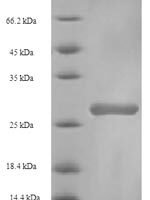
Recommended applications depend on the target, product format, and product-specific validation data. Refer to the product datasheet or Certificate of Analysis (CoA), or contact BioCrest Sci for application guidance.

Biological Activity: Please contact us to obtain bioactivity data.

Storage: Store at -20°C/-80°C upon receipt, aliquoting is necessary for mutiple use. Avoid repeated freeze-thaw cycles.

Shipping & Lead Time: Availability, shipping conditions, and estimated lead time are confirmed in the formal quotation or order confirmation based on the product format, destination, and order requirements.

Protein Biology

Function

Small zinc- and- and calcium-binding protein that is highly expressed in astrocytes and constitutes one of the most abundant soluble proteins in brain (PubMed:3722149, PubMed:6615778). Weakly binds calcium but binds zinc very tightly-distinct binding sites with different affinities exist for both ions on each monomer (PubMed:3722149, PubMed:6615778). Physiological concentrations of potassium ion antagonize the binding of both divalent cations, especially affecting high-affinity calcium-binding sites (PubMed:3722149). Acts as a neurotrophic factor that promotes astrocytosis and axonal proliferation (By similarity). Involved in innervation of thermogenic adipose tissue by acting as an adipocyte-derived neurotrophic factor that promotes sympathetic innervation of adipose tissue (By similarity). Binds to and initiates the activation of STK38 by releasing autoinhibitory intramolecular interactions within the kinase (PubMed:14661952). Interaction with AGER after myocardial infarction may play a role in myocyte apoptosis by activating ERK1/2 and p53/TP53 signaling (By similarity). Could assist ATAD3A cytoplasmic processing, preventing aggregation and favoring mitochondrial localization (By similarity). May mediate calcium-dependent regulation on many physiological processes by interacting with other proteins, such as TPR-containing proteins, and modulating their activity (By similarity)

Subcellular Location

Cytoplasm; Nucleus; Secreted

Subunit

Dimer of either two alpha chains, or two beta chains, or one alpha and one beta chain (PubMed:14661952). The S100B dimer binds two molecules of STK38 (PubMed:14661952). Interacts with CACYBP in a calcium-dependent manner (By similarity). Interacts with ATAD3A; this interaction probably occurs in the cytosol prior to ATAD3A mitochondrial targeting (By similarity). Interacts with S100A6 (By similarity). The S100B dimer interacts with two molecules of CAPZA1 (By similarity). Interacts with AGER (By similarity). Interacts with PPP5C (via TPR repeats); the interaction is calcium-dependent and modulates PPP5C activity (By similarity). Interacts with TPPP; this interaction inhibits TPPP dimerization (By similarity). Interacts with isoform CLSTN3beta of CLSTN3; interaction promotes secretion (By similarity)

Gene: S100B  |  Organism: Bos taurus  |  Synonyms: S-100 protein beta chain; S-100 protein subunit beta; S100 calcium-binding protein B
Key Publications

Frequently Asked Questions

How do I order or inquire about this product?

Submit the Online Inquiry form with your required quantity and specifications, or email sales@biocrestsci.com. Available sizes, pricing, stock status, documentation, and estimated lead time are confirmed in the formal quotation.

What is the shipping and delivery time?

Availability, dispatch timing, shipping conditions, and delivery estimates depend on the product format, destination, and order requirements. These details are confirmed in the formal quotation or order confirmation.

How should this product be stored?

Follow the storage and handling instructions in the product-specific datasheet and Certificate of Analysis (CoA). Requirements may vary by product form and formulation; contact BioCrest Sci if product-specific guidance is needed.

What quality controls are performed on your products?

Quality-control data such as identity, purity, endotoxin level, or biological activity are provided only when specified on this product page, the datasheet, or Certificate of Analysis (CoA). Biological activity is not implied unless explicitly stated.

Shopping Cart
Scroll to Top