,

Recombinant Cricetulus griseus Protein disulfide-isomerase (P4HB)

Recombinant Cricetulus griseus Protein disulfide-isomerase (P4HB) — This multifunctional protein catalyzes the formation, breakage and rearrangement of disulfide bonds. Purity >90%.

SKU: BCRECP-004000 Categories: ,

Product Specifications

Product SkuBCRECP-004000
Product DescriptionRecombinant Cricetulus griseus Protein disulfide-isomerase (P4HB) Protein is expressed from Yeast with N-terminal 6xHis-tagged. It contains 20-509aa. [Accession | Q8R4U2].
Uniprot No.Q8R4U2
Gene NamesP4HB
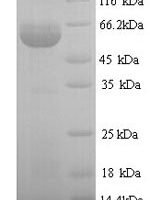
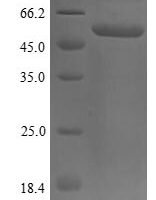
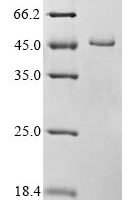
PurityGreater than 90% as determined by SDS-PAGE.
Expression SystemYeast
Expression Region20-509aa
SpeciesCricetulus griseus (Chinese hamster) (Cricetulus barabensis griseus)
Tag InfoN-terminal 6xHis-tagged
Molecular weight57.0kDa
ActivityPlease contact us to obtain bioactivity data.
BufferIf the delivery form is liquid, the default storage buffer is Tris/PBS-based buffer, 5%-50% glycerol. If the delivery form is lyophilized powder, the buffer before lyophilization is Tris/PBS-based buffer, 6% Trehalose.
StorageStore at -20°C/-80°C upon receipt, aliquoting is necessary for mutiple use. Avoid repeated freeze-thaw cycles.
Research AreasSignal Transduction

Function

This multifunctional protein catalyzes the formation, breakage and rearrangement of disulfide bonds. At the cell surface, seems to act as a reductase that cleaves disulfide bonds of proteins attached to the cell. May therefore cause structural modifications of exofacial proteins.

Biological Context

Subcellular Location: Endoplasmic reticulum; Endoplasmic reticulum lumen; Melanosome; Cell membrane (Peripheral membrane protein)

Product Specifications

Recombinant Cricetulus griseus Protein disulfide-isomerase (P4HB) is a recombinant protein from Cricetulus griseus (Chinese hamster) (Cricetulus barabensis griseus), expressed in Yeast, covering amino acids 20-509aa, with N-terminal 6xHis-tagged tag, molecular weight 57.0kDa, purity Greater than 90% as determined by SDS-PAGE.. Suitable for ELISA and Western Blot applications.

Recommended applications depend on the target, product format, and product-specific validation data. Refer to the product datasheet or Certificate of Analysis (CoA), or contact BioCrest Sci for application guidance.

Biological Activity: Please contact us to obtain bioactivity data.

Storage: Store at -20°C/-80°C upon receipt, aliquoting is necessary for mutiple use. Avoid repeated freeze-thaw cycles.

Shipping & Lead Time: Availability, shipping conditions, and estimated lead time are confirmed in the formal quotation or order confirmation based on the product format, destination, and order requirements.

Protein Biology

Function

This multifunctional protein catalyzes the formation, breakage and rearrangement of disulfide bonds. At the cell surface, seems to act as a reductase that cleaves disulfide bonds of proteins attached to the cell. May therefore cause structural modifications of exofacial proteins. Inside the cell, seems to form/rearrange disulfide bonds of nascent proteins. At high concentrations and following phosphorylation by FAM20C, functions as a chaperone that inhibits aggregation of misfolded proteins. At low concentrations, facilitates aggregation (anti-chaperone activity). May be involved with other chaperones in the structural modification of the TG precursor in hormone biogenesis. Also acts as a structural subunit of various enzymes such as prolyl 4-hydroxylase and microsomal triacylglycerol transfer protein MTTP. Receptor for LGALS9; the interaction retains P4HB at the cell surface of Th2 T helper cells, increasing disulfide reductase activity at the plasma membrane, altering the plasma membrane redox state and enhancing cell migration

Subcellular Location

Endoplasmic reticulum; Endoplasmic reticulum lumen; Melanosome; Cell membrane (Peripheral membrane protein)

Subunit

Heterodimer; heterodimerizes with the protein microsomal triglyceride transfer MTTP. Homodimer. Homodimer. Monomers and homotetramers may also occur. Interacts with P4HA2, forming a heterotetramer consisting of 2 alpha subunits (P4HA2) and 2 beta (P4HB), where P4HB plays the role of a structural subunit; this tetramer catalyzes the formation of 4-hydroxyproline in collagen (By similarity). Also constitutes the structural subunit of the microsomal triacylglycerol transfer protein MTTP in mammalian cells. Stabilizes both enzymes and retain them in the ER without contributing to the catalytic activity. Binds UBQLN1. Interacts with ERO1B. Interacts with ILDR2 (By similarity). Interacts with ERN1/IRE1A (via N-terminus); the interaction is enhanced by phosphorylation of P4HB by FAM20C in response to endoplasmic reticulum stress and results in attenuation of ERN1 activity (By similarity)

Gene: P4HB  |  Organism: Cricetulus griseus  |  Synonyms: Prolyl 4-hydroxylase subunit beta; p58

Frequently Asked Questions

How do I order or inquire about this product?

Submit the Online Inquiry form with your required quantity and specifications, or email sales@biocrestsci.com. Available sizes, pricing, stock status, documentation, and estimated lead time are confirmed in the formal quotation.

What is the shipping and delivery time?

Availability, dispatch timing, shipping conditions, and delivery estimates depend on the product format, destination, and order requirements. These details are confirmed in the formal quotation or order confirmation.

How should this product be stored?

Follow the storage and handling instructions in the product-specific datasheet and Certificate of Analysis (CoA). Requirements may vary by product form and formulation; contact BioCrest Sci if product-specific guidance is needed.

What quality controls are performed on your products?

Quality-control data such as identity, purity, endotoxin level, or biological activity are provided only when specified on this product page, the datasheet, or Certificate of Analysis (CoA). Biological activity is not implied unless explicitly stated.

Shopping Cart
Scroll to Top