, , ,

Recombinant Epstein-Barr virus Epstein-Barr nuclear antigen 1 (EBNA1), partial, Biotinylated

Recombinant Epstein-Barr virus Epstein-Barr nuclear antigen 1 (EBNA1), partial, Biotinylated — Responsible for the origin of replication (oriP) dependent replication and maintenance of viral episomes during latent infection. Purity >85%.

Product Specifications

Product SkuBCRECP-002579
Product DescriptionRecombinant Epstein-Barr virus Epstein-Barr nuclear antigen 1 (EBNA1) Protein is expressed from E.coli with N-terminal MBP-tagged and C-terminal 6xHis-Avi-tagged. It contains 458-641aa. [Accession | P03211].
Uniprot No.P03211
Gene NamesEBNA1
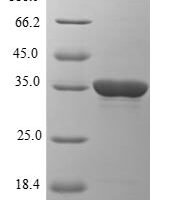
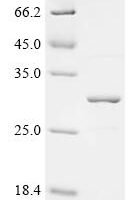
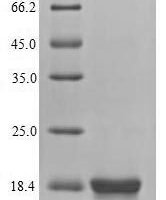
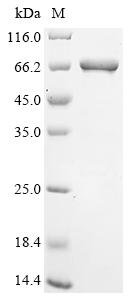
PurityGreater than 85% as determined by SDS-PAGE.
Expression SystemE.coli
Expression Region458-641aa
SpeciesEpstein-Barr virus (strain B95-8) (HHV-4) (Human herpesvirus 4)
Tag InfoN-terminal MBP-tagged and C-terminal 6xHis-Avi-tagged
Molecular weight67.6kDa
ActivityPlease contact us to obtain bioactivity data.
BufferIf the delivery form is liquid, the default storage buffer is Tris/PBS-based buffer, 5%-50% glycerol. If the delivery form is lyophilized powder, the buffer before lyophilization is Tris/PBS-based buffer, 6% Trehalose.
StorageStore at -20°C/-80°C upon receipt, aliquoting is necessary for mutiple use. Avoid repeated freeze-thaw cycles.
Research AreasMicrobiology

Function

Responsible for the origin of replication (oriP) dependent replication and maintenance of viral episomes during latent infection. EBNA1 dimer interacts with the DS (dyad symmetry) element within the origin of replication oriP and with a host mitotic chromosome to initiate viral DNA replication during latency.

Product Specifications

Recombinant Epstein-Barr virus Epstein-Barr nuclear antigen 1 (EBNA1), partial, Biotinylated — Responsible for the origin of replication (oriP) dependent replication and maintenance of viral episomes during latent infection. Purity >85%. Suitable for ELISA and Western Blot applications.

Recommended applications depend on the target, product format, and product-specific validation data. Refer to the product datasheet or Certificate of Analysis (CoA), or contact BioCrest Sci for application guidance.

Biological Activity: Please contact us to obtain bioactivity data.

Storage: Store at -20°C/-80°C upon receipt, aliquoting is necessary for mutiple use. Avoid repeated freeze-thaw cycles.

Shipping & Lead Time: Availability, shipping conditions, and estimated lead time are confirmed in the formal quotation or order confirmation based on the product format, destination, and order requirements.

Protein Biology

Function

Responsible for the origin of replication (oriP) dependent replication and maintenance of viral episomes during latent infection (PubMed:15479791, PubMed:2996781). EBNA1 dimer interacts with the DS (dyad symmetry) element within the origin of replication oriP and with a host mitotic chromosome to initiate viral DNA replication during latency (PubMed:24067969, PubMed:2996781, PubMed:31142669, PubMed:8551585). EBNA1 binding to DS recruits the host origin recognition complex (ORC) (PubMed:12953058). Governs the faithful mitotic segregation of the viral episomes by binding both the FR (family of repeats) element within oriP and the host mitotic chromosomes (PubMed:11172042, PubMed:15479791, PubMed:24067969). Forms a cell cycle-dependent tyrosine-dependent DNA cross-link and single-strand cleavage at oriP required for terminating replication and maintaining viral episomes (PubMed:33482082). Counteracts the stabilization of host p53/TP53 by host USP7, thereby decreasing apoptosis and increasing host cell survival (PubMed:15808506). Induces degradation of host PML through the ubiquitin-proteasome system, which promotes lytic reactivation and may impair the host cell DNA repair (PubMed:18833293). Increases the association of CK2 with PML proteins which increases the phosphorylation of PML proteins by CK2, triggering the polyubiquitylation and degradation of PML (PubMed:20719947). Displays inhibitory effects on a SUMO2-modified complex that includes STUB1, KAP1 and USP7 (PubMed:32176739). This inhibitory effect possibly participates to the maintenance of latency linked to PML silencing (PubMed:32176739)

Subcellular Location

Host nucleus

Subunit

Homodimer (PubMed:19521517, PubMed:9878348). Dimers can assemble into higher-order oligomers like a homohexamer (PubMed:28701406). Binding to the DS element involves 2 dimers of EBNA1 (PubMed:14506283, PubMed:15808506, PubMed:18833293, PubMed:31142669). Interacts with human USP7; this interaction is independent and simultaneous to EBNA1 interaction with CSNK2B as well as necessary for PML nuclear bodies disruption by EBNA1 (PubMed:14506283, PubMed:15808506, PubMed:18833293, PubMed:20719947, PubMed:24216761). Interacts with host CSNK2B (via KSSR motif); the interaction requires phosphorylation of EBNA1, is independent and simultaneous to EBNA1 interaction with USP7 as well as necessary for PML nuclear bodies disruption by EBNA1. EBNA1, USP7 and CSNK2B form a ternary complex. EBNA1, USP7 and CSNK2B form a ternary complex (PubMed:20719947, PubMed:24216761). Interacts with human EBP2; it is not clear if this interaction is linked with the ability of EBNA1 to associate with host mitotic chromosomes (PubMed:10074103, PubMed:15479791). Interacts with BGLF4; this interaction facilitates the switch from latent to lytic DNA replication by down-regulating EBNA1 replication function (PubMed:19244323). Interacts with human PAX5; this interaction promotes EBNA1-dependent transcription (PubMed:31941781). Interacts with host KPNA1/Importin subunit alpha-5; this interaction allows the nuclear import of EBNA1 (PubMed:10612665). Interacts with host KPNA2/Importin subunit alpha-1; this interaction allows the nuclear import of EBNA1 (PubMed:10612665, PubMed:28104399, PubMed:9020106). Interacts with host C1QBP/P32 (PubMed:9299613). Interacts with host BIRC5/Survivin; this interaction is probably important for EBV episome maintenance in Burkitt's lymphoma host cells (PubMed:28077791)

Gene: EBNA1  |  Organism: Epstein-Barr virus (strain B95-8)
Key Publications

Frequently Asked Questions

How do I order or inquire about this product?

Submit the Online Inquiry form with your required quantity and specifications, or email sales@biocrestsci.com. Available sizes, pricing, stock status, documentation, and estimated lead time are confirmed in the formal quotation.

What is the shipping and delivery time?

Availability, dispatch timing, shipping conditions, and delivery estimates depend on the product format, destination, and order requirements. These details are confirmed in the formal quotation or order confirmation.

How should this product be stored?

Follow the storage and handling instructions in the product-specific datasheet and Certificate of Analysis (CoA). Requirements may vary by product form and formulation; contact BioCrest Sci if product-specific guidance is needed.

What quality controls are performed on your products?

Quality-control data such as identity, purity, endotoxin level, or biological activity are provided only when specified on this product page, the datasheet, or Certificate of Analysis (CoA). Biological activity is not implied unless explicitly stated.

Shopping Cart
Scroll to Top