Recombinant Escherichia coli DNA-binding protein H-NS (hns)

Recombinant Escherichia coli DNA-binding protein H-NS (hns) — A DNA-binding protein implicated in transcriptional repression (silencing). Purity >85%.

SKU: BCRECP-003012 Category:

Product Specifications

Product SkuBCRECP-003012
Product DescriptionRecombinant Escherichia coli DNA-binding protein H-NS (hns) Protein is expressed from E.coli with N-terminal 6xHis-tagged. It contains 2-137aa. [Accession | P0ACF8].
Uniprot No.P0ACF8
Gene Nameshns
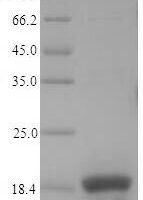
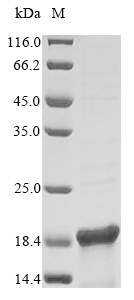
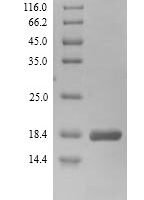
PurityGreater than 85% as determined by SDS-PAGE.
Expression SystemE.coli
Expression Region2-137aa
SpeciesEscherichia coli (strain K12)
Tag InfoN-terminal 6xHis-tagged
Molecular weight19.5kDa
ActivityPlease contact us to obtain bioactivity data.
BufferIf the delivery form is liquid, the default storage buffer is Tris/PBS-based buffer, 5%-50% glycerol. If the delivery form is lyophilized powder, the buffer before lyophilization is Tris/PBS-based buffer, 6% Trehalose.
StorageStore at -20°C/-80°C upon receipt, aliquoting is necessary for mutiple use. Avoid repeated freeze-thaw cycles.
Research AreasOthers

Function

A DNA-binding protein implicated in transcriptional repression (silencing). Also involved in bacterial chromosome organization and compaction. H-NS binds tightly to AT-rich dsDNA and inhibits transcription.

Biological Context

Subcellular Location: Cytoplasm, nucleoid

Product Specifications

Recombinant Escherichia coli DNA-binding protein H-NS (hns) is a recombinant protein from Escherichia coli (strain K12), expressed in E.coli, covering amino acids 2-137aa, with N-terminal 6xHis-tagged tag, molecular weight 19.5kDa, purity Greater than 85% as determined by SDS-PAGE.. Suitable for ELISA and Western Blot applications.

Recommended applications depend on the target, product format, and product-specific validation data. Refer to the product datasheet or Certificate of Analysis (CoA), or contact BioCrest Sci for application guidance.

Biological Activity: Please contact us to obtain bioactivity data.

Storage: Store at -20°C/-80°C upon receipt, aliquoting is necessary for mutiple use. Avoid repeated freeze-thaw cycles.

Shipping & Lead Time: Availability, shipping conditions, and estimated lead time are confirmed in the formal quotation or order confirmation based on the product format, destination, and order requirements.

Protein Biology

Function

A DNA-binding protein implicated in transcriptional repression (silencing) (PubMed:16963779, PubMed:17046956, PubMed:2128918, PubMed:23543115, PubMed:333393, PubMed:8890170, PubMed:8913298, PubMed:9398522). Also involved in bacterial chromosome organization and compaction (PubMed:10982869, PubMed:21903814, PubMed:6379600). H-NS binds tightly to AT-rich dsDNA and inhibits transcription (PubMed:16963779, PubMed:17435766, PubMed:17881364, PubMed:23543115, PubMed:2512122). Binds upstream and downstream of initiating RNA polymerase, trapping it in a loop and preventing transcription (PubMed:11714691). Binds to hundreds of sites, approximately half its binding sites are in non-coding DNA, which only accounts for about 10% of the genome (PubMed:16963779, PubMed:17046956, PubMed:23543115). Many of these loci were horizontally transferred (HTG); this offers the selective advantage of silencing foreign DNA while keeping it in the genome in case of need (PubMed:17046956, PubMed:17881364, PubMed:26789284). Suppresses transcription at many intragenic sites as well as transcription of spurious, non-coding RNAs genome-wide (PubMed:24449106). Repression of HTG by H-NS is thought to allow their DNA to evolve faster than non-H-NS-bound regions, and facilitates integration of HTG into transcriptional regulatory networks (PubMed:26789284). A subset of H-NS/StpA-regulated genes also require Hha (and/or Cnu, ydgT) for repression; Hha and Cnu increase the number of genes DNA bound by H-NS/StpA and may also modulate the oligomerization of the H-NS/StpA-complex (PubMed:23543115). The protein forms 2 clusters in the nucleoid which gather hns-bound loci together, bridging non-contiguous DNA, and causes DNA substantial condensation (PubMed:21903814). Binds DNA better at low temperatures than at 37 degrees Celsius; AT-rich sites nucleate H-NS binding, further DNA-binding is cooperative and this cooperativity decreases with rising temperature (PubMed:17435766, PubMed:17881364). Transcriptional repression can be inhibited by dominant-negative mutants of StpA or itself (PubMed:8755860). May affect transcriptional elongation (PubMed:25638302). Can increase translational efficiency of mRNA with suboptimal Shine-Dalgarno sequences (PubMed:20595230). Plays a role in the thermal control of pili and adhesive curli fimbriae production, by inducing transcription of csgD (PubMed:17010156). Plays a role in flagellar function (PubMed:11031114). Represses the CRISPR-cas promoters, permits only weak transcription of the crRNA precursor; its repression is antagonized by LeuO (PubMed:20132443, PubMed:20659289). Binds preferentially to the upstream region of its own gene recognizing two segments of DNA on both sides of a bend centered around -150 (PubMed:7934818). Overexpression suppresses secY24, a temperature-sensitive mutation (PubMed:1537791). Has also been reported to activate transcription of some genes (PubMed:2128918, PubMed:338303, PubMed:4566454)

Subcellular Location

Cytoplasm, nucleoid

Subunit

Homodimer, also found as tetramers or higher oligomers (PubMed:12460581, PubMed:23601147, PubMed:3135462, PubMed:338303, PubMed:4566454, PubMed:8755860, PubMed:8913298, PubMed:9398522). Oligomerizes into higher-order complexes that form bridges between adjacent DNA helices. The N-terminal region (residues 1-64) can interact with overexpressed StpA (PubMed:8755860). Forms a complex with Cnu (YdgT) (PubMed:21600204). The H-NS dimer forms a heterotrimeric complex with Hha in the absence of DNA; this is mediated by residues 1-46 (PubMed:11790731, PubMed:16650431, PubMed:21600204, PubMed:26085102). Interacts with Hfq (PubMed:2020545)

Gene: hns  |  Organism: Escherichia coli (strain K12)  |  Synonyms: Heat-stable nucleoid-structuring protein; Histone-like protein HLP-II; Protein B1; Protein H1
Key Publications

Frequently Asked Questions

How do I order or inquire about this product?

Submit the Online Inquiry form with your required quantity and specifications, or email sales@biocrestsci.com. Available sizes, pricing, stock status, documentation, and estimated lead time are confirmed in the formal quotation.

What is the shipping and delivery time?

Availability, dispatch timing, shipping conditions, and delivery estimates depend on the product format, destination, and order requirements. These details are confirmed in the formal quotation or order confirmation.

How should this product be stored?

Follow the storage and handling instructions in the product-specific datasheet and Certificate of Analysis (CoA). Requirements may vary by product form and formulation; contact BioCrest Sci if product-specific guidance is needed.

What quality controls are performed on your products?

Quality-control data such as identity, purity, endotoxin level, or biological activity are provided only when specified on this product page, the datasheet, or Certificate of Analysis (CoA). Biological activity is not implied unless explicitly stated.

Shopping Cart
Scroll to Top