Recombinant Escherichia coli Multidrug efflux pump subunit AcrA (acrA)

Recombinant Escherichia coli Multidrug efflux pump subunit AcrA (acrA) — Periplasmic adaptor component of the AcrAB-TolC efflux system that confers multidrug resistance. Purity >95%.

SKU: BCRECP-002009 Category:

Product Specifications

Product SkuBCRECP-002009
Product DescriptionRecombinant Escherichia coli Multidrug efflux pump subunit AcrA (acrA) Protein is expressed from E.coli with C-terminal 6xHis-tagged. It contains 25-397aa. [Accession | P0AE06].
Uniprot No.P0AE06
Gene NamesacrA
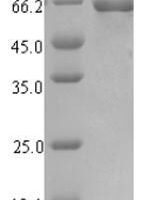
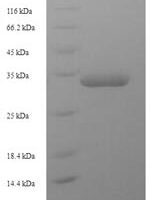
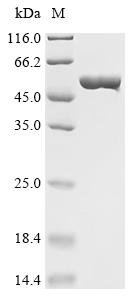
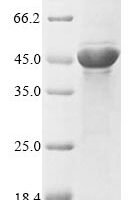
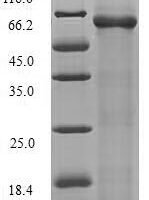
PurityGreater than 95% as determined by SDS-PAGE.
Expression SystemE.coli
Expression Region25-397aa
SpeciesEscherichia coli (strain K12)
Tag InfoC-terminal 6xHis-tagged
Molecular weight46.6kDa
ActivityPlease contact us to obtain bioactivity data.
BufferIf the delivery form is liquid, the default storage buffer is Tris/PBS-based buffer, 5%-50% glycerol. If the delivery form is lyophilized powder, the buffer before lyophilization is Tris/PBS-based buffer, 6% Trehalose.
StorageStore at -20°C/-80°C upon receipt, aliquoting is necessary for mutiple use. Avoid repeated freeze-thaw cycles.
Research AreasOthers

Function

Periplasmic adaptor component of the AcrAB-TolC efflux system that confers multidrug resistance. The AcrAB-TolC efflux system has a broad substrate specificity, acting as a substrate:proton antiporter, using proton motive force to export substrates (Probable). AcrA is elongated in shape, being long enough to span the periplasm, linking AcrB and TolC stably together, perhaps promoted by binding to peptidoglycan.

Biological Context

Subcellular Location: Cell inner membrane (Lipid-anchor)

Product Specifications

Recombinant Escherichia coli Multidrug efflux pump subunit AcrA (acrA) is a recombinant protein from Escherichia coli (strain K12), expressed in E.coli, covering amino acids 25-397aa, with C-terminal 6xHis-tagged tag, molecular weight 46.6kDa, purity Greater than 95% as determined by SDS-PAGE.. Suitable for ELISA and Western Blot applications.
Recommended applications depend on the target, product format, and product-specific validation data. Refer to the product datasheet or Certificate of Analysis (CoA), or contact BioCrest Sci for application guidance.

Biological Activity: Please contact us to obtain bioactivity data.

Storage: Store at -20°C/-80°C upon receipt, aliquoting is necessary for mutiple use. Avoid repeated freeze-thaw cycles.

Shipping & Lead Time: Availability, shipping conditions, and estimated lead time are confirmed in the formal quotation or order confirmation based on the product format, destination, and order requirements.

Protein Biology

Function

Periplasmic adaptor component of the AcrAB-TolC efflux system that confers multidrug resistance (PubMed:9878415). The AcrAB-TolC efflux system has a broad substrate specificity, acting as a substrate:proton antiporter, using proton motive force to export substrates (Probable). AcrA is elongated in shape, being long enough to span the periplasm, linking AcrB and TolC stably together, perhaps promoted by binding to peptidoglycan (PubMed:22308040, PubMed:9878415). AcrA is also a component of the AcrABZ-TolC efflux system, where the small accessory protein AcrZ, together with membrane lipids, may influence the specificity of drug export (PubMed:23010927, PubMed:28355133)

Subcellular Location

Cell inner membrane (Lipid-anchor)

Subunit

Monomeric in solution (PubMed:9878415). Homotrimeric (PubMed:16079137). Component of the AcrAB-TolC multidrug efflux complex, composed of six AcrA subunits forming a hexameric tube, binding to a AcrB trimer, which interact with the trimeric TolC outer membrane channel protein (PubMed:10920254, PubMed:15228545, PubMed:28355133, PubMed:31201302). Complex assembly may be independent of an efflux substrate and appears to be constitutive; AcrA may adopt two conformationally distinct protomers in the assembled pump (PubMed:15228545, PubMed:28355133). TolC is thought to not directly contact AcrB; instead, AcrA joins AcrB and TolC by forming a funnel-like hexamer anchored to the inner membrane (PubMed:15228545, PubMed:28355133, PubMed:31201302). AcrA may initially form a hexameric ring complex with AcrB, in a bipartite complex, which may be stabilized by binding of AcrA with the peptidoglycan layer, prior to forming the full AcrAB-TolC efflux pump complex (PubMed:22308040, PubMed:28355133, PubMed:31201302). Contact between AcrA-AcrB and TolC may prompt a conformational change in the presence of substrate, allowing the periplasmic gate to open (PubMed:28355133, PubMed:31201302). It is thought that, under high intracellular substrate concentration, AcrB ejects substrate into the tunnel formed by AcrA-TolC; as the substrate level declines, conformational changes in AcrB cause efflux to reduce and stop and the complex shifts to the closed state (PubMed:31201302). Component of the AcrABZ-TolC efflux pump complex, composed of six AcrA subunits forming a hexameric tube binding to an AcrB trimer, which interact with the trimeric TolC outer membrane channel protein; AcrZ interacts directly with AcrB, probably in 1:1 stoichiometry (PubMed:23010927, PubMed:28355133)

Gene: acrA  |  Organism: Escherichia coli (strain K12)  |  Synonyms: AcrAB-TolC multidrug efflux pump subunit AcrA; Acridine resistance protein A; Membrane fusion protein AcrA
Key Publications

Frequently Asked Questions

How do I order or inquire about this product?

Submit the Online Inquiry form with your required quantity and specifications, or email sales@biocrestsci.com. Available sizes, pricing, stock status, documentation, and estimated lead time are confirmed in the formal quotation.

What is the shipping and delivery time?

Availability, dispatch timing, shipping conditions, and delivery estimates depend on the product format, destination, and order requirements. These details are confirmed in the formal quotation or order confirmation.

How should this product be stored?

Follow the storage and handling instructions in the product-specific datasheet and Certificate of Analysis (CoA). Requirements may vary by product form and formulation; contact BioCrest Sci if product-specific guidance is needed.

What quality controls are performed on your products?

Quality-control data such as identity, purity, endotoxin level, or biological activity are provided only when specified on this product page, the datasheet, or Certificate of Analysis (CoA). Biological activity is not implied unless explicitly stated.

Shopping Cart
Scroll to Top