Recombinant Human 14-3-3 protein sigma (SFN)

Recombinant Human 14-3-3 protein sigma (SFN) — Adapter protein implicated in the regulation of a large spectrum of both general and specialized signaling pathways. Purity >85%.

SKU: BCRECP-001624 Category:

Product Specifications

Product SkuBCRECP-001624
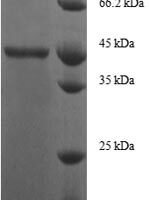
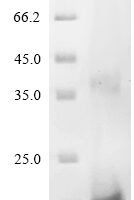
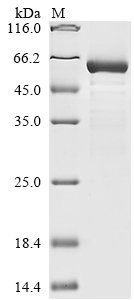
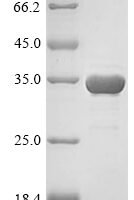
Product DescriptionRecombinant Human 14-3-3 protein sigma (SFN) Protein is expressed from E.coli with N-terminal 10xHis-GST-tagged and C-terminal Myc-tagged. It contains 1-248aa. [Accession | P31947].
Uniprot No.P31947
Gene NamesSFN
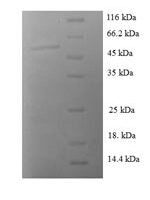
PurityGreater than 85% as determined by SDS-PAGE.
Expression SystemE.coli
Expression Region1-248aa
SpeciesHomo sapiens (Human)
Tag InfoN-terminal 10xHis-GST-tagged and C-terminal Myc-tagged
Molecular weight62.9kDa
ActivityPlease contact us to obtain bioactivity data.
BufferIf the delivery form is liquid, the default storage buffer is Tris/PBS-based buffer, 5%-50% glycerol. If the delivery form is lyophilized powder, the buffer before lyophilization is Tris/PBS-based buffer, 6% Trehalose.
StorageStore at -20°C/-80°C upon receipt, aliquoting is necessary for mutiple use. Avoid repeated freeze-thaw cycles.
Research AreasNeuroscience

Function

Adapter protein implicated in the regulation of a large spectrum of both general and specialized signaling pathways. Binds to a large number of partners, usually by recognition of a phosphoserine or phosphothreonine motif. Binding generally results in the modulation of the activity of the binding partner.

Biological Context

Subcellular Location: Cytoplasm; Nucleus; Secreted
Tissue Specificity: Present mainly in tissues enriched in stratified squamous keratinizing epithelium

Product Specifications

Recombinant Human 14-3-3 protein sigma (SFN) is a recombinant protein from Homo sapiens (Human), expressed in E.coli, covering amino acids 1-248aa, with N-terminal 10xHis-GST-tagged and C-terminal Myc-tagged tag, molecular weight 62.9kDa, purity Greater than 85% as determined by SDS-PAGE.. Suitable for ELISA and Western Blot applications.
Recommended applications depend on the target, product format, and product-specific validation data. Refer to the product datasheet or Certificate of Analysis (CoA), or contact BioCrest Sci for application guidance.

Biological Activity: Please contact us to obtain bioactivity data.

Storage: Store at -20°C/-80°C upon receipt, aliquoting is necessary for mutiple use. Avoid repeated freeze-thaw cycles.

Shipping & Lead Time: Availability, shipping conditions, and estimated lead time are confirmed in the formal quotation or order confirmation based on the product format, destination, and order requirements.

Protein Biology

Function

Adapter protein implicated in the regulation of a large spectrum of both general and specialized signaling pathways (PubMed:15731107, PubMed:22634725, PubMed:28202711, PubMed:37797010). Binds to a large number of partners, usually by recognition of a phosphoserine or phosphothreonine motif (PubMed:15731107, PubMed:22634725, PubMed:28202711, PubMed:37797010). Binding generally results in the modulation of the activity of the binding partner (PubMed:15731107, PubMed:22634725, PubMed:28202711, PubMed:37797010). Promotes cytosolic retention of GBP1 GTPase by binding to phosphorylated GBP1, thereby inhibiting the innate immune response (PubMed:37797010). Also acts as a TP53/p53-regulated inhibitor of G2/M progression (PubMed:9659898). When bound to KRT17, regulates protein synthesis and epithelial cell growth by stimulating Akt/mTOR pathway (By similarity). Acts to maintain desmosome cell junction adhesion in epithelial cells via interacting with and sequestering PKP3 to the cytoplasm, thereby restricting its translocation to existing desmosome structures and therefore maintaining desmosome protein homeostasis (PubMed:24124604). Also acts to facilitate PKP3 exchange at desmosome plaques, thereby maintaining keratinocyte intercellular adhesion (PubMed:29678907). May also regulate MDM2 autoubiquitination and degradation and thereby activate p53/TP53 (PubMed:18382127)

Subcellular Location

Cytoplasm; Nucleus; Secreted

Tissue Specificity

Present mainly in tissues enriched in stratified squamous keratinizing epithelium

Subunit

Homodimer (PubMed:28202711). Interacts with KRT17 and SAMSN1 (By similarity). Found in a complex with XPO7, EIF4A1, ARHGAP1, VPS26A, VPS29 and VPS35 (PubMed:15282546). Interacts with GAB2 (PubMed:19172738). Interacts with SRPK2 (PubMed:19592491). Interacts with COPS6 (PubMed:21625211). Interacts with COP1; this interaction leads to proteasomal degradation (PubMed:21625211). Interacts with the 'Thr-369' phosphorylated form of DAPK2 (PubMed:26047703). Interacts with PI4KB (PubMed:23572552). Interacts with SLITRK1 (PubMed:19640509). Interacts with LRRK2; this interaction is dependent on LRRK2 phosphorylation (PubMed:28202711). Interacts with PKP3 (via N-terminus); the interaction maintains the cytoplasmic pool of PKP3, facilitates PKP3 exchange at desmosomes and restricts PKP3 localization to existing desmosome cell junctions (PubMed:24124604, PubMed:29678907). Interacts with LCP2 (PubMed:33159816)

Gene: SFN  |  Organism: Homo sapiens  |  Synonyms: Epithelial cell marker protein 1; Stratifin
Key Publications

Frequently Asked Questions

How do I order or inquire about this product?

Submit the Online Inquiry form with your required quantity and specifications, or email sales@biocrestsci.com. Available sizes, pricing, stock status, documentation, and estimated lead time are confirmed in the formal quotation.

What is the shipping and delivery time?

Availability, dispatch timing, shipping conditions, and delivery estimates depend on the product format, destination, and order requirements. These details are confirmed in the formal quotation or order confirmation.

How should this product be stored?

Follow the storage and handling instructions in the product-specific datasheet and Certificate of Analysis (CoA). Requirements may vary by product form and formulation; contact BioCrest Sci if product-specific guidance is needed.

What quality controls are performed on your products?

Quality-control data such as identity, purity, endotoxin level, or biological activity are provided only when specified on this product page, the datasheet, or Certificate of Analysis (CoA). Biological activity is not implied unless explicitly stated.

Shopping Cart
Scroll to Top