Recombinant Human Actin, aortic smooth muscle (ACTA2)

Recombinant Human Actin, aortic smooth muscle (ACTA2) — recombinant protein from Homo sapiens (Human), expressed in E.coli. Purity >85%.

SKU: BCRECP-000025 Category:

Product Specifications

Product SkuBCRECP-000025
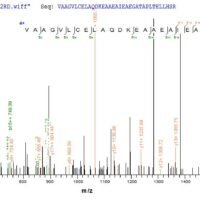
Product DescriptionRecombinant Human Actin, aortic smooth muscle (ACTA2) Protein is expressed from E.coli with N-terminal 10xHis-tagged. It contains 3-377aa. [Accession | P62736].
Uniprot No.P62736
Gene NamesACTA2
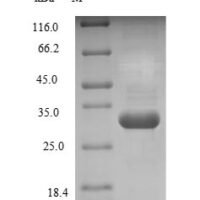
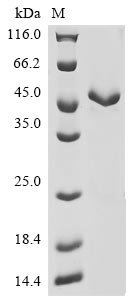
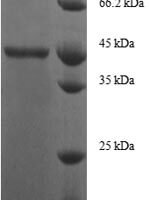
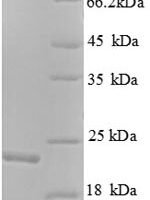
PurityGreater than 85% as determined by SDS-PAGE.
Expression SystemE.coli
Expression Region3-377aa
SpeciesHomo sapiens (Human)
Tag InfoN-terminal 10xHis-tagged
Molecular weight47.8kDa
ActivityPlease contact us to obtain bioactivity data.
BufferIf the delivery form is liquid, the default storage buffer is Tris/PBS-based buffer, 5%-50% glycerol. If the delivery form is lyophilized powder, the buffer before lyophilization is Tris/PBS-based buffer, 6% Trehalose.
StorageStore at -20°C/-80°C upon receipt, aliquoting is necessary for mutiple use. Avoid repeated freeze-thaw cycles.
Research AreasSignal Transduction

Function

Actins are highly conserved proteins that are involved in various types of cell motility and are ubiquitously expressed in all eukaryotic cells.

Biological Context

Subcellular Location: Cytoplasm, cytoskeleton
Disease Association: [ACTA2 mutations predispose patients to a variety of diffuse and diverse vascular diseases, premature onset coronary artery disease (CAD), premature ischemic strokes and Moyamoya disease] | Aortic aneurysm, familial thoracic 6 (AAT6) : A disease characterized by permanent dilation of the thoracic aorta usually due to degenerative changes in the aortic wall. It is primarily associated with a characteristic histologic appearance known as 'medial necrosis' or 'Erdheim cystic medial necrosis' in which there is degeneration and fragmentation of elastic fibers, loss of smooth muscle cells, and an accumulation of basophilic ground substance. [The disease is caused by variants affecting the gene represented in this entry] | Moyamoya disease 5 (MYMY5) : A progressive cerebral angiopathy characterized by bilateral intracranial carotid artery stenosis and telangiectatic vessels in the region of the basal ganglia. The abnormal vessels resemble a 'puff of smoke' (moyamoya) on cerebral angiogram. Affected individuals can develop transient ischemic attacks and/or cerebral infarction, and rupture of the collateral vessels can cause intracranial hemorrhage. Hemiplegia of sudden onset and epileptic seizures constitute the prevailing presentation in childhood, while subarachnoid bleeding occurs more frequently in adults. [The disease is caused by variants affecting the gene represented in this entry] | Smooth muscle dysfunction syndrome (SMDYS) : An autosomal dominant syndrome characterized by dysfunction of smooth muscle cells throughout the body, leading to aortic and cerebrovascular disease, fixed dilated pupils, hypotonic bladder, malrotation, and hypoperistalsis of the gut and pulmonary hypertension. [The disease is caused by variants affecting the gene represented in this entry]

Product Specifications

Recombinant Human Actin, aortic smooth muscle (ACTA2) is a recombinant protein from Homo sapiens (Human), expressed in E.coli, covering amino acids 3-377aa, with N-terminal 10xHis-tagged tag, molecular weight 47.8kDa, purity Greater than 85% as determined by SDS-PAGE.. Suitable for ELISA and Western Blot applications.
Recommended applications depend on the target, product format, and product-specific validation data. Refer to the product datasheet or Certificate of Analysis (CoA), or contact BioCrest Sci for application guidance.

Biological Activity: Please contact us to obtain bioactivity data.

Storage: Store at -20°C/-80°C upon receipt, aliquoting is necessary for mutiple use. Avoid repeated freeze-thaw cycles.

Shipping & Lead Time: Availability, shipping conditions, and estimated lead time are confirmed in the formal quotation or order confirmation based on the product format, destination, and order requirements.

Protein Biology

Function

Actins are highly conserved proteins that are involved in various types of cell motility and are ubiquitously expressed in all eukaryotic cells

Subcellular Location

Cytoplasm, cytoskeleton

Disease Association

[ACTA2 mutations predispose patients to a variety of diffuse and diverse vascular diseases, premature onset coronary artery disease (CAD), premature ischemic strokes and Moyamoya disease] | Aortic aneurysm, familial thoracic 6 (AAT6) : A disease characterized by permanent dilation of the thoracic aorta usually due to degenerative changes in the aortic wall. It is primarily associated with a characteristic histologic appearance known as 'medial necrosis' or 'Erdheim cystic medial necrosis' in which there is degeneration and fragmentation of elastic fibers, loss of smooth muscle cells, and an accumulation of basophilic ground substance. [The disease is caused by variants affecting the gene represented in this entry] | Moyamoya disease 5 (MYMY5) : A progressive cerebral angiopathy characterized by bilateral intracranial carotid artery stenosis and telangiectatic vessels in the region of the basal ganglia. The abnormal vessels resemble a 'puff of smoke' (moyamoya) on cerebral angiogram. Affected individuals can develop transient ischemic attacks and/or cerebral infarction, and rupture of the collateral vessels can cause intracranial hemorrhage. Hemiplegia of sudden onset and epileptic seizures constitute the prevailing presentation in childhood, while subarachnoid bleeding occurs more frequently in adults. [The disease is caused by variants affecting the gene represented in this entry] | Smooth muscle dysfunction syndrome (SMDYS) : An autosomal dominant syndrome characterized by dysfunction of smooth muscle cells throughout the body, leading to aortic and cerebrovascular disease, fixed dilated pupils, hypotonic bladder, malrotation, and hypoperistalsis of the gut and pulmonary hypertension. [The disease is caused by variants affecting the gene represented in this entry]

Subunit

Polymerization of globular actin (G-actin) leads to a structural filament (F-actin) in the form of a two-stranded helix. Each actin can bind to 4 others

Gene: ACTA2  |  Organism: Homo sapiens  |  Synonyms: Alpha-actin-2; Cell growth-inhibiting gene 46 protein
Key Publications

Frequently Asked Questions

How do I order or inquire about this product?

Submit the Online Inquiry form with your required quantity and specifications, or email sales@biocrestsci.com. Available sizes, pricing, stock status, documentation, and estimated lead time are confirmed in the formal quotation.

What is the shipping and delivery time?

Availability, dispatch timing, shipping conditions, and delivery estimates depend on the product format, destination, and order requirements. These details are confirmed in the formal quotation or order confirmation.

How should this product be stored?

Follow the storage and handling instructions in the product-specific datasheet and Certificate of Analysis (CoA). Requirements may vary by product form and formulation; contact BioCrest Sci if product-specific guidance is needed.

What quality controls are performed on your products?

Quality-control data such as identity, purity, endotoxin level, or biological activity are provided only when specified on this product page, the datasheet, or Certificate of Analysis (CoA). Biological activity is not implied unless explicitly stated.

Shopping Cart
Scroll to Top