,

Recombinant Human Aldo-keto reductase family 1 member C3 (AKR1C3)

Recombinant Human Aldo-keto reductase family 1 member C3 (AKR1C3) — Cytosolic aldo-keto reductase that catalyzes NADPH-dependent reduction of ketosteroids to hydroxysteroids. Purity >90%.

SKU: BCRECP-000054 Categories: ,

Product Specifications

Product SkuBCRECP-000054
Product DescriptionRecombinant Human Aldo-keto reductase family 1 member C3 (AKR1C3) Protein is expressed from E.coli with C-terminal 6xHis-tagged. It contains 1-323aa. [Accession | P42330].
Uniprot No.P42330
Gene NamesAKR1C3
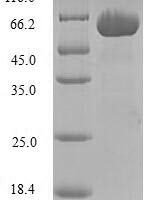
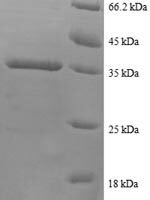
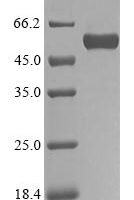
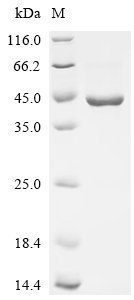
PurityGreater than 90% as determined by SDS-PAGE.
Expression SystemE.coli
Expression Region1-323aa
SpeciesHomo sapiens (Human)
Tag InfoC-terminal 6xHis-tagged
Molecular weight43.8kDa
ActivityPlease contact us to obtain bioactivity data.
BufferIf the delivery form is liquid, the default storage buffer is Tris/PBS-based buffer, 5%-50% glycerol. If the delivery form is lyophilized powder, the buffer before lyophilization is Tris/PBS-based buffer, 6% Trehalose.
StorageStore at -20°C/-80°C upon receipt, aliquoting is necessary for mutiple use. Avoid repeated freeze-thaw cycles.
Research AreasSignal Transduction

Function

Cytosolic aldo-keto reductase that catalyzes NADPH-dependent reduction of ketosteroids to hydroxysteroids. Displays broad substrate specificity with distinct positional and stereochemistry, primarily generating 17beta-hydroxysteroids, but also 3alpha- and 20alpha-hydroxysteroids. Produces potent androgens via classical and 'backdoor'/alternative pathways.

Biological Context

Subcellular Location: Cytoplasm
Tissue Specificity: Expressed in many tissues including adrenal gland, brain, kidney, liver, lung, mammary gland, placenta, small intestine, colon, spleen, prostate and testis. High expression in prostate and mammary gland. In the prostate, higher levels in epithelial cells than in stromal cells. In the brain, expressed in medulla, spinal cord, frontotemporal lobes, thalamus, subthalamic nuclei and amygdala. Weaker expression in the hippocampus, substantia nigra and caudate

Product Specifications

Recombinant Human Aldo-keto reductase family 1 member C3 (AKR1C3) is a recombinant protein from Homo sapiens (Human), expressed in E.coli, covering amino acids 1-323aa, with C-terminal 6xHis-tagged tag, molecular weight 43.8kDa, purity Greater than 90% as determined by SDS-PAGE.. Suitable for ELISA and Western Blot applications.

SDS-PAGE: Single band at expected molecular weight confirming purity.

ELISA: Suitable as coating antigen or detection standard.

Western Blot: Compatible with standard Western Blot protocols.

Protein Interaction: Validated for SPR (Surface Plasmon Resonance) and BLI (Bio-Layer Interferometry) studies.

Shipping: Shipped at ambient temperature. Lyophilized protein is stable during transit.

Storage: Store lyophilized protein at -20°C to -80°C. Reconstituted protein should be aliquoted and stored at -80°C. Avoid repeated freeze-thaw cycles.

Shelf Life: 12 months from date of receipt when stored as recommended.

Shipping Time: Orders placed before 2 PM EST ship same day. International orders typically deliver within 5-10 business days.

Protein Biology

Function

Cytosolic aldo-keto reductase that catalyzes NADPH-dependent reduction of ketosteroids to hydroxysteroids. Displays broad substrate specificity with distinct positional and stereochemistry, primarily generating 17beta-hydroxysteroids, but also 3alpha- and 20alpha-hydroxysteroids (PubMed:10998348, PubMed:11165022, PubMed:20036328, PubMed:9415401, PubMed:9927279, PubMed:10998348, PubMed:9927279). Produces potent androgens via classical and 'backdoor'/alternative pathways. In the classical androgen metabolic pathway (biosynthesis of 5alpha-dihydrotestosterone (5alpha-DHT) via testosterone), catalyzes the reduction of delta4-androstenedione to form testosterone (PubMed:10998348, PubMed:11165022, PubMed:20036328, PubMed:9415401, PubMed:9927279). In the 'backdoor' androgen metabolic pathway (biosynthesis of 5alpha-dihydrotestosterone (5alpha-DHT) via pregnanes), reduces androsterone to 5alpha-androstane-3alpha,17beta-diol preceding 5alpha-DHT secretion (PubMed:10557352, PubMed:10998348, PubMed:9415401). Reduces 5alpha-DHT to less potent androgen 5alpha-androstane-3alpha,17beta-diol, likely regulating ligand availability for androgen receptors (PubMed:10557352, PubMed:10998348, PubMed:11165022, PubMed:14672942, PubMed:7650035, PubMed:9415401). May contribute to the metabolism of adrenal-derived androgen precursors. Reduces 11-keto-4-androstene-3,17-dione (11KA4) and 11-keto-5alpha-androstane-3,17-dione (11K-Adione) into potent androgens 11-ketotestosterone (11KT) and 11-ketodihydrotestosterone (11KDHT), respectively (PubMed:31926269). In estrogen metabolism, catalyzes the conversion of estrone to potent estrogen 17beta-estradiol (PubMed:10998348, PubMed:11165022, PubMed:20036328). Acts as a prostaglandin (PG) F2alpha synthase. Displays 11-ketoreductase and 9,11-endoperoxide reductase activities and reduces PGD2 to 11beta-PGF2alpha and PGH2 to PGF2alpha (PubMed:10622721, PubMed:11165022, PubMed:15047184, PubMed:19010934, PubMed:20036328, PubMed:7650035, PubMed:9415401, PubMed:9927279). Also displays retinaldehyde reductase activity toward 9-cis-retinal (PubMed:21851338). In vitro can efficiently catalyze bidirectional conversion between ketosteroids and hydroxysteroids using NADPH/NADP(+) or NADH/NAD(+) as cofactors. In vivo however, the reductase activity prevails since the major reducing cofactor NADPH inhibits NAD(+)-dependent oxidase activity (PubMed:11165022, PubMed:14672942). In addition, it is able to reduce in vitro various carbonyl compounds like menadione, phenanthrenequinone and nitrobenzaldehyde (By similarity)

Subcellular Location

Cytoplasm

Tissue Specificity

Expressed in many tissues including adrenal gland, brain, kidney, liver, lung, mammary gland, placenta, small intestine, colon, spleen, prostate and testis. High expression in prostate and mammary gland. In the prostate, higher levels in epithelial cells than in stromal cells. In the brain, expressed in medulla, spinal cord, frontotemporal lobes, thalamus, subthalamic nuclei and amygdala. Weaker expression in the hippocampus, substantia nigra and caudate

Gene: AKR1C3  |  Organism: Homo sapiens  |  Synonyms: 17-beta-hydroxysteroid dehydrogenase type 5; 3-alpha-HSD type II, brain; 3-alpha-hydroxysteroid dehydrogenase type 2; Chlordecone reductase homolog HAKRb; Dihydrodiol dehydrogenase 3; Dihydrodiol dehydrogenase type I; HA1753; Prostaglandin F synthase; Testosterone 17-beta-dehydrogenase 5
Key Publications

Frequently Asked Questions

How do I order or inquire about this product?

Fill out the Online Inquiry form with your required quantity and specifications. You can also email sales@biocrestsci.com. Our team typically responds within 4 business hours with a quote and availability confirmation.

What is the shipping and delivery time?

Orders placed before 2 PM EST ship the same day. Domestic (US) delivery typically takes 2-3 business days. International orders deliver within 5-10 business days. All products are shipped at ambient temperature with appropriate packaging to ensure stability.

How should I store this recombinant protein?

Lyophilized proteins should be stored at -20°C to -80°C upon receipt. After reconstitution, aliquot and store at -80°C. Avoid repeated freeze-thaw cycles. Shelf life is 12 months from date of receipt when stored as recommended.

What quality controls are performed on your products?

Each product undergoes SDS-PAGE purity analysis (typically >85-95%), endotoxin testing, and bioactivity validation. Products are validated for ELISA, Western Blot, and SPR/BLI applications as specified on this product page. A Certificate of Analysis (CoA) is available upon request.

Shopping Cart
Scroll to Top