Recombinant Human Angiogenin (ANG), partial

Recombinant Human Angiogenin (ANG), partial — Secreted ribonuclease that can either promote or restrict cell proliferation of target cells, depending on the context. Purity >90%.

SKU: BCRECP-001546 Category:

Product Specifications

Product SkuBCRECP-001546
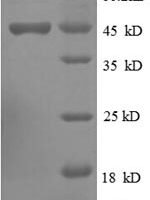
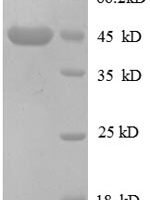
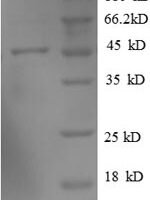
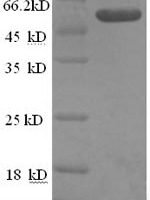
Product DescriptionRecombinant Human Angiogenin (ANG) Protein is expressed from E.coli with N-terminal 6xHis-tagged. It contains 26-147aa. [Accession | P03950].
Uniprot No.P03950
Gene NamesRNASE5
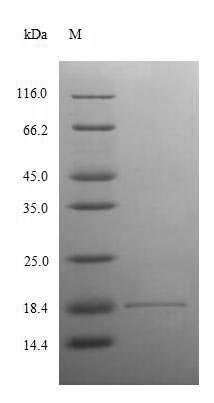
PurityGreater than 90% as determined by SDS-PAGE.
Expression SystemE.coli
Expression Region26-147aa
SpeciesHomo sapiens (Human)
Tag InfoN-terminal 6xHis-tagged
Molecular weight18.0kDa
ActivityPlease contact us to obtain bioactivity data.
BufferIf the delivery form is liquid, the default storage buffer is Tris/PBS-based buffer, 5%-50% glycerol. If the delivery form is lyophilized powder, the buffer before lyophilization is Tris/PBS-based buffer, 6% Trehalose.
StorageStore at -20°C/-80°C upon receipt, aliquoting is necessary for mutiple use. Avoid repeated freeze-thaw cycles.
Research AreasSignal Transduction

Function

Secreted ribonuclease that can either promote or restrict cell proliferation of target cells, depending on the context. Endocytosed in target cells via its receptor PLXNB2 and translocates to the cytoplasm or nucleus.

Product Specifications

Recombinant Human Angiogenin (ANG), partial — Secreted ribonuclease that can either promote or restrict cell proliferation of target cells, depending on the context. Purity >90%. Suitable for ELISA and Western Blot applications.

Recommended applications depend on the target, product format, and product-specific validation data. Refer to the product datasheet or Certificate of Analysis (CoA), or contact BioCrest Sci for application guidance.

Biological Activity: Please contact us to obtain bioactivity data.

Storage: Store at -20°C/-80°C upon receipt, aliquoting is necessary for mutiple use. Avoid repeated freeze-thaw cycles.

Shipping & Lead Time: Availability, shipping conditions, and estimated lead time are confirmed in the formal quotation or order confirmation based on the product format, destination, and order requirements.

Protein Biology

Function

Secreted ribonuclease that can either promote or restrict cell proliferation of target cells, depending on the context (PubMed:12051708, PubMed:1400510, PubMed:19332886, PubMed:20129916, PubMed:21855800, PubMed:23047679, PubMed:23843625, PubMed:2424496, PubMed:2459697, PubMed:2730651, PubMed:27518564, PubMed:28176817, PubMed:29100074, PubMed:29748193, PubMed:3122207, PubMed:32510170, PubMed:38718836, PubMed:8159680, PubMed:8570639, PubMed:8622921, PubMed:9578571). Endocytosed in target cells via its receptor PLXNB2 and translocates to the cytoplasm or nucleus (PubMed:29100074, PubMed:32510170). Under stress conditions, localizes to the cytoplasm and promotes the assembly of stress granules (SGs): specifically cleaves a subset of tRNAs within anticodon loops to produce tRNA-derived stress-induced fragments (tiRNAs), resulting in translation repression and inhibition of cell proliferation (PubMed:1400510, PubMed:19332886, PubMed:20129916, PubMed:21855800, PubMed:23047679, PubMed:27518564, PubMed:29100074, PubMed:29748193, PubMed:32510170, PubMed:38718836). tiRNas also prevent formation of apoptosome, thereby promoting cell survival (By similarity). Preferentially cleaves RNAs between a pyrimidine and an adenosine residue, suggesting that it cleaves the anticodon loop of tRNA(Ala) (32-UUAGCAU-38) after positions 33 and 36 (PubMed:3289612, PubMed:38718836). Cleaves a subset of tRNAs, including tRNA(Ala), tRNA(Glu), tRNA(Gly), tRNA(Lys), tRNA(Val), tRNA(His), tRNA(Asp) and tRNA(Sec) (PubMed:31582561). Under growth conditions and in differentiated cells, translocates to the nucleus and stimulates ribosomal RNA (rRNA) transcription, including that containing the initiation site sequences of 45S rRNA, thereby promoting cell growth and proliferation (PubMed:12051708, PubMed:15735021, PubMed:27518564, PubMed:29100074, PubMed:8127865). Angiogenin induces vascularization of normal and malignant tissues via its ability to promote rRNA transcription (PubMed:19354288, PubMed:4074709, PubMed:8448182). Involved in hematopoietic stem and progenitor cell (HSPC) growth and survival by promoting rRNA transcription in growth conditions and inhibiting translation in response to stress, respectively (PubMed:27518564). Mediates the crosstalk between myeloid and intestinal epithelial cells to protect the intestinal epithelial barrier integrity: secreted by myeloid cells and promotes intestinal epithelial cells proliferation and survival (PubMed:32510170). Also mediates osteoclast-endothelial cell crosstalk in growing bone: produced by osteoclasts and protects the neighboring vascular cells against senescence by promoting rRNA transcription (By similarity)

Subcellular Location

Secreted; Nucleus; Nucleus, nucleolus; Cytoplasm, Stress granule

Disease Association

Amyotrophic lateral sclerosis 9 (ALS9) : A neurodegenerative disorder affecting upper motor neurons in the brain and lower motor neurons in the brain stem and spinal cord, resulting in fatal paralysis. Sensory abnormalities are absent. The pathologic hallmarks of the disease include pallor of the corticospinal tract due to loss of motor neurons, presence of ubiquitin-positive inclusions within surviving motor neurons, and deposition of pathologic aggregates. The etiology of amyotrophic lateral sclerosis is likely to be multifactorial, involving both genetic and environmental factors. The disease is inherited in 5-10% of the cases. [Disease susceptibility is associated with variants affecting the gene represented in this entry]

Tissue Specificity

Expressed predominantly in the liver (PubMed:2440105). Also detected in endothelial cells and spinal cord neurons (PubMed:17886298, PubMed:2440105)

Subunit

Homodimer (PubMed:25372031). Interacts with RNH1; inhibiting ANG ribonuclease activity (PubMed:10413501, PubMed:19332886, PubMed:19354288, PubMed:23843625, PubMed:27518564, PubMed:3243277, PubMed:32510170, PubMed:9311977). Interacts with PCNA (PubMed:37218877)

Gene: ANG  |  Organism: Homo sapiens  |  Synonyms: Ribonuclease 5

Frequently Asked Questions

How do I order or inquire about this product?

Submit the Online Inquiry form with your required quantity and specifications, or email sales@biocrestsci.com. Available sizes, pricing, stock status, documentation, and estimated lead time are confirmed in the formal quotation.

What is the shipping and delivery time?

Availability, dispatch timing, shipping conditions, and delivery estimates depend on the product format, destination, and order requirements. These details are confirmed in the formal quotation or order confirmation.

How should this product be stored?

Follow the storage and handling instructions in the product-specific datasheet and Certificate of Analysis (CoA). Requirements may vary by product form and formulation; contact BioCrest Sci if product-specific guidance is needed.

What quality controls are performed on your products?

Quality-control data such as identity, purity, endotoxin level, or biological activity are provided only when specified on this product page, the datasheet, or Certificate of Analysis (CoA). Biological activity is not implied unless explicitly stated.

Shopping Cart
Scroll to Top