Recombinant Human Ankyrin-3 (ANK3), partial

Recombinant Human Ankyrin-3 (ANK3), partial — recombinant protein from Homo sapiens (Human), expressed in E.coli. Purity >90%.

SKU: BCRECP-000078 Category:

Product Specifications

Product SkuBCRECP-000078
Product DescriptionRecombinant Human Ankyrin-3 (ANK3) Protein is expressed from E.coli with N-terminal 6xHis-tagged. It contains 4088-4199aa. [Accession | Q12955].
Uniprot No.Q12955
Gene NamesANK3
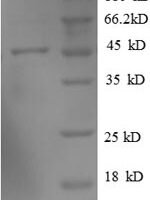
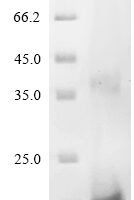
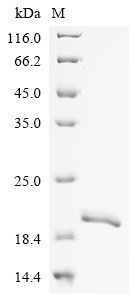
PurityGreater than 90% as determined by SDS-PAGE.
Expression SystemE.coli
Expression Region4088-4199aa
SpeciesHomo sapiens (Human)
Tag InfoN-terminal 6xHis-tagged
Molecular weight18.6kDa
ActivityPlease contact us to obtain bioactivity data.
BufferIf the delivery form is liquid, the default storage buffer is Tris/PBS-based buffer, 5%-50% glycerol. If the delivery form is lyophilized powder, the buffer before lyophilization is Tris/PBS-based buffer, 6% Trehalose.
StorageStore at -20°C/-80°C upon receipt, aliquoting is necessary for mutiple use. Avoid repeated freeze-thaw cycles.
Research AreasNeuroscience

Function

May be part of a Golgi-specific membrane cytoskeleton in association with beta-spectrin.

Biological Context

Subcellular Location: Cytoplasm, cytoskeleton; Golgi apparatus
Tissue Specificity: Expressed in brain, neurons, muscles and other tissues
Disease Association: [Genetic variations in ANK3 may be associated with autism spectrum disorders susceptibility] | Intellectual developmental disorder, autosomal recessive 37 (MRT37) : A disorder characterized by significantly below average general intellectual functioning associated with impairments in adaptive behavior and manifested during the developmental period. MRT37 patients manifest delayed global development with speech delay, hypotonia, spasticity, and a sleep disorder. Severe behavioral abnormalities include aggression, hyperactivity, and grinding of the teeth. [The disease is caused by variants affecting the gene represented in this entry. A homozygous deletion in ANK3 predicted to result in frameshift and premature truncation, has been shown to be the cause of moderate intellectual disability, an ADHD-like phenotype and behavioral problems in a consanguineous family ]

Product Specifications

Recombinant Human Ankyrin-3 (ANK3), partial is a recombinant protein from Homo sapiens (Human), expressed in E.coli, covering amino acids 4088-4199aa, with N-terminal 6xHis-tagged tag, molecular weight 18.6kDa, purity Greater than 90% as determined by SDS-PAGE.. Suitable for ELISA and Western Blot applications.
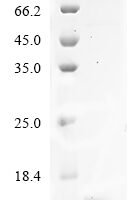
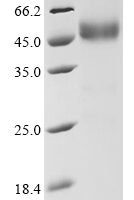
SDS-PAGE: Single band at expected molecular weight confirming purity.

ELISA: Suitable as coating antigen or detection standard.

Western Blot: Compatible with standard Western Blot protocols.

Protein Interaction: Validated for SPR (Surface Plasmon Resonance) and BLI (Bio-Layer Interferometry) studies.

Shipping: Shipped at ambient temperature. Lyophilized protein is stable during transit.

Storage: Store lyophilized protein at -20°C to -80°C. Reconstituted protein should be aliquoted and stored at -80°C. Avoid repeated freeze-thaw cycles.

Shelf Life: 12 months from date of receipt when stored as recommended.

Shipping Time: Orders placed before 2 PM EST ship same day. International orders typically deliver within 5-10 business days.

Protein Biology

Function

May be part of a Golgi-specific membrane cytoskeleton in association with beta-spectrin

Subcellular Location

Cytoplasm, cytoskeleton; Golgi apparatus

Disease Association

[Genetic variations in ANK3 may be associated with autism spectrum disorders susceptibility] | Intellectual developmental disorder, autosomal recessive 37 (MRT37) : A disorder characterized by significantly below average general intellectual functioning associated with impairments in adaptive behavior and manifested during the developmental period. MRT37 patients manifest delayed global development with speech delay, hypotonia, spasticity, and a sleep disorder. Severe behavioral abnormalities include aggression, hyperactivity, and grinding of the teeth. [The disease is caused by variants affecting the gene represented in this entry. A homozygous deletion in ANK3 predicted to result in frameshift and premature truncation, has been shown to be the cause of moderate intellectual disability, an ADHD-like phenotype and behavioral problems in a consanguineous family (PubMed:23390136)]

Tissue Specificity

Expressed in brain, neurons, muscles and other tissues

Subunit

Directly interacts with DMD and betaDAG1. This interaction does not interfere with binding between DMD and betaDAG1. It is also required for DMD and betaDAG1 retention at costameres (By similarity). Interacts (via N-terminal ANK repeats) with SCHIP1 isoform 5 (via C-terminus); this interaction is required for the localization at axon initial segments (AISs) and nodes of Ranvier (NRs) (By similarity). May be a constituent of a NFASC/NRCAM/ankyrin G complex. Interacts with RHBG (PubMed:15611082). Interacts with PLEC and FLNC (PubMed:21223964). Interacts with KCNA1; this inhibits channel activity (PubMed:23903368). Interacts (via ANK repeats) with IQCJ-SCHIP1; required for IQCJ-SCHIP1 localization at axon initial segments (AIS) and nodes of Ranvier (PubMed:25950943). Interacts with SCHIP1 (PubMed:25950943). Interacts with SCN5A (PubMed:15579534). Interacts with PKP2 and GJA1/CX43 (By similarity). Interacts with PRICKLE2; the interaction is necessary for correct microtubule bundling (By similarity)

Gene: ANK3  |  Organism: Homo sapiens  |  Synonyms: Ankyrin-G
Key Publications

Frequently Asked Questions

How do I order or inquire about this product?

Fill out the Online Inquiry form with your required quantity and specifications. You can also email sales@biocrestsci.com. Our team typically responds within 4 business hours with a quote and availability confirmation.

What is the shipping and delivery time?

Orders placed before 2 PM EST ship the same day. Domestic (US) delivery typically takes 2-3 business days. International orders deliver within 5-10 business days. All products are shipped at ambient temperature with appropriate packaging to ensure stability.

How should I store this recombinant protein?

Lyophilized proteins should be stored at -20°C to -80°C upon receipt. After reconstitution, aliquot and store at -80°C. Avoid repeated freeze-thaw cycles. Shelf life is 12 months from date of receipt when stored as recommended.

What quality controls are performed on your products?

Each product undergoes SDS-PAGE purity analysis (typically >85-95%), endotoxin testing, and bioactivity validation. Products are validated for ELISA, Western Blot, and SPR/BLI applications as specified on this product page. A Certificate of Analysis (CoA) is available upon request.

Shopping Cart
Scroll to Top