Recombinant Human AP-2 complex subunit mu (AP2M1)

Recombinant Human AP-2 complex subunit mu (AP2M1) — Component of the adaptor protein complex 2 (AP-2). Purity >85%.

SKU: BCRECP-000097 Category:

Product Specifications

Product SkuBCRECP-000097
Product DescriptionRecombinant Human AP-2 complex subunit mu (AP2M1) Protein is expressed from E.coli with N-terminal 6xHis-tagged. It contains 1-435aa. [Accession | Q96CW1].
Uniprot No.Q96CW1
Gene NamesAP2M1
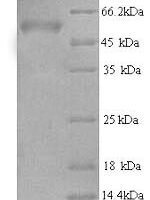
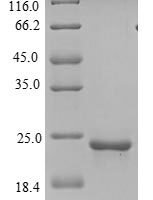
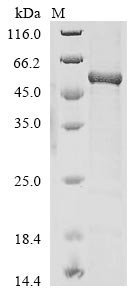
PurityGreater than 85% as determined by SDS-PAGE.
Expression SystemE.coli
Expression Region1-435aa
SpeciesHomo sapiens (Human)
Tag InfoN-terminal 6xHis-tagged
Molecular weight53.7kDa
ActivityPlease contact us to obtain bioactivity data.
BufferIf the delivery form is liquid, the default storage buffer is Tris/PBS-based buffer, 5%-50% glycerol. If the delivery form is lyophilized powder, the buffer before lyophilization is Tris/PBS-based buffer, 6% Trehalose.
StorageStore at -20°C/-80°C upon receipt, aliquoting is necessary for mutiple use. Avoid repeated freeze-thaw cycles.
Research AreasOthers

Function

Component of the adaptor protein complex 2 (AP-2). Adaptor protein complexes function in protein transport via transport vesicles in different membrane traffic pathways. Adaptor protein complexes are vesicle coat components and appear to be involved in cargo selection and vesicle formation.

Biological Context

Subcellular Location: Cell membrane; Membrane, coated pit (Peripheral membrane protein)
Tissue Specificity: Expressed in the brain (at protein level)
Disease Association: Intellectual developmental disorder, autosomal dominant 60, with seizures (MRD60) : An autosomal dominant disorder characterized by global developmental delay apparent in the first six months of life, followed by onset of seizures between 21 months and 4 years. Disease features include moderate-to-severe intellectual disability, poor speech, delayed walking, and ataxia. [The disease is caused by variants affecting the gene represented in this entry]

Product Specifications

Recombinant Human AP-2 complex subunit mu (AP2M1) is a recombinant protein from Homo sapiens (Human), expressed in E.coli, covering amino acids 1-435aa, with N-terminal 6xHis-tagged tag, molecular weight 53.7kDa, purity Greater than 85% as determined by SDS-PAGE.. Suitable for ELISA and Western Blot applications.
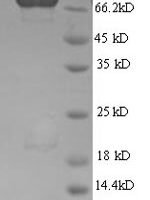
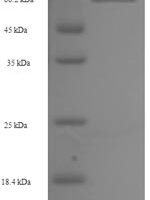
SDS-PAGE: Single band at expected molecular weight confirming purity.

ELISA: Suitable as coating antigen or detection standard.

Western Blot: Compatible with standard Western Blot protocols.

Protein Interaction: Validated for SPR (Surface Plasmon Resonance) and BLI (Bio-Layer Interferometry) studies.

Shipping: Shipped at ambient temperature. Lyophilized protein is stable during transit.

Storage: Store lyophilized protein at -20°C to -80°C. Reconstituted protein should be aliquoted and stored at -80°C. Avoid repeated freeze-thaw cycles.

Shelf Life: 12 months from date of receipt when stored as recommended.

Shipping Time: Orders placed before 2 PM EST ship same day. International orders typically deliver within 5-10 business days.

Protein Biology

Function

Component of the adaptor protein complex 2 (AP-2) (PubMed:12694563, PubMed:12952941, PubMed:14745134, PubMed:14985334, PubMed:15473838, PubMed:31104773). Adaptor protein complexes function in protein transport via transport vesicles in different membrane traffic pathways (PubMed:12694563, PubMed:12952941, PubMed:14745134, PubMed:14985334, PubMed:15473838, PubMed:31104773). Adaptor protein complexes are vesicle coat components and appear to be involved in cargo selection and vesicle formation (PubMed:12694563, PubMed:12952941, PubMed:14745134, PubMed:14985334, PubMed:15473838, PubMed:31104773). AP-2 is involved in clathrin-dependent endocytosis in which cargo proteins are incorporated into vesicles surrounded by clathrin (clathrin-coated vesicles, CCVs) which are destined for fusion with the early endosome (PubMed:12694563, PubMed:12952941, PubMed:14745134, PubMed:14985334, PubMed:15473838, PubMed:31104773). The clathrin lattice serves as a mechanical scaffold but is itself unable to bind directly to membrane components (PubMed:12694563, PubMed:12952941, PubMed:14745134, PubMed:14985334, PubMed:15473838, PubMed:31104773). Clathrin-associated adaptor protein (AP) complexes which can bind directly to both the clathrin lattice and to the lipid and protein components of membranes are considered to be the major clathrin adaptors contributing the CCV formation (PubMed:12694563, PubMed:12952941, PubMed:14745134, PubMed:14985334, PubMed:15473838, PubMed:31104773). AP-2 also serves as a cargo receptor to selectively sort the membrane proteins involved in receptor-mediated endocytosis (PubMed:16581796). AP-2 seems to play a role in the recycling of synaptic vesicle membranes from the presynaptic surface (PubMed:12694563, PubMed:12952941, PubMed:14745134, PubMed:14985334, PubMed:15473838, PubMed:31104773). AP-2 recognizes Y-X-X-[FILMV] (Y-X-X-Phi) and [ED]-X-X-X-L-[LI] endocytosis signal motifs within the cytosolic tails of transmembrane cargo molecules (By similarity). AP-2 may also play a role in maintaining normal post-endocytic trafficking through the ARF6-regulated, non-clathrin pathway (PubMed:19033387). During long-term potentiation in hippocampal neurons, AP-2 is responsible for the endocytosis of ADAM10 (PubMed:23676497). The AP-2 mu subunit binds to transmembrane cargo proteins; it recognizes the Y-X-X-Phi motifs (By similarity). The surface region interacting with to the Y-X-X-Phi motif is inaccessible in cytosolic AP-2, but becomes accessible through a conformational change following phosphorylation of AP-2 mu subunit at Thr-156 in membrane-associated AP-2 (PubMed:11877457). The membrane-specific phosphorylation event appears to involve assembled clathrin which activates the AP-2 mu kinase AAK1 (PubMed:11877457). Plays a role in endocytosis of frizzled family members upon Wnt signaling (By similarity)

Subcellular Location

Cell membrane; Membrane, coated pit (Peripheral membrane protein)

Disease Association

Intellectual developmental disorder, autosomal dominant 60, with seizures (MRD60) : An autosomal dominant disorder characterized by global developmental delay apparent in the first six months of life, followed by onset of seizures between 21 months and 4 years. Disease features include moderate-to-severe intellectual disability, poor speech, delayed walking, and ataxia. [The disease is caused by variants affecting the gene represented in this entry]

Tissue Specificity

Expressed in the brain (at protein level)

Subunit

Adapter protein complex 2 (AP-2) is a heterotetramer composed of two large adaptins (alpha-type subunit AP2A1 or AP2A2 and beta-type subunit AP2B1), a medium adaptin (mu-type subunit AP2M1) and a small adaptin (sigma-type subunit AP2S1) (By similarity). Interacts with ATP6V1H and MEGF10 (PubMed:12032142, PubMed:17643423). Interacts with EGFR and TTGN1 (By similarity). Interacts with F2R (PubMed:16581796). Interacts with PIP5K1C; tyrosine phosphorylation of PIP5K1C weakens the interaction (By similarity). Interacts with KIAA0319; required for clathrin-mediated endocytosis of KIAA0319 (PubMed:19419997). Interacts with DVL2 (via DEP domain) (By similarity). Interacts with KCNQ1; mediates estrogen-induced internalization via clathrin-coated vesicles (PubMed:23529131). Interacts with P2RX4 (via internalization motif) (By similarity). Together with AP2A1 or AP2A2 and AP2B1, it interacts with ADAM10; this interaction facilitates ADAM10 endocytosis from the plasma membrane during long-term potentiation in hippocampal neurons (PubMed:23676497). Probably interacts with ACE2 (via endocytic sorting signal motif); the interaction is inhibited by ACE2 phosphorylation (PubMed:33436498). Interacts with RALBP1; the interaction is direct (PubMed:10910768). Interacts with TMEM106B (via N-terminus) (PubMed:25066864)

Gene: AP2M1  |  Organism: Homo sapiens  |  Synonyms: AP-2 mu chain; Adaptin-mu2; Adaptor protein complex AP-2 subunit mu; Adaptor-related protein complex 2 subunit mu; Clathrin assembly protein complex 2 mu medium chain; Clathrin coat assembly protein AP50; Clathrin coat-associated protein AP50; HA2 50 kDa subunit; Plasma membrane adaptor AP-2 50 kDa protein
Key Publications

Frequently Asked Questions

How do I order or inquire about this product?

Fill out the Online Inquiry form with your required quantity and specifications. You can also email sales@biocrestsci.com. Our team typically responds within 4 business hours with a quote and availability confirmation.

What is the shipping and delivery time?

Orders placed before 2 PM EST ship the same day. Domestic (US) delivery typically takes 2-3 business days. International orders deliver within 5-10 business days. All products are shipped at ambient temperature with appropriate packaging to ensure stability.

How should I store this recombinant protein?

Lyophilized proteins should be stored at -20°C to -80°C upon receipt. After reconstitution, aliquot and store at -80°C. Avoid repeated freeze-thaw cycles. Shelf life is 12 months from date of receipt when stored as recommended.

What quality controls are performed on your products?

Each product undergoes SDS-PAGE purity analysis (typically >85-95%), endotoxin testing, and bioactivity validation. Products are validated for ELISA, Western Blot, and SPR/BLI applications as specified on this product page. A Certificate of Analysis (CoA) is available upon request.

Shopping Cart
Scroll to Top