Recombinant Human Apoptosis-inducing factor 1, mitochondrial (AIFM1), partial

Recombinant Human Apoptosis-inducing factor 1, mitochondrial (AIFM1), partial — recombinant protein from Homo sapiens (Human), expressed in E.coli. Purity >90%.

SKU: BCRECP-000049 Category:

Product Specifications

Product SkuBCRECP-000049
Product DescriptionRecombinant Human Apoptosis-inducing factor 1, mitochondrial (AIFM1) Protein is expressed from E.coli with N-terminal 6xHis-SUMO-tagged. It contains 103-612aa. [Accession | O95831].
Uniprot No.O95831
Gene NamesAIFM1
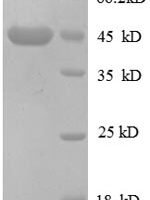
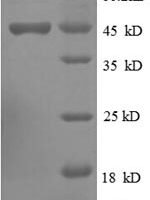
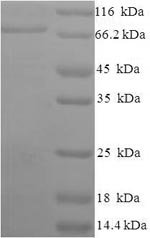
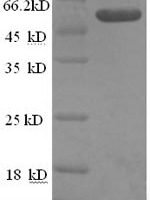
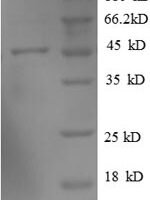
PurityGreater than 90% as determined by SDS-PAGE.
Expression SystemE.coli
Expression Region103-612aa
SpeciesHomo sapiens (Human)
Tag InfoN-terminal 6xHis-SUMO-tagged
Molecular weight71.6kDa
ActivityPlease contact us to obtain bioactivity data.
BufferIf the delivery form is liquid, the default storage buffer is Tris/PBS-based buffer, 5%-50% glycerol. If the delivery form is lyophilized powder, the buffer before lyophilization is Tris/PBS-based buffer, 6% Trehalose.
StorageStore at -20°C/-80°C upon receipt, aliquoting is necessary for mutiple use. Avoid repeated freeze-thaw cycles.
Research AreasApoptosis

Function

Pro-apoptotic isoform.

Biological Context

Subcellular Location: Cytoplasm
Tissue Specificity: Isoform 5 is frequently down-regulated in human cancers
Disease Association: Combined oxidative phosphorylation deficiency 6 (COXPD6) : A mitochondrial disease resulting in a neurodegenerative disorder characterized by psychomotor delay, hypotonia, areflexia, muscle weakness and wasting. Some patients manifest prenatal ventriculomegaly and severe postnatal encephalomyopathy. [The disease is caused by variants affecting the gene represented in this entry] | Charcot-Marie-Tooth disease, X-linked recessive, 4, with or without cerebellar ataxia (CMTX4) : A neuromuscular disorder characterized by progressive sensorimotor axonal neuropathy, distal sensory impairment, difficulty walking due to peripheral neuropathy and/or cerebellar ataxia, and deafness due to auditory neuropathy. Additional features include cognitive impairment, cerebellar atrophy, dysarthria, abnormal extraocular movements, tremor, dysmetria and spasticity. The age at onset ranges from infancy to young adulthood. [The disease is caused by variants affecting the gene represented in this entry] | Deafness, X-linked, 5, with peripheral neuropathy (DFNX5) : A form of hearing loss characterized by absent or severely abnormal auditory brainstem response, abnormal middle ear reflexes, abnormal speech discrimination, loss of outer hair cell function, and cochlear nerve hypoplasia. DFNX5 patients manifest auditory neuropathy with childhood onset, associated with distal sensory impairment affecting the peripheral nervous system. [The disease is caused by variants affecting the gene represented in this entry] | Spondyloepimetaphyseal dysplasia, X-linked, with hypomyelinating leukodystrophy (SEMDHL) : An X-linked recessive developmental disorder characterized by slowly progressive skeletal and neurologic abnormalities, including short stature, large and deformed joints, significant motor impairment, visual defects, and sometimes cognitive deficits. Affected individuals typically have normal early development in the first year or so of life, followed by development regression and the development of symptoms. Brain imaging shows white matter abnormalities consistent with hypomyelinating leukodystrophy. [The disease is caused by variants affecting the gene represented in this entry]

Product Specifications

Recombinant Human Apoptosis-inducing factor 1, mitochondrial (AIFM1), partial is a recombinant protein from Homo sapiens (Human), expressed in E.coli, covering amino acids 103-612aa, with N-terminal 6xHis-SUMO-tagged tag, molecular weight 71.6kDa, purity Greater than 90% as determined by SDS-PAGE.. Suitable for ELISA and Western Blot applications.
Recommended applications depend on the target, product format, and product-specific validation data. Refer to the product datasheet or Certificate of Analysis (CoA), or contact BioCrest Sci for application guidance.

Biological Activity: Please contact us to obtain bioactivity data.

Storage: Store at -20°C/-80°C upon receipt, aliquoting is necessary for mutiple use. Avoid repeated freeze-thaw cycles.

Shipping & Lead Time: Availability, shipping conditions, and estimated lead time are confirmed in the formal quotation or order confirmation based on the product format, destination, and order requirements.

Protein Biology

Function

Pro-apoptotic isoform

Subcellular Location

Cytoplasm

Disease Association

Combined oxidative phosphorylation deficiency 6 (COXPD6) : A mitochondrial disease resulting in a neurodegenerative disorder characterized by psychomotor delay, hypotonia, areflexia, muscle weakness and wasting. Some patients manifest prenatal ventriculomegaly and severe postnatal encephalomyopathy. [The disease is caused by variants affecting the gene represented in this entry] | Charcot-Marie-Tooth disease, X-linked recessive, 4, with or without cerebellar ataxia (CMTX4) : A neuromuscular disorder characterized by progressive sensorimotor axonal neuropathy, distal sensory impairment, difficulty walking due to peripheral neuropathy and/or cerebellar ataxia, and deafness due to auditory neuropathy. Additional features include cognitive impairment, cerebellar atrophy, dysarthria, abnormal extraocular movements, tremor, dysmetria and spasticity. The age at onset ranges from infancy to young adulthood. [The disease is caused by variants affecting the gene represented in this entry] | Deafness, X-linked, 5, with peripheral neuropathy (DFNX5) : A form of hearing loss characterized by absent or severely abnormal auditory brainstem response, abnormal middle ear reflexes, abnormal speech discrimination, loss of outer hair cell function, and cochlear nerve hypoplasia. DFNX5 patients manifest auditory neuropathy with childhood onset, associated with distal sensory impairment affecting the peripheral nervous system. [The disease is caused by variants affecting the gene represented in this entry] | Spondyloepimetaphyseal dysplasia, X-linked, with hypomyelinating leukodystrophy (SEMDHL) : An X-linked recessive developmental disorder characterized by slowly progressive skeletal and neurologic abnormalities, including short stature, large and deformed joints, significant motor impairment, visual defects, and sometimes cognitive deficits. Affected individuals typically have normal early development in the first year or so of life, followed by development regression and the development of symptoms. Brain imaging shows white matter abnormalities consistent with hypomyelinating leukodystrophy. [The disease is caused by variants affecting the gene represented in this entry]

Tissue Specificity

Isoform 5 is frequently down-regulated in human cancers

Subunit

Monomer (oxidized form). Homodimer (reduced form). Upon reduction with NADH, undergoes dimerization and forms tight, long-lived FADH2-NAD charge transfer complexes (CTC) resistant to oxidation (PubMed:20111043, PubMed:23217327, PubMed:24914854, PubMed:27818101). Also dimerizes with isoform 3 preventing its release from mitochondria (PubMed:20111043). Interacts with XIAP/BIRC4 (PubMed:17967870). Interacts (via N-terminus) with EIF3G (via C-terminus) (PubMed:17094969). Interacts with PRELID1 (PubMed:21364629). Interacts with CHCHD4; the interaction increases in presence of NADH (PubMed:26004228). Interacts with processed form of PARP1 (Poly [ADP-ribose] polymerase 1, processed C-terminus); interaction is mediated with poly-ADP-ribose chains attached to PARP1, promoting translocation into the nucleus (PubMed:33168626)

Gene: AIFM1  |  Organism: Homo sapiens  |  Synonyms: Programmed cell death protein 8
Key Publications

Frequently Asked Questions

How do I order or inquire about this product?

Submit the Online Inquiry form with your required quantity and specifications, or email sales@biocrestsci.com. Available sizes, pricing, stock status, documentation, and estimated lead time are confirmed in the formal quotation.

What is the shipping and delivery time?

Availability, dispatch timing, shipping conditions, and delivery estimates depend on the product format, destination, and order requirements. These details are confirmed in the formal quotation or order confirmation.

How should this product be stored?

Follow the storage and handling instructions in the product-specific datasheet and Certificate of Analysis (CoA). Requirements may vary by product form and formulation; contact BioCrest Sci if product-specific guidance is needed.

What quality controls are performed on your products?

Quality-control data such as identity, purity, endotoxin level, or biological activity are provided only when specified on this product page, the datasheet, or Certificate of Analysis (CoA). Biological activity is not implied unless explicitly stated.

Shopping Cart
Scroll to Top