Recombinant Human Arachidonate 12-lipoxygenase, 12S-type (ALOX12)

Recombinant Human Arachidonate 12-lipoxygenase, 12S-type (ALOX12) — Catalyzes the regio and stereo-specific incorporation of molecular oxygen into free and esterified polyunsaturated fatty acids generating lipid hydroperoxides that can be further reduced to the cor… Purity >90%.

SKU: BCRECP-000064 Category:

Product Specifications

Product SkuBCRECP-000064
Product DescriptionRecombinant Human Arachidonate 12-lipoxygenase, 12S-type (ALOX12) Protein is expressed from E.coli with N-terminal 6xHis-tagged. It contains 1-663aa. [Accession | P18054].
Uniprot No.P18054
Gene NamesALOX12
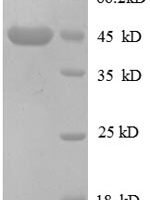
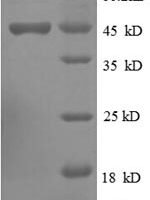
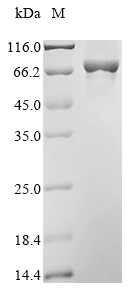
PurityGreater than 90% as determined by SDS-PAGE.
Expression SystemE.coli
Expression Region1-663aa
SpeciesHomo sapiens (Human)
Tag InfoN-terminal 6xHis-tagged
Molecular weight79.8kDa
ActivityPlease contact us to obtain bioactivity data.
BufferIf the delivery form is liquid, the default storage buffer is Tris/PBS-based buffer, 5%-50% glycerol. If the delivery form is lyophilized powder, the buffer before lyophilization is Tris/PBS-based buffer, 6% Trehalose.
StorageStore at -20°C/-80°C upon receipt, aliquoting is necessary for mutiple use. Avoid repeated freeze-thaw cycles.
Research AreasCardiovascular

Function

Catalyzes the regio and stereo-specific incorporation of molecular oxygen into free and esterified polyunsaturated fatty acids generating lipid hydroperoxides that can be further reduced to the corresponding hydroxy species. Mainly converts arachidonate ((5Z,8Z,11Z,14Z)-eicosatetraenoate) to the specific bioactive lipid (12S)-hydroperoxyeicosatetraenoate/(12S)-HPETE. Through the production of bioactive lipids like (12S)-HPETE it regulates different biological processes including platelet activation.

Biological Context

Subcellular Location: Cytoplasm, cytosol; Membrane
Tissue Specificity: Expressed in vascular smooth muscle cells
Disease Association: Esophageal cancer (ESCR) : A malignancy of the esophagus. The most common types are esophageal squamous cell carcinoma and adenocarcinoma. Cancer of the esophagus remains a devastating disease because it is usually not detected until it has progressed to an advanced incurable stage. [Disease susceptibility may be associated with variants affecting the gene represented in this entry. Gln at position 261 may confer interindividual susceptibility to esophageal cancer ] | Colorectal cancer (CRC) : A complex disease characterized by malignant lesions arising from the inner wall of the large intestine (the colon) and the rectum. Genetic alterations are often associated with progression from premalignant lesion (adenoma) to invasive adenocarcinoma. Risk factors for cancer of the colon and rectum include colon polyps, long-standing ulcerative colitis, and genetic family history. [Disease susceptibility may be associated with variants affecting the gene represented in this entry. Gln at position 261 may confer interindividual susceptibility to colorectal cancer ]
Pathway: Lipid metabolism; hydroperoxy eicosatetraenoic acid biosynthesis

Product Specifications

Recombinant Human Arachidonate 12-lipoxygenase, 12S-type (ALOX12) is a recombinant protein from Homo sapiens (Human), expressed in E.coli, covering amino acids 1-663aa, with N-terminal 6xHis-tagged tag, molecular weight 79.8kDa, purity Greater than 90% as determined by SDS-PAGE.. Suitable for ELISA and Western Blot applications.
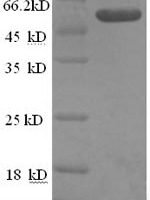
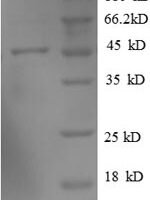
SDS-PAGE: Single band at expected molecular weight confirming purity.

ELISA: Suitable as coating antigen or detection standard.

Western Blot: Compatible with standard Western Blot protocols.

Protein Interaction: Validated for SPR (Surface Plasmon Resonance) and BLI (Bio-Layer Interferometry) studies.

Shipping: Shipped at ambient temperature. Lyophilized protein is stable during transit.

Storage: Store lyophilized protein at -20°C to -80°C. Reconstituted protein should be aliquoted and stored at -80°C. Avoid repeated freeze-thaw cycles.

Shelf Life: 12 months from date of receipt when stored as recommended.

Shipping Time: Orders placed before 2 PM EST ship same day. International orders typically deliver within 5-10 business days.

Protein Biology

Function

Catalyzes the regio and stereo-specific incorporation of molecular oxygen into free and esterified polyunsaturated fatty acids generating lipid hydroperoxides that can be further reduced to the corresponding hydroxy species (PubMed:17493578, PubMed:18311922, PubMed:1851637, PubMed:32404334, PubMed:8319693, PubMed:8500694). Mainly converts arachidonate ((5Z,8Z,11Z,14Z)-eicosatetraenoate) to the specific bioactive lipid (12S)-hydroperoxyeicosatetraenoate/(12S)-HPETE (PubMed:17493578, PubMed:22984144, PubMed:24282679, PubMed:8319693, PubMed:8500694). Through the production of bioactive lipids like (12S)-HPETE it regulates different biological processes including platelet activation (PubMed:8319693, PubMed:8500694). It can also catalyze the epoxidation of double bonds of polyunsaturated fatty acids such as (14S)-hydroperoxy-docosahexaenoate/(14S)-HPDHA resulting in the formation of (13S,14S)-epoxy-DHA (PubMed:23504711). Furthermore, it may participate in the sequential oxidations of DHA ((4Z,7Z,10Z,13Z,16Z,19Z)-docosahexaenoate) to generate specialized pro-resolving mediators (SPMs) like resolvin D5 ((7S,17S)-diHPDHA) and (7S,14S)-diHPDHA, that actively down-regulate the immune response and have anti-aggregation properties with platelets (PubMed:32404334). An additional function involves a multistep process by which it transforms leukotriene A4/LTA4 into the bioactive lipids lipoxin A4/LXA4 and lipoxin B4/LXB4, both are vasoactive and LXA4 may regulate neutrophil function via occupancy of specific recognition sites (PubMed:8250832). Can also peroxidize linoleate ((9Z,12Z)-octadecadienoate) to (13S)-hydroperoxyoctadecadienoate/ (13S-HPODE) (By similarity). Due to its role in regulating both the expression of the vascular endothelial growth factor (VEGF, an angiogenic factor involved in the survival and metastasis of solid tumors) and the expression of integrin beta-1 (known to affect tumor cell migration and proliferation), it can be regarded as protumorigenic (PubMed:16638750, PubMed:22237009, PubMed:9751607). Important for cell survival, as it may play a role not only in proliferation but also in the prevention of apoptosis in vascular smooth muscle cells (PubMed:23578768)

Subcellular Location

Cytoplasm, cytosol; Membrane

Disease Association

Esophageal cancer (ESCR) : A malignancy of the esophagus. The most common types are esophageal squamous cell carcinoma and adenocarcinoma. Cancer of the esophagus remains a devastating disease because it is usually not detected until it has progressed to an advanced incurable stage. [Disease susceptibility may be associated with variants affecting the gene represented in this entry. Gln at position 261 may confer interindividual susceptibility to esophageal cancer (PubMed:17460548)] | Colorectal cancer (CRC) : A complex disease characterized by malignant lesions arising from the inner wall of the large intestine (the colon) and the rectum. Genetic alterations are often associated with progression from premalignant lesion (adenoma) to invasive adenocarcinoma. Risk factors for cancer of the colon and rectum include colon polyps, long-standing ulcerative colitis, and genetic family history. [Disease susceptibility may be associated with variants affecting the gene represented in this entry. Gln at position 261 may confer interindividual susceptibility to colorectal cancer (PubMed:17460548)]

Tissue Specificity

Expressed in vascular smooth muscle cells

Pathway

Lipid metabolism; hydroperoxy eicosatetraenoic acid biosynthesis

Gene: ALOX12  |  Organism: Homo sapiens  |  Synonyms: Arachidonate (12S)-lipoxygenase; Arachidonate (15S)-lipoxygenase; Linoleate (13S)-lipoxygenase; Lipoxin synthase 12-LO; Platelet-type lipoxygenase 12
Key Publications

Frequently Asked Questions

How do I order or inquire about this product?

Fill out the Online Inquiry form with your required quantity and specifications. You can also email sales@biocrestsci.com. Our team typically responds within 4 business hours with a quote and availability confirmation.

What is the shipping and delivery time?

Orders placed before 2 PM EST ship the same day. Domestic (US) delivery typically takes 2-3 business days. International orders deliver within 5-10 business days. All products are shipped at ambient temperature with appropriate packaging to ensure stability.

How should I store this recombinant protein?

Lyophilized proteins should be stored at -20°C to -80°C upon receipt. After reconstitution, aliquot and store at -80°C. Avoid repeated freeze-thaw cycles. Shelf life is 12 months from date of receipt when stored as recommended.

What quality controls are performed on your products?

Each product undergoes SDS-PAGE purity analysis (typically >85-95%), endotoxin testing, and bioactivity validation. Products are validated for ELISA, Western Blot, and SPR/BLI applications as specified on this product page. A Certificate of Analysis (CoA) is available upon request.

Shopping Cart
Scroll to Top