Recombinant Human Ataxin-3 (ATXN3)

Recombinant Human Ataxin-3 (ATXN3) — Deubiquitinating enzyme involved in protein homeostasis maintenance, transcription, cytoskeleton regulation, myogenesis and degradation of misfolded chaperone substrates. Purity >95%.

SKU: BCRECP-000138 Category:

Product Specifications

Product SkuBCRECP-000138
Product DescriptionRecombinant Human Ataxin-3 (ATXN3) Protein is expressed from E.coli with C-terminal 6xHis-tagged. It contains 1-364aa. [Accession | P54252].
Uniprot No.P54252
Gene NamesATXN3
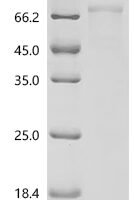
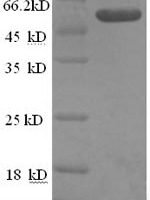
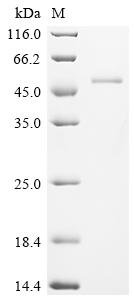
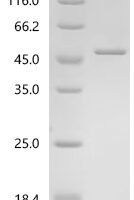
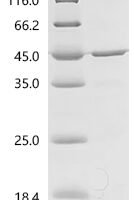
PurityGreater than 95% as determined by SDS-PAGE.
Expression SystemE.coli
Expression Region1-364aa
SpeciesHomo sapiens (Human)
Tag InfoC-terminal 6xHis-tagged
Molecular weight48.7kDa
ActivityPlease contact us to obtain bioactivity data.
BufferIf the delivery form is liquid, the default storage buffer is Tris/PBS-based buffer, 5%-50% glycerol. If the delivery form is lyophilized powder, the buffer before lyophilization is Tris/PBS-based buffer, 6% Trehalose.
StorageStore at -20°C/-80°C upon receipt, aliquoting is necessary for mutiple use. Avoid repeated freeze-thaw cycles.
Research AreasEpigenetics and Nuclear Signaling

Function

Deubiquitinating enzyme involved in protein homeostasis maintenance, transcription, cytoskeleton regulation, myogenesis and degradation of misfolded chaperone substrates. Binds long polyubiquitin chains and trims them, while it has weak or no activity against chains of 4 or less ubiquitins. Involved in degradation of misfolded chaperone substrates via its interaction with STUB1/CHIP: recruited to monoubiquitinated STUB1/CHIP, and restricts the length of ubiquitin chain attached to STUB1/CHIP substrates and preventing further chain extension.

Biological Context

Subcellular Location: Nucleus matrix; Nucleus; Lysosome membrane (Peripheral membrane protein)
Tissue Specificity: Ubiquitous
Disease Association: Spinocerebellar ataxia 3 (SCA3) : Spinocerebellar ataxia is a clinically and genetically heterogeneous group of cerebellar disorders. Patients show progressive incoordination of gait and often poor coordination of hands, speech and eye movements, due to cerebellum degeneration with variable involvement of the brainstem and spinal cord. SCA3 belongs to the autosomal dominant cerebellar ataxias type I (ADCA I) which are characterized by cerebellar ataxia in combination with additional clinical features like optic atrophy, ophthalmoplegia, bulbar and extrapyramidal signs, peripheral neuropathy and dementia. The molecular defect in SCA3 is the a CAG repeat expansion in ATX3 coding region. Longer expansions result in earlier onset and more severe clinical manifestations of the disease. [The disease is caused by variants affecting the gene represented in this entry]

Product Specifications

Recombinant Human Ataxin-3 (ATXN3) is a recombinant protein from Homo sapiens (Human), expressed in E.coli, covering amino acids 1-364aa, with C-terminal 6xHis-tagged tag, molecular weight 48.7kDa, purity Greater than 95% as determined by SDS-PAGE.. Suitable for ELISA and Western Blot applications.
Recommended applications depend on the target, product format, and product-specific validation data. Refer to the product datasheet or Certificate of Analysis (CoA), or contact BioCrest Sci for application guidance.

Biological Activity: Please contact us to obtain bioactivity data.

Storage: Store at -20°C/-80°C upon receipt, aliquoting is necessary for mutiple use. Avoid repeated freeze-thaw cycles.

Shipping & Lead Time: Availability, shipping conditions, and estimated lead time are confirmed in the formal quotation or order confirmation based on the product format, destination, and order requirements.

Protein Biology

Function

Deubiquitinating enzyme involved in protein homeostasis maintenance, transcription, cytoskeleton regulation, myogenesis and degradation of misfolded chaperone substrates (PubMed:12297501, PubMed:16118278, PubMed:17696782, PubMed:23625928, PubMed:28445460, PubMed:33157014). Binds long polyubiquitin chains and trims them, while it has weak or no activity against chains of 4 or less ubiquitins (PubMed:17696782). Involved in degradation of misfolded chaperone substrates via its interaction with STUB1/CHIP: recruited to monoubiquitinated STUB1/CHIP, and restricts the length of ubiquitin chain attached to STUB1/CHIP substrates and preventing further chain extension (By similarity). Interacts with key regulators of transcription and represses transcription: acts as a histone-binding protein that regulates transcription (PubMed:12297501). Acts as a negative regulator of mTORC1 signaling in response to amino acid deprivation by mediating deubiquitination of RHEB, thereby promoting RHEB inactivation by the TSC-TBC complex (PubMed:33157014). Regulates autophagy via the deubiquitination of 'Lys-402' of BECN1 leading to the stabilization of BECN1 (PubMed:28445460)

Subcellular Location

Nucleus matrix; Nucleus; Lysosome membrane (Peripheral membrane protein)

Disease Association

Spinocerebellar ataxia 3 (SCA3) : Spinocerebellar ataxia is a clinically and genetically heterogeneous group of cerebellar disorders. Patients show progressive incoordination of gait and often poor coordination of hands, speech and eye movements, due to cerebellum degeneration with variable involvement of the brainstem and spinal cord. SCA3 belongs to the autosomal dominant cerebellar ataxias type I (ADCA I) which are characterized by cerebellar ataxia in combination with additional clinical features like optic atrophy, ophthalmoplegia, bulbar and extrapyramidal signs, peripheral neuropathy and dementia. The molecular defect in SCA3 is the a CAG repeat expansion in ATX3 coding region. Longer expansions result in earlier onset and more severe clinical manifestations of the disease. [The disease is caused by variants affecting the gene represented in this entry]

Tissue Specificity

Ubiquitous

Subunit

Interacts with STUB1/CHIP (when monoubiquitinated) (By similarity). Interacts with DNA repair proteins RAD23A and RAD23B (PubMed:16020535, PubMed:30455355). Interacts with BECN1 (via its poly-Gln domain) (PubMed:28445460). Interacts with PRKN, UBR2, VCP and tubulin. Short isoform 1 interacts with CASP7 (PubMed:30455355)

Gene: ATXN3  |  Organism: Homo sapiens  |  Synonyms: Machado-Joseph disease protein 1; Spinocerebellar ataxia type 3 protein

Frequently Asked Questions

How do I order or inquire about this product?

Submit the Online Inquiry form with your required quantity and specifications, or email sales@biocrestsci.com. Available sizes, pricing, stock status, documentation, and estimated lead time are confirmed in the formal quotation.

What is the shipping and delivery time?

Availability, dispatch timing, shipping conditions, and delivery estimates depend on the product format, destination, and order requirements. These details are confirmed in the formal quotation or order confirmation.

How should this product be stored?

Follow the storage and handling instructions in the product-specific datasheet and Certificate of Analysis (CoA). Requirements may vary by product form and formulation; contact BioCrest Sci if product-specific guidance is needed.

What quality controls are performed on your products?

Quality-control data such as identity, purity, endotoxin level, or biological activity are provided only when specified on this product page, the datasheet, or Certificate of Analysis (CoA). Biological activity is not implied unless explicitly stated.

Shopping Cart
Scroll to Top