,

Recombinant Human ATP-binding cassette sub-family D member 3 (ABCD3) Protein

Recombinant Human ATP-binding cassette sub-family D member 3 (ABCD3) Protein — Broad substrate specificity ATP-dependent transporter of the ATP-binding cassette (ABC) family that catalyzes the transport of long-chain fatty acids (LCFA)-CoA, dicarboxylic acids-CoA, long-branch… Purity >85%.

SKU: BCRECP-00147TM Categories: ,

Product Specifications

Uniprot No.P28288
Gene NamesABCD3
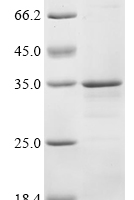
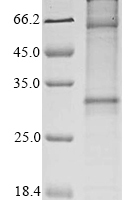
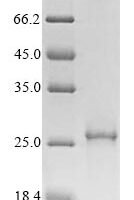
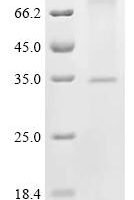
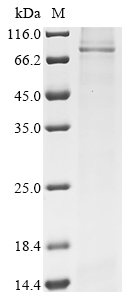
PurityGreater than 85% as determined by SDS-PAGE.
Expression Systemin vitro E.coli expression system
Expression Region1-659aa
SpeciesHomo sapiens (Human)
Tag InfoN-terminal 10xHis-tagged
Molecular weight81.5kDa
BufferIf the delivery form is liquid, the default storage buffer is Tris/PBS-based buffer, 5%-50% glycerol.If the delivery form is lyophilized powder, the buffer before lyophilization is Tris/PBS-based buffer, 6% Trehalose.
StorageStore at -20°C/-80°C upon receipt, aliquoting is necessary for mutiple use. Avoid repeated freeze-thaw cycles.

Function

Broad substrate specificity ATP-dependent transporter of the ATP-binding cassette (ABC) family that catalyzes the transport of long-chain fatty acids (LCFA)-CoA, dicarboxylic acids-CoA, long-branched-chain fatty acids-CoA and bile acids from the cytosol to the peroxisome lumen for beta-oxydation. Has fatty acyl-CoA thioesterase and ATPase activities. Probably hydrolyzes fatty acyl-CoAs into free fatty acids prior to their ATP-dependent transport into peroxisomes.

Biological Context

Subcellular Location: Peroxisome membrane (Multi-pass membrane protein)
Disease Association: Congenital bile acid synthesis defect 5 (CBAS5) : An autosomal recessive disorder characterized by hepatosplenomegaly, hepatic fibrosis, progressive liver failure, and accumulation of peroxisomal C27-bile acid intermediates in plasma. [The disease may be caused by variants affecting the gene represented in this entry] | Oculopharyngodistal myopathy 5 (OPDM5) : An autosomal dominant form of oculopharyngodistal myopathy, a muscle disorder characterized by progressive ptosis, external ophthalmoplegia, and weakness of the masseter, facial, pharyngeal, and distal limb muscles. The myopathological features are the presence of rimmed vacuoles in the muscle fibers and myopathic changes of differing severity. [The disease is caused by variants affecting the gene represented in this entry. Pathogenic CCG repeat expansions in the 5'-UTR of ABCD3 have been found in patients of European ancestry]

Product Specifications

Recombinant Human ATP-binding cassette sub-family D member 3 (ABCD3) Protein is a recombinant protein from Homo sapiens (Human), expressed in in vitro E.coli expression system, covering amino acids 1-659aa, with N-terminal 10xHis-tagged tag, molecular weight 81.5kDa, purity Greater than 85% as determined by SDS-PAGE.. Suitable for ELISA and Western Blot applications.

Recommended applications depend on the target, product format, and product-specific validation data. Refer to the product datasheet or Certificate of Analysis (CoA), or contact BioCrest Sci for application guidance.

Biological Activity: Not implied unless activity data are explicitly listed on this product page, the datasheet, or the CoA.

Storage: Store at -20°C/-80°C upon receipt, aliquoting is necessary for mutiple use. Avoid repeated freeze-thaw cycles.

Shipping & Lead Time: Availability, shipping conditions, and estimated lead time are confirmed in the formal quotation or order confirmation based on the product format, destination, and order requirements.

Protein Biology

Function

Broad substrate specificity ATP-dependent transporter of the ATP-binding cassette (ABC) family that catalyzes the transport of long-chain fatty acids (LCFA)-CoA, dicarboxylic acids-CoA, long-branched-chain fatty acids-CoA and bile acids from the cytosol to the peroxisome lumen for beta-oxydation (PubMed:11248239, PubMed:24333844, PubMed:25168382, PubMed:29397936). Has fatty acyl-CoA thioesterase and ATPase activities (PubMed:29397936). Probably hydrolyzes fatty acyl-CoAs into free fatty acids prior to their ATP-dependent transport into peroxisomes (By similarity). Thus, play a role in regulation of LCFAs and energy metabolism namely, in the degradation and biosynthesis of fatty acids by beta-oxidation (PubMed:24333844, PubMed:25944712)

Subcellular Location

Peroxisome membrane (Multi-pass membrane protein)

Disease Association

Congenital bile acid synthesis defect 5 (CBAS5) : An autosomal recessive disorder characterized by hepatosplenomegaly, hepatic fibrosis, progressive liver failure, and accumulation of peroxisomal C27-bile acid intermediates in plasma. [The disease may be caused by variants affecting the gene represented in this entry] | Oculopharyngodistal myopathy 5 (OPDM5) : An autosomal dominant form of oculopharyngodistal myopathy, a muscle disorder characterized by progressive ptosis, external ophthalmoplegia, and weakness of the masseter, facial, pharyngeal, and distal limb muscles. The myopathological features are the presence of rimmed vacuoles in the muscle fibers and myopathic changes of differing severity. [The disease is caused by variants affecting the gene represented in this entry. Pathogenic CCG repeat expansions in the 5'-UTR of ABCD3 have been found in patients of European ancestry]

Subunit

Homodimers (PubMed:17609205). Can form heterodimers with ABCD1 and ABCD2 (PubMed:10551832, PubMed:10777694, PubMed:17609205). Dimerization is necessary to form an active transporter (PubMed:17609205). Interacts with PEX19; mediates the targeting of ABCD3 to peroxisomes (PubMed:10704444, PubMed:16344115, PubMed:17761678)

Gene: ABCD3  |  Organism: Homo sapiens  |  Synonyms: 70 kDa peroxisomal membrane protein
Key Publications

Frequently Asked Questions

How do I order or inquire about this product?

Submit the Online Inquiry form with your required quantity and specifications, or email sales@biocrestsci.com. Available sizes, pricing, stock status, documentation, and estimated lead time are confirmed in the formal quotation.

What is the shipping and delivery time?

Availability, dispatch timing, shipping conditions, and delivery estimates depend on the product format, destination, and order requirements. These details are confirmed in the formal quotation or order confirmation.

How should this product be stored?

Follow the storage and handling instructions in the product-specific datasheet and Certificate of Analysis (CoA). Requirements may vary by product form and formulation; contact BioCrest Sci if product-specific guidance is needed.

What quality controls are performed on your products?

Quality-control data such as identity, purity, endotoxin level, or biological activity are provided only when specified on this product page, the datasheet, or Certificate of Analysis (CoA). Biological activity is not implied unless explicitly stated.

Shopping Cart
Scroll to Top