,

Recombinant Human ATP synthase F(0) complex subunit a (MT-ATP6) Protein

Recombinant Human ATP synthase F(0) complex subunit a (MT-ATP6) Protein — Subunit a, of the mitochondrial membrane ATP synthase complex (F(1)F(0) ATP synthase or Complex V) that produces ATP from ADP in the presence of a proton gradient across the membrane which is gener… Purity >85%.

SKU: BCRECP-00152TM Categories: ,

Product Specifications

Uniprot No.P00846
Gene NamesMT-ATP6
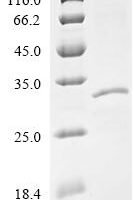
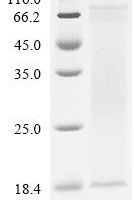
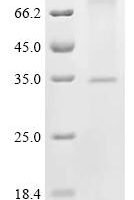
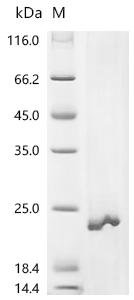
PurityGreater than 85% as determined by SDS-PAGE.
Expression Systemin vitro E.coli expression system
Expression Region1-226aa
SpeciesHomo sapiens (Human)
Tag InfoN-terminal 10xHis-tagged
Molecular weight26.3kDa
ActivityNot Test
BufferIf the delivery form is liquid, the default storage buffer is Tris/PBS-based buffer, 5%-50% glycerol.If the delivery form is lyophilized powder, the buffer before lyophilization is Tris/PBS-based buffer, 6% Trehalose.
StorageStore at -20°C/-80°C upon receipt, aliquoting is necessary for mutiple use. Avoid repeated freeze-thaw cycles.

Function

Subunit a, of the mitochondrial membrane ATP synthase complex (F(1)F(0) ATP synthase or Complex V) that produces ATP from ADP in the presence of a proton gradient across the membrane which is generated by electron transport complexes of the respiratory chain (Probable). ATP synthase complex consist of a soluble F(1) head domain – the catalytic core – and a membrane F(1) domain – the membrane proton channel. These two domains are linked by a central stalk rotating inside the F(1) region and a stationary peripheral stalk.

Biological Context

Subcellular Location: Mitochondrion inner membrane (Multi-pass membrane protein)
Disease Association: Neuropathy, ataxia, and retinitis pigmentosa (NARP) : A syndrome characterized by variable combination of developmental delay, psychomotor retardation, hearing loss, optic atrophy and retinitis pigmentosa, dementia, seizures, ataxia, proximal neurogenic muscle weakness, and sensory neuropathy. [The disease is caused by variants affecting the gene represented in this entry] | Leber hereditary optic neuropathy (LHON) : A maternally inherited form of Leber hereditary optic neuropathy, a mitochondrial disease resulting in bilateral painless loss of central vision due to selective degeneration of the retinal ganglion cells and their axons. The disorder shows incomplete penetrance and male predominance. Cardiac conduction defects and neurological defects have also been described in some LHON patients. LHON results from primary mitochondrial DNA mutations affecting the respiratory chain complexes. [The disease is caused by variants affecting the gene represented in this entry] | Leigh syndrome (LS) : An early-onset progressive neurodegenerative disorder characterized by the presence of focal, bilateral lesions in one or more areas of the central nervous system including the brainstem, thalamus, basal ganglia, cerebellum and spinal cord. Clinical features depend on which areas of the central nervous system are involved and include subacute onset of psychomotor retardation, hypotonia, ataxia, weakness, vision loss, eye movement abnormalities, seizures, and dysphagia. [The disease is caused by variants affecting the gene represented in this entry] | Mitochondrial infantile bilateral striatal necrosis (MIBSN) : Bilateral striatal necrosis is a neurological disorder resembling Leigh syndrome. [The disease is caused by variants affecting the gene represented in this entry] | Mitochondrial complex V deficiency, mitochondrial 1 (MC5DM1) : A mitochondrial disorder with heterogeneous clinical manifestations including neuropathy, ataxia, hypertrophic cardiomyopathy. Hypertrophic cardiomyopathy can present with negligible to extreme hypertrophy, minimal to extensive fibrosis and myocyte disarray, absent to severe left ventricular outflow tract obstruction, and distinct septal contours/morphologies with extremely varying clinical course. [The disease is caused by variants affecting the gene represented in this entry] | Myopathy, lactic acidosis, and sideroblastic anemia 3 (MLASA3) : A rare mitochondrial disorder characterized by sideroblastic anemia, muscle weakness, and exercise intolerance associated with persistent lactic acidemia. Additional MLASA3 features are failure to thrive, hearing loss, epilepsy, stroke-like episodes, and severe developmental delay. [The disease is caused by variants affecting the gene represented in this entry] | Ataxia and polyneuropathy, adult-onset (APAO) : A mitochondrial disease characterized by ataxia, axonal sensorimotor polyneuropathy, abnormal eye movements, and dysarthria. [The disease is caused by variants affecting the gene represented in this entry] | Cardiomyopathy, infantile hypertrophic (CMHI) : An infantile form of hypertrophic cardiomyopathy, a heart disorder characterized by ventricular hypertrophy, which is usually asymmetric and often involves the interventricular septum. The symptoms include dyspnea, syncope, collapse, palpitations, and chest pain. They can be readily provoked by exercise. The disorder has inter- and intrafamilial variability ranging from benign to malignant forms with high risk of cardiac failure and sudden cardiac death. [The disease is caused by variants affecting the gene represented in this entry]

Product Specifications

Recombinant Human ATP synthase F(0) complex subunit a (MT-ATP6) Protein is a recombinant protein from Homo sapiens (Human), expressed in in vitro E.coli expression system, covering amino acids 1-226aa, with N-terminal 10xHis-tagged tag, molecular weight 26.3kDa, purity Greater than 85% as determined by SDS-PAGE.. Suitable for ELISA and Western Blot applications.

SDS-PAGE: Single band at expected molecular weight confirming purity.

ELISA: Suitable as coating antigen or detection standard.

Western Blot: Compatible with standard Western Blot protocols.

Protein Interaction: Validated for SPR (Surface Plasmon Resonance) and BLI (Bio-Layer Interferometry) studies.

Shipping: Shipped at ambient temperature. Lyophilized protein is stable during transit.

Storage: Store lyophilized protein at -20°C to -80°C. Reconstituted protein should be aliquoted and stored at -80°C. Avoid repeated freeze-thaw cycles.

Shelf Life: 12 months from date of receipt when stored as recommended.

Shipping Time: Orders placed before 2 PM EST ship same day. International orders typically deliver within 5-10 business days.

Protein Biology

Function

Subunit a, of the mitochondrial membrane ATP synthase complex (F(1)F(0) ATP synthase or Complex V) that produces ATP from ADP in the presence of a proton gradient across the membrane which is generated by electron transport complexes of the respiratory chain (Probable). ATP synthase complex consist of a soluble F(1) head domain - the catalytic core - and a membrane F(1) domain - the membrane proton channel (PubMed:37244256). These two domains are linked by a central stalk rotating inside the F(1) region and a stationary peripheral stalk (PubMed:37244256). During catalysis, ATP synthesis in the catalytic domain of F(1) is coupled via a rotary mechanism of the central stalk subunits to proton translocation (Probable). With the subunit c (ATP5MC1), forms the proton-conducting channel in the F(0) domain, that contains two crucial half-channels (inlet and outlet) that facilitate proton movement from the mitochondrial intermembrane space (IMS) into the matrix (PubMed:37244256). Protons are taken up via the inlet half-channel and released through the outlet half-channel, following a Grotthuss mechanism (PubMed:37244256)

Subcellular Location

Mitochondrion inner membrane (Multi-pass membrane protein)

Disease Association

Neuropathy, ataxia, and retinitis pigmentosa (NARP) : A syndrome characterized by variable combination of developmental delay, psychomotor retardation, hearing loss, optic atrophy and retinitis pigmentosa, dementia, seizures, ataxia, proximal neurogenic muscle weakness, and sensory neuropathy. [The disease is caused by variants affecting the gene represented in this entry] | Leber hereditary optic neuropathy (LHON) : A maternally inherited form of Leber hereditary optic neuropathy, a mitochondrial disease resulting in bilateral painless loss of central vision due to selective degeneration of the retinal ganglion cells and their axons. The disorder shows incomplete penetrance and male predominance. Cardiac conduction defects and neurological defects have also been described in some LHON patients. LHON results from primary mitochondrial DNA mutations affecting the respiratory chain complexes. [The disease is caused by variants affecting the gene represented in this entry] | Leigh syndrome (LS) : An early-onset progressive neurodegenerative disorder characterized by the presence of focal, bilateral lesions in one or more areas of the central nervous system including the brainstem, thalamus, basal ganglia, cerebellum and spinal cord. Clinical features depend on which areas of the central nervous system are involved and include subacute onset of psychomotor retardation, hypotonia, ataxia, weakness, vision loss, eye movement abnormalities, seizures, and dysphagia. [The disease is caused by variants affecting the gene represented in this entry] | Mitochondrial infantile bilateral striatal necrosis (MIBSN) : Bilateral striatal necrosis is a neurological disorder resembling Leigh syndrome. [The disease is caused by variants affecting the gene represented in this entry] | Mitochondrial complex V deficiency, mitochondrial 1 (MC5DM1) : A mitochondrial disorder with heterogeneous clinical manifestations including neuropathy, ataxia, hypertrophic cardiomyopathy. Hypertrophic cardiomyopathy can present with negligible to extreme hypertrophy, minimal to extensive fibrosis and myocyte disarray, absent to severe left ventricular outflow tract obstruction, and distinct septal contours/morphologies with extremely varying clinical course. [The disease is caused by variants affecting the gene represented in this entry] | Myopathy, lactic acidosis, and sideroblastic anemia 3 (MLASA3) : A rare mitochondrial disorder characterized by sideroblastic anemia, muscle weakness, and exercise intolerance associated with persistent lactic acidemia. Additional MLASA3 features are failure to thrive, hearing loss, epilepsy, stroke-like episodes, and severe developmental delay. [The disease is caused by variants affecting the gene represented in this entry] | Ataxia and polyneuropathy, adult-onset (APAO) : A mitochondrial disease characterized by ataxia, axonal sensorimotor polyneuropathy, abnormal eye movements, and dysarthria. [The disease is caused by variants affecting the gene represented in this entry] | Cardiomyopathy, infantile hypertrophic (CMHI) : An infantile form of hypertrophic cardiomyopathy, a heart disorder characterized by ventricular hypertrophy, which is usually asymmetric and often involves the interventricular septum. The symptoms include dyspnea, syncope, collapse, palpitations, and chest pain. They can be readily provoked by exercise. The disorder has inter- and intrafamilial variability ranging from benign to malignant forms with high risk of cardiac failure and sudden cardiac death. [The disease is caused by variants affecting the gene represented in this entry]

Subunit

Component of the ATP synthase complex composed at least of ATP5F1A/subunit alpha, ATP5F1B/subunit beta, ATP5MC1/subunit c (homooctamer), MT-ATP6/subunit a, MT-ATP8/subunit 8, ATP5ME/subunit e, ATP5MF/subunit f, ATP5MG/subunit g, ATP5MK/subunit k, ATP5MJ/subunit j, ATP5F1C/subunit gamma, ATP5F1D/subunit delta, ATP5F1E/subunit epsilon, ATP5PF/subunit F6, ATP5PB/subunit b, ATP5PD/subunit d, ATP5PO/subunit OSCP (PubMed:37244256). ATP synthase complex consists of a soluble F(1) head domain (subunits alpha(3) and beta(3)) - the catalytic core - and a membrane F(0) domain - the membrane proton channel (subunits c, a, 8, e, f, g, k and j) (PubMed:37244256). These two domains are linked by a central stalk (subunits gamma, delta, and epsilon) rotating inside the F1 region and a stationary peripheral stalk (subunits F6, b, d, and OSCP) (PubMed:37244256). Interacts with DNAJC30; interaction is direct (PubMed:30318146)

Gene: MT-ATP6  |  Organism: Homo sapiens  |  Synonyms: F-ATPase protein 6; Proton-conducting channel, ATP synthase F(0) complex subunit a
Key Publications

Frequently Asked Questions

How do I order or inquire about this product?

Fill out the Online Inquiry form with your required quantity and specifications. You can also email sales@biocrestsci.com. Our team typically responds within 4 business hours with a quote and availability confirmation.

What is the shipping and delivery time?

Orders placed before 2 PM EST ship the same day. Domestic (US) delivery typically takes 2-3 business days. International orders deliver within 5-10 business days. All products are shipped at ambient temperature with appropriate packaging to ensure stability.

How should I store this recombinant protein?

Lyophilized proteins should be stored at -20°C to -80°C upon receipt. After reconstitution, aliquot and store at -80°C. Avoid repeated freeze-thaw cycles. Shelf life is 12 months from date of receipt when stored as recommended.

What quality controls are performed on your products?

Each product undergoes SDS-PAGE purity analysis (typically >85-95%), endotoxin testing, and bioactivity validation. Products are validated for ELISA, Western Blot, and SPR/BLI applications as specified on this product page. A Certificate of Analysis (CoA) is available upon request.

Shopping Cart
Scroll to Top