Recombinant Human B-cell lymphoma 6 protein (BCL6)

Recombinant Human B-cell lymphoma 6 protein (BCL6) — Transcriptional repressor mainly required for germinal center (GC) formation and antibody affinity maturation which has different mechanisms of action specific to the lineage and biological functions. Purity >90%.

SKU: BCRECP-000154 Category:

Product Specifications

Product SkuBCRECP-000154
Product DescriptionRecombinant Human B-cell lymphoma 6 protein (BCL6) Protein is expressed from E.coli with N-terminal 6xHis-tagged. It contains 1-706aa. [Accession | P41182].
Uniprot No.P41182
Gene NamesBCL6
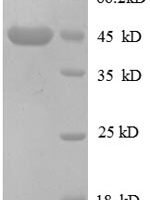
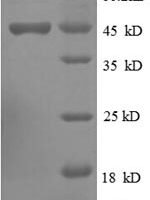
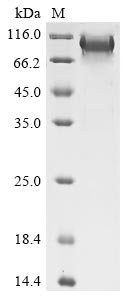
PurityGreater than 90% as determined by SDS-PAGE.
Expression SystemE.coli
Expression Region1-706aa
SpeciesHomo sapiens (Human)
Tag InfoN-terminal 6xHis-tagged
Molecular weight84.8kDa
ActivityPlease contact us to obtain bioactivity data.
BufferIf the delivery form is liquid, the default storage buffer is Tris/PBS-based buffer, 5%-50% glycerol. If the delivery form is lyophilized powder, the buffer before lyophilization is Tris/PBS-based buffer, 6% Trehalose.
StorageStore at -20°C/-80°C upon receipt, aliquoting is necessary for mutiple use. Avoid repeated freeze-thaw cycles.
Research AreasEpigenetics and Nuclear Signaling

Function

Transcriptional repressor mainly required for germinal center (GC) formation and antibody affinity maturation which has different mechanisms of action specific to the lineage and biological functions. Forms complexes with different corepressors and histone deacetylases to repress the transcriptional expression of different subsets of target genes. Represses its target genes by binding directly to the DNA sequence 5'-TTCCTAGAA-3' (BCL6-binding site) or indirectly by repressing the transcriptional activity of transcription factors.

Biological Context

Subcellular Location: Nucleus
Tissue Specificity: Expressed in germinal center T- and B-cells and in primary immature dendritic cells
Disease Association: [Chromosomal aberrations involving BCL6 are a cause of B-cell non-Hodgkin lymphomas (B-cell NHL), including diffuse large B-cell lymphoma and follicular lymphoma. Approximately 40% of diffuse large B-cell lymphomas and 5 to 10% of follicular lymphomas are associated with chromosomal translocations that deregulate expression of BCL6 by juxtaposing heterologous promoters to the BCL6 coding domain. Translocation t(3;14)(q27;q32). Translocation t(3;22)(q27;q11) with immunoglobulin gene regions. Translocation t(3;7)(q27;p12) with IKZF1 gene 5'non-coding region. Translocation t(3;6)(q27;p21) with Histone H4. Translocation t(3;16)(q27;p11) with IL21R. Translocation t(3;13)(q27;q14) with LCP1 ] | [A chromosomal aberration involving BCL6 may be a cause of a form of B-cell leukemia. Translocation t(3;11)(q27;q23) with POU2AF1/OBF1] | [A chromosomal aberration involving BCL6 may be a cause of lymphoma. Translocation t(3;4)(q27;p11) with ARHH/TTF]

Product Specifications

Recombinant Human B-cell lymphoma 6 protein (BCL6) is a recombinant protein from Homo sapiens (Human), expressed in E.coli, covering amino acids 1-706aa, with N-terminal 6xHis-tagged tag, molecular weight 84.8kDa, purity Greater than 90% as determined by SDS-PAGE.. Suitable for ELISA and Western Blot applications.
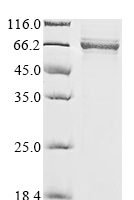
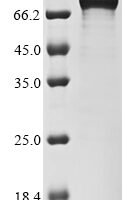
SDS-PAGE: Single band at expected molecular weight confirming purity.

ELISA: Suitable as coating antigen or detection standard.

Western Blot: Compatible with standard Western Blot protocols.

Protein Interaction: Validated for SPR (Surface Plasmon Resonance) and BLI (Bio-Layer Interferometry) studies.

Shipping: Shipped at ambient temperature. Lyophilized protein is stable during transit.

Storage: Store lyophilized protein at -20°C to -80°C. Reconstituted protein should be aliquoted and stored at -80°C. Avoid repeated freeze-thaw cycles.

Shelf Life: 12 months from date of receipt when stored as recommended.

Shipping Time: Orders placed before 2 PM EST ship same day. International orders typically deliver within 5-10 business days.

Protein Biology

Function

Transcriptional repressor mainly required for germinal center (GC) formation and antibody affinity maturation which has different mechanisms of action specific to the lineage and biological functions. Forms complexes with different corepressors and histone deacetylases to repress the transcriptional expression of different subsets of target genes. Represses its target genes by binding directly to the DNA sequence 5'-TTCCTAGAA-3' (BCL6-binding site) or indirectly by repressing the transcriptional activity of transcription factors. In GC B-cells, represses genes that function in differentiation, inflammation, apoptosis and cell cycle control, also autoregulates its transcriptional expression and up-regulates, indirectly, the expression of some genes important for GC reactions, such as AICDA, through the repression of microRNAs expression, like miR155. An important function is to allow GC B-cells to proliferate very rapidly in response to T-cell dependent antigens and tolerate the physiological DNA breaks required for immunoglobulin class switch recombination and somatic hypermutation without inducing a p53/TP53-dependent apoptotic response. In follicular helper CD4(+) T-cells (T(FH) cells), promotes the expression of T(FH)-related genes but inhibits the differentiation of T(H)1, T(H)2 and T(H)17 cells. Also required for the establishment and maintenance of immunological memory for both T- and B-cells. Suppresses macrophage proliferation through competition with STAT5 for STAT-binding motifs binding on certain target genes, such as CCL2 and CCND2. In response to genotoxic stress, controls cell cycle arrest in GC B-cells in both p53/TP53-dependedent and -independent manners. Besides, also controls neurogenesis through the alteration of the composition of NOTCH-dependent transcriptional complexes at selective NOTCH targets, such as HES5, including the recruitment of the deacetylase SIRT1 and resulting in an epigenetic silencing leading to neuronal differentiation

Subcellular Location

Nucleus

Disease Association

[Chromosomal aberrations involving BCL6 are a cause of B-cell non-Hodgkin lymphomas (B-cell NHL), including diffuse large B-cell lymphoma and follicular lymphoma. Approximately 40% of diffuse large B-cell lymphomas and 5 to 10% of follicular lymphomas are associated with chromosomal translocations that deregulate expression of BCL6 by juxtaposing heterologous promoters to the BCL6 coding domain (PubMed:10469447, PubMed:10753856, PubMed:11821949, PubMed:12414651). Translocation t(3;14)(q27;q32). Translocation t(3;22)(q27;q11) with immunoglobulin gene regions (PubMed:11821949). Translocation t(3;7)(q27;p12) with IKZF1 gene 5'non-coding region (PubMed:10753856). Translocation t(3;6)(q27;p21) with Histone H4 (PubMed:12414651). Translocation t(3;16)(q27;p11) with IL21R. Translocation t(3;13)(q27;q14) with LCP1 (PubMed:10469447)] | [A chromosomal aberration involving BCL6 may be a cause of a form of B-cell leukemia. Translocation t(3;11)(q27;q23) with POU2AF1/OBF1] | [A chromosomal aberration involving BCL6 may be a cause of lymphoma. Translocation t(3;4)(q27;p11) with ARHH/TTF]

Tissue Specificity

Expressed in germinal center T- and B-cells and in primary immature dendritic cells

Subunit

Homodimer. Interacts (via BTB domain) with the corepressors BCOR, NCOR1 and SMRT/NCOR2; the interactions are direct. Forms preferably ternary complexes with BCOR and SMRT/NCOR2 on target gene promoters but, on enhancer elements, interacts with SMRT/NCOR2 and HDAC3 to repress proximal gene expression. Interacts with histone deacetylases HDAC2, HDAC5 and HDAC9 (via the catalytic domain). Interacts with ZBTB7 and BCL6B. Interacts with SCF(FBXO11) complex; the interaction is independent of phosphorylation and promotes ubiquitination. Interacts (when phosphorylated) with PIN1; the interaction is required for BCL6 degradation upon genotoxic stress. Interacts with ZBTB17; inhibits ZBTB17 transcriptional activity. Interacts with CTBP1, autoinhibits its transcriptional expression. Interacts with NOTCH1 NCID and SIRT1; leads to a epigenetic repression of selective NOTCH1-target genes. Interacts (nor via BTB domain neither acetylated) with the NuRD complex components CHD4, HDAC1, MBD3 and MTA3; the interaction with MTA3 inhibits BCL6 acetylation and is required for BCL6 transpriptional repression

Gene: BCL6  |  Organism: Homo sapiens  |  Synonyms: B-cell lymphoma 5 protein; Protein LAZ-3; Zinc finger and BTB domain-containing protein 27; Zinc finger protein 51
Key Publications

Frequently Asked Questions

How do I order or inquire about this product?

Fill out the Online Inquiry form with your required quantity and specifications. You can also email sales@biocrestsci.com. Our team typically responds within 4 business hours with a quote and availability confirmation.

What is the shipping and delivery time?

Orders placed before 2 PM EST ship the same day. Domestic (US) delivery typically takes 2-3 business days. International orders deliver within 5-10 business days. All products are shipped at ambient temperature with appropriate packaging to ensure stability.

How should I store this recombinant protein?

Lyophilized proteins should be stored at -20°C to -80°C upon receipt. After reconstitution, aliquot and store at -80°C. Avoid repeated freeze-thaw cycles. Shelf life is 12 months from date of receipt when stored as recommended.

What quality controls are performed on your products?

Each product undergoes SDS-PAGE purity analysis (typically >85-95%), endotoxin testing, and bioactivity validation. Products are validated for ELISA, Western Blot, and SPR/BLI applications as specified on this product page. A Certificate of Analysis (CoA) is available upon request.

Shopping Cart
Scroll to Top