,

Recombinant Human Beta-nerve growth factor (NGF), partial (Active)

Recombinant Human Beta-nerve growth factor (NGF), partial (Active) — Nerve growth factor is important for the development and maintenance of the sympathetic and sensory nervous systems. Purity >95%.

SKU: BCACP-001212 Categories: ,
Product SKUBCACP-001212
Product DescriptionRecombinant Human Beta-nerve growth factor (NGF) protein is expressed from Mammalian cell with Tag-Free. It contains 122-239aa. [Accession | P01138].
Uniprot No.P01138
Gene NamesNGF
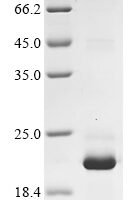
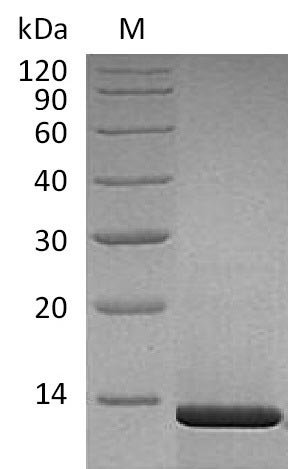
PurityGreater than 95% as determined by SDS-PAGE.
Expression SystemMammalian cell
Expression Region122-239aa
SpeciesHomo sapiens (Human)
Tag InfoTag-Free
Molecular weight13.5 kDa
ActivityThe ED50 as determined in a cell proliferation assay using TF‑1 human erythroleukemic cells is 25-150 pg/ml.
BufferLyophilized from a 0.2 μm filtered 20 mM Tris-HCl, 0.5 M NaCl, 6% Trehalose, pH 8.0
StorageStore at -20°C/-80°C upon receipt, aliquoting is necessary for mutiple use. Avoid repeated freeze-thaw cycles.
Alternative NamesBeta nerve growth factor; Beta NGF; Beta-nerve growth factor; Beta-NGF; HSAN5; MGC161426; MGC161428; Nerve growth factor (beta polypeptide); Nerve growth factor; Nerve growth factor beta; Nerve growth factor beta polypeptide; Nerve growth factor beta subunit; NGF; NGF_HUMAN; NGFB; NID67

Function

Nerve growth factor is important for the development and maintenance of the sympathetic and sensory nervous systems. Extracellular ligand for the NTRK1 and NGFR receptors, activates cellular signaling cascades to regulate neuronal proliferation, differentiation and survival (Probable). The immature NGF precursor (proNGF) functions as a ligand for the heterodimeric receptor formed by SORCS2 and NGFR, and activates cellular signaling cascades that lead to inactivation of RAC1 and/or RAC2, reorganization of the actin cytoskeleton and neuronal growth cone collapse.

Biological Context

Subcellular Location: Secreted; Endosome lumen
Disease Association: Neuropathy, hereditary sensory and autonomic, 5 (HSAN5) : A form of hereditary sensory and autonomic neuropathy, a genetically and clinically heterogeneous group of disorders characterized by degeneration of dorsal root and autonomic ganglion cells, and by sensory and/or autonomic abnormalities. HSAN5 patients manifest loss of pain perception and impaired temperature sensitivity, ulcers, and in some cases self-mutilation. The autonomic involvement is variable. [The disease is caused by variants affecting the gene represented in this entry]

Product Specifications

Recombinant Human Beta-nerve growth factor (NGF), partial (Active) is a recombinant protein from Homo sapiens (Human), expressed in Mammalian cell, covering amino acids 122-239aa, with Tag-Free tag, molecular weight 13.5 kDa, purity Greater than 95% as determined by SDS-PAGE.. Suitable for ELISA and Western Blot applications.

SDS-PAGE: Single band at expected molecular weight confirming purity.

ELISA: Suitable as coating antigen or detection standard.

Western Blot: Compatible with standard Western Blot protocols.

Protein Interaction: Validated for SPR (Surface Plasmon Resonance) and BLI (Bio-Layer Interferometry) studies.

Shipping: Shipped at ambient temperature. Lyophilized protein is stable during transit.

Storage: Store lyophilized protein at -20°C to -80°C. Reconstituted protein should be aliquoted and stored at -80°C. Avoid repeated freeze-thaw cycles.

Shelf Life: 12 months from date of receipt when stored as recommended.

Shipping Time: Orders placed before 2 PM EST ship same day. International orders typically deliver within 5-10 business days.

Protein Biology

Function

Nerve growth factor is important for the development and maintenance of the sympathetic and sensory nervous systems (PubMed:14976160, PubMed:20978020). Extracellular ligand for the NTRK1 and NGFR receptors, activates cellular signaling cascades to regulate neuronal proliferation, differentiation and survival (Probable) (PubMed:20978020). The immature NGF precursor (proNGF) functions as a ligand for the heterodimeric receptor formed by SORCS2 and NGFR, and activates cellular signaling cascades that lead to inactivation of RAC1 and/or RAC2, reorganization of the actin cytoskeleton and neuronal growth cone collapse. In contrast to mature NGF, the precursor form (proNGF) promotes neuronal apoptosis (in vitro) (By similarity). Inhibits metalloproteinase-dependent proteolysis of platelet glycoprotein VI (PubMed:20164177). Binds lysophosphatidylinositol and lysophosphatidylserine between the two chains of the homodimer. The lipid-bound form promotes histamine relase from mast cells, contrary to the lipid-free form (By similarity)

Subcellular Location

Secreted; Endosome lumen

Disease Association

Neuropathy, hereditary sensory and autonomic, 5 (HSAN5) : A form of hereditary sensory and autonomic neuropathy, a genetically and clinically heterogeneous group of disorders characterized by degeneration of dorsal root and autonomic ganglion cells, and by sensory and/or autonomic abnormalities. HSAN5 patients manifest loss of pain perception and impaired temperature sensitivity, ulcers, and in some cases self-mutilation. The autonomic involvement is variable. [The disease is caused by variants affecting the gene represented in this entry]

Subunit

Homodimer (PubMed:10490030, PubMed:15131306, PubMed:17196528). The homodimer interacts with a single NTRK1 chain (PubMed:10490030, PubMed:17196528). The homodimer interacts with a single NGFR chain (PubMed:15131306). The NGF dimer interacts with a single SORCS2 chain (via extracellular domain) (By similarity). The NGF precursor (proNGF) binds to a receptor complex formed by SORT1 and NGFR, which leads to NGF endocytosis. Both mature NGF and the immature NGF precursor (proNGF) interact with SORCS2 and with the heterodimer formed by SORCS2 and NGFR (via extracellular domains) (By similarity). The NGF precursor (proNGF) has much higher affinity for SORCS2 than mature NGF. The NGF precursor (proNGF) has much higher affinity for SORT1 than mature NGF (By similarity). Interacts with ADAM10 in a divalent cation-dependent manner (PubMed:20164177). Interaction with SORCS3 (PubMed:15710408)

Gene: NGF  |  Organism: Homo sapiens
Key Publications

Frequently Asked Questions

How do I order or inquire about this product?

Fill out the Online Inquiry form with your required quantity and specifications. You can also email sales@biocrestsci.com. Our team typically responds within 4 business hours with a quote and availability confirmation.

What is the shipping and delivery time?

Orders placed before 2 PM EST ship the same day. Domestic (US) delivery typically takes 2-3 business days. International orders deliver within 5-10 business days. All products are shipped at ambient temperature with appropriate packaging to ensure stability.

How should I store this recombinant protein?

Lyophilized proteins should be stored at -20°C to -80°C upon receipt. After reconstitution, aliquot and store at -80°C. Avoid repeated freeze-thaw cycles. Shelf life is 12 months from date of receipt when stored as recommended.

What quality controls are performed on your products?

Each product undergoes SDS-PAGE purity analysis (typically >85-95%), endotoxin testing, and bioactivity validation. Products are validated for ELISA, Western Blot, and SPR/BLI applications as specified on this product page. A Certificate of Analysis (CoA) is available upon request.

Shopping Cart
Scroll to Top