Recombinant Human Bile salt export pump (ABCB11), partial

Recombinant Human Bile salt export pump (ABCB11), partial — Catalyzes the transport of the major hydrophobic bile salts, such as taurine and glycine-conjugated cholic acid across the canalicular membrane of hepatocytes in an ATP-dependent manner, therefore … Purity >85%.

SKU: BCRECP-000005 Category:

Product Specifications

Product SkuBCRECP-000005
Product DescriptionRecombinant Human Bile salt export pump (ABCB11) Protein is expressed from E.coli with N-terminal 6xHis-tagged. It contains 1033-1321aa. [Accession | O95342].
Uniprot No.O95342
Gene NamesABCB11
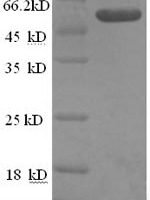
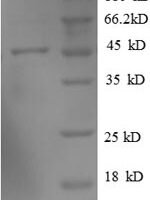
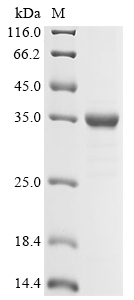
PurityGreater than 85% as determined by SDS-PAGE.
Expression SystemE.coli
Expression Region1033-1321aa
SpeciesHomo sapiens (Human)
Tag InfoN-terminal 6xHis-tagged
Molecular weight35.8kDa
ActivityPlease contact us to obtain bioactivity data.
BufferIf the delivery form is liquid, the default storage buffer is Tris/PBS-based buffer, 5%-50% glycerol. If the delivery form is lyophilized powder, the buffer before lyophilization is Tris/PBS-based buffer, 6% Trehalose.
StorageStore at -20°C/-80°C upon receipt, aliquoting is necessary for mutiple use. Avoid repeated freeze-thaw cycles.
Research AreasCancer

Function

Catalyzes the transport of the major hydrophobic bile salts, such as taurine and glycine-conjugated cholic acid across the canalicular membrane of hepatocytes in an ATP-dependent manner, therefore participates in hepatic bile acid homeostasis and consequently to lipid homeostasis through regulation of biliary lipid secretion in a bile salts dependent manner. Transports taurine-conjugated bile salts more rapidly than glycine-conjugated bile salts. Also transports non-bile acid compounds, such as pravastatin and fexofenadine in an ATP-dependent manner and may be involved in their biliary excretion.

Biological Context

Subcellular Location: Apical cell membrane (Multi-pass membrane protein); Recycling endosome membrane (Multi-pass membrane protein); Endosome; Cell membrane (Multi-pass membrane protein)
Tissue Specificity: Expressed predominantly, if not exclusively in the liver, where it was further localized to the canalicular microvilli and to subcanalicular vesicles of the hepatocytes by in situ
Disease Association: Cholestasis, progressive familial intrahepatic, 2 (PFIC2) : A disorder characterized by early onset of cholestasis that progresses to hepatic fibrosis, cirrhosis, and end-stage liver disease before adulthood. PFIC2 inheritance is autosomal recessive. [The disease is caused by variants affecting the gene represented in this entry] | Cholestasis, benign recurrent intrahepatic, 2 (BRIC2) : A disorder characterized by intermittent episodes of cholestasis without progression to liver failure. There is initial elevation of serum bile acids, followed by cholestatic jaundice which generally spontaneously resolves after periods of weeks to months. The cholestatic attacks vary in severity and duration. Patients are asymptomatic between episodes, both clinically and biochemically. [The disease is caused by variants affecting the gene represented in this entry]

Product Specifications

Recombinant Human Bile salt export pump (ABCB11), partial is a recombinant protein from Homo sapiens (Human), expressed in E.coli, covering amino acids 1033-1321aa, with N-terminal 6xHis-tagged tag, molecular weight 35.8kDa, purity Greater than 85% as determined by SDS-PAGE.. Suitable for ELISA and Western Blot applications.
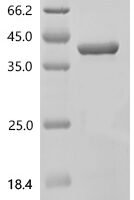
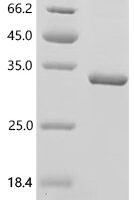
SDS-PAGE: Single band at expected molecular weight confirming purity.

ELISA: Suitable as coating antigen or detection standard.

Western Blot: Compatible with standard Western Blot protocols.

Protein Interaction: Validated for SPR (Surface Plasmon Resonance) and BLI (Bio-Layer Interferometry) studies.

Shipping: Shipped at ambient temperature. Lyophilized protein is stable during transit.

Storage: Store lyophilized protein at -20°C to -80°C. Reconstituted protein should be aliquoted and stored at -80°C. Avoid repeated freeze-thaw cycles.

Shelf Life: 12 months from date of receipt when stored as recommended.

Shipping Time: Orders placed before 2 PM EST ship same day. International orders typically deliver within 5-10 business days.

Protein Biology

Function

Catalyzes the transport of the major hydrophobic bile salts, such as taurine and glycine-conjugated cholic acid across the canalicular membrane of hepatocytes in an ATP-dependent manner, therefore participates in hepatic bile acid homeostasis and consequently to lipid homeostasis through regulation of biliary lipid secretion in a bile salts dependent manner (PubMed:15791618, PubMed:16332456, PubMed:18985798, PubMed:19228692, PubMed:20010382, PubMed:20398791, PubMed:22262466, PubMed:24711118, PubMed:29507376, PubMed:32203132). Transports taurine-conjugated bile salts more rapidly than glycine-conjugated bile salts (PubMed:16332456). Also transports non-bile acid compounds, such as pravastatin and fexofenadine in an ATP-dependent manner and may be involved in their biliary excretion (PubMed:15901796, PubMed:18245269)

Subcellular Location

Apical cell membrane (Multi-pass membrane protein); Recycling endosome membrane (Multi-pass membrane protein); Endosome; Cell membrane (Multi-pass membrane protein)

Disease Association

Cholestasis, progressive familial intrahepatic, 2 (PFIC2) : A disorder characterized by early onset of cholestasis that progresses to hepatic fibrosis, cirrhosis, and end-stage liver disease before adulthood. PFIC2 inheritance is autosomal recessive. [The disease is caused by variants affecting the gene represented in this entry] | Cholestasis, benign recurrent intrahepatic, 2 (BRIC2) : A disorder characterized by intermittent episodes of cholestasis without progression to liver failure. There is initial elevation of serum bile acids, followed by cholestatic jaundice which generally spontaneously resolves after periods of weeks to months. The cholestatic attacks vary in severity and duration. Patients are asymptomatic between episodes, both clinically and biochemically. [The disease is caused by variants affecting the gene represented in this entry]

Tissue Specificity

Expressed predominantly, if not exclusively in the liver, where it was further localized to the canalicular microvilli and to subcanalicular vesicles of the hepatocytes by in situ

Subunit

Interacts with HAX1 (By similarity). Interacts with the adapter protein complex 2 (AP-2) throught AP2A2 or AP2A1; this interaction regulates cell membrane expression of ABCB11 through its internalization in a clathrin-dependent manner and its subsequent degradation (PubMed:22262466)

Gene: ABCB11  |  Organism: Homo sapiens  |  Synonyms: ATP-binding cassette sub-family B member 11
Key Publications

Frequently Asked Questions

How do I order or inquire about this product?

Fill out the Online Inquiry form with your required quantity and specifications. You can also email sales@biocrestsci.com. Our team typically responds within 4 business hours with a quote and availability confirmation.

What is the shipping and delivery time?

Orders placed before 2 PM EST ship the same day. Domestic (US) delivery typically takes 2-3 business days. International orders deliver within 5-10 business days. All products are shipped at ambient temperature with appropriate packaging to ensure stability.

How should I store this recombinant protein?

Lyophilized proteins should be stored at -20°C to -80°C upon receipt. After reconstitution, aliquot and store at -80°C. Avoid repeated freeze-thaw cycles. Shelf life is 12 months from date of receipt when stored as recommended.

What quality controls are performed on your products?

Each product undergoes SDS-PAGE purity analysis (typically >85-95%), endotoxin testing, and bioactivity validation. Products are validated for ELISA, Western Blot, and SPR/BLI applications as specified on this product page. A Certificate of Analysis (CoA) is available upon request.

Shopping Cart
Scroll to Top