Recombinant Human Bone morphogenetic protein 2 (BMP2) (Active)

Recombinant Human Bone morphogenetic protein 2 (BMP2) (Active) — Growth factor of the TGF-beta superfamily that plays essential roles in many developmental processes, including cardiogenesis, neurogenesis, and osteogenesis. Purity >95%.

SKU: BCACP-001216 Category:
Product SKUBCACP-001216
Product DescriptionRecombinant Human Bone morphogenetic protein 2 (BMP2) protein is expressed from E.coli with Tag-Free. It contains 283-396aa. [Accession | P12643].
Uniprot No.P12643
Gene NamesBMP2
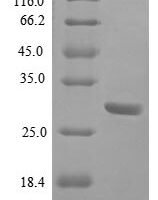
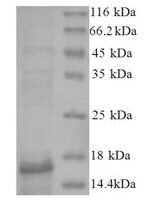
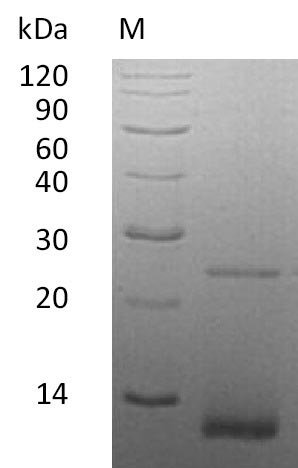
PurityGreater than 95% as determined by SDS-PAGE.
Expression SystemE.coli
Expression Region283-396aa
SpeciesHomo sapiens (Human)
Tag InfoTag-Free
Molecular weight13.3 kDa
ActivityThe ED50 as determined in a cell proliferation assay using BALB/c 3T3 cells is less than 0.5 ug/ml.
BufferLyophilized from a 0.2 μm filtered 20 mM Tris-HCl, 0.5 M NaCl, 6% Trehalose, pH 8.0
StorageStore at -20°C/-80°C upon receipt, aliquoting is necessary for mutiple use. Avoid repeated freeze-thaw cycles.
Alternative NamesBDA2; BMP-2; BMP-2A; Bmp2; BMP2_HUMAN; BMP2A; Bone morphogenetic protein 2; Bone morphogenetic protein 2A

Function

Growth factor of the TGF-beta superfamily that plays essential roles in many developmental processes, including cardiogenesis, neurogenesis, and osteogenesis. Induces cartilage and bone formation. Initiates the canonical BMP signaling cascade by associating with type I receptor BMPR1A and type II receptor BMPR2.

Biological Context

Subcellular Location: Secreted
Tissue Specificity: Particularly abundant in lung, spleen and colon and in low but significant levels in heart, brain, placenta, liver, skeletal muscle, kidney, pancreas, prostate, ovary and small intestine
Disease Association: Brachydactyly A2 (BDA2) : A form of brachydactyly. Brachydactyly defines a group of inherited malformations characterized by shortening of the digits due to abnormal development of the phalanges and/or the metacarpals. In brachydactyly type A2 shortening of the middle phalanges is confined to the index finger and the second toe, all other digits being more or less normal. Because of a rhomboid or triangular shape of the affected middle phalanx, the end of the second finger usually deviates radially. [The gene represented in this entry is involved in disease pathogenesis. Duplications of a cis-regulatory element located approximately 110 kb downstream of BMP2 have been found in BDA2 families. They likely cause altered BMP2 expression with pathological consequences] | Short stature, facial dysmorphism, and skeletal anomalies with or without cardiac anomalies 1 (SSFSC1) : An autosomal dominant disorder characterized by short stature, facial dysmorphism, skeletal anomalies, and variable cardiac defects. Distinctive facial features include midface retrusion, short upturned nose, long philtrum, high-arched or cleft palate, and variable degrees of micrognathia and dental crowding. Skeletal anomalies include patterning defects of the axial skeleton, characterized by 11 pairs of ribs and brachydactyly of the fifth ray. Congenital heart defects are variably observed and appear to involve primarily the cardiac outflow tract. [The disease is caused by variants affecting the gene represented in this entry]

Product Specifications

Recombinant Human Bone morphogenetic protein 2 (BMP2) (Active) is a recombinant protein from Homo sapiens (Human), expressed in E.coli, covering amino acids 283-396aa, with Tag-Free tag, molecular weight 13.3 kDa, purity Greater than 95% as determined by SDS-PAGE.. Suitable for ELISA and Western Blot applications.
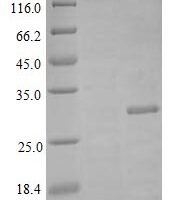
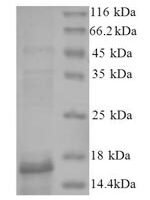
SDS-PAGE: Single band at expected molecular weight confirming purity.

ELISA: Suitable as coating antigen or detection standard.

Western Blot: Compatible with standard Western Blot protocols.

Protein Interaction: Validated for SPR (Surface Plasmon Resonance) and BLI (Bio-Layer Interferometry) studies.

Shipping: Shipped at ambient temperature. Lyophilized protein is stable during transit.

Storage: Store lyophilized protein at -20°C to -80°C. Reconstituted protein should be aliquoted and stored at -80°C. Avoid repeated freeze-thaw cycles.

Shelf Life: 12 months from date of receipt when stored as recommended.

Shipping Time: Orders placed before 2 PM EST ship same day. International orders typically deliver within 5-10 business days.

Protein Biology

Function

Growth factor of the TGF-beta superfamily that plays essential roles in many developmental processes, including cardiogenesis, neurogenesis, and osteogenesis (PubMed:18436533, PubMed:24362451, PubMed:31019025). Induces cartilage and bone formation (PubMed:3201241). Initiates the canonical BMP signaling cascade by associating with type I receptor BMPR1A and type II receptor BMPR2 (PubMed:15064755, PubMed:17295905, PubMed:18436533). Once all three components are bound together in a complex at the cell surface, BMPR2 phosphorylates and activates BMPR1A (PubMed:7791754). In turn, BMPR1A propagates signal by phosphorylating SMAD1/5/8 that travel to the nucleus and act as activators and repressors of transcription of target genes. Also acts to promote expression of HAMP, via the interaction with its receptor BMPR1A/ALK3 (PubMed:31800957). Can also signal through non-canonical pathways such as ERK/MAP kinase signaling cascade that regulates osteoblast differentiation (PubMed:16771708, PubMed:20851880). Also stimulates the differentiation of myoblasts into osteoblasts via the EIF2AK3-EIF2A-ATF4 pathway by stimulating EIF2A phosphorylation which leads to increased expression of ATF4 which plays a central role in osteoblast differentiation (PubMed:24362451). Acts as a positive regulator of odontoblast differentiation during mesenchymal tooth germ formation, expression is repressed during the bell stage by MSX1-mediated inhibition of CTNNB1 signaling (By similarity)

Subcellular Location

Secreted

Disease Association

Brachydactyly A2 (BDA2) : A form of brachydactyly. Brachydactyly defines a group of inherited malformations characterized by shortening of the digits due to abnormal development of the phalanges and/or the metacarpals. In brachydactyly type A2 shortening of the middle phalanges is confined to the index finger and the second toe, all other digits being more or less normal. Because of a rhomboid or triangular shape of the affected middle phalanx, the end of the second finger usually deviates radially. [The gene represented in this entry is involved in disease pathogenesis. Duplications of a cis-regulatory element located approximately 110 kb downstream of BMP2 have been found in BDA2 families. They likely cause altered BMP2 expression with pathological consequences] | Short stature, facial dysmorphism, and skeletal anomalies with or without cardiac anomalies 1 (SSFSC1) : An autosomal dominant disorder characterized by short stature, facial dysmorphism, skeletal anomalies, and variable cardiac defects. Distinctive facial features include midface retrusion, short upturned nose, long philtrum, high-arched or cleft palate, and variable degrees of micrognathia and dental crowding. Skeletal anomalies include patterning defects of the axial skeleton, characterized by 11 pairs of ribs and brachydactyly of the fifth ray. Congenital heart defects are variably observed and appear to involve primarily the cardiac outflow tract. [The disease is caused by variants affecting the gene represented in this entry]

Tissue Specificity

Particularly abundant in lung, spleen and colon and in low but significant levels in heart, brain, placenta, liver, skeletal muscle, kidney, pancreas, prostate, ovary and small intestine

Subunit

Homodimer; disulfide-linked (PubMed:10074410). Interacts with SOSTDC1 (PubMed:15020244). Interacts with GREM2, RGMA, RGMB and RGMC. Interacts with ASPN (By similarity). Interacts with MAFP5 (By similarity). Interacts with FBN1 (via N-terminal domain) and FBN2 (PubMed:18339631). Interacts with type I receptor BMPR1A (PubMed:15064755). Interacts with type II receptor BMPR2 (PubMed:7791754). Interacts with SCUBE3 (PubMed:33308444). Interacts with TNFAIP6 (primarily via Link domain); this interaction is inhibited by hyaluronan. Interacts with ERFE (PubMed:31800957). Interacts with BMPR1A/ALK3; the interaction may induce HAMP expression (PubMed:31800957). Forms heterodimers with BMP6 in vitro; the heterodimer then binds to its receptor BMPR1A /ALK3 and may induce HAMP expression (PubMed:31800957). Interacts with TGFBR3 (PubMed:18184661)

Gene: BMP2  |  Organism: Homo sapiens  |  Synonyms: Bone morphogenetic protein 2A
Key Publications

Frequently Asked Questions

How do I order or inquire about this product?

Fill out the Online Inquiry form with your required quantity and specifications. You can also email sales@biocrestsci.com. Our team typically responds within 4 business hours with a quote and availability confirmation.

What is the shipping and delivery time?

Orders placed before 2 PM EST ship the same day. Domestic (US) delivery typically takes 2-3 business days. International orders deliver within 5-10 business days. All products are shipped at ambient temperature with appropriate packaging to ensure stability.

How should I store this recombinant protein?

Lyophilized proteins should be stored at -20°C to -80°C upon receipt. After reconstitution, aliquot and store at -80°C. Avoid repeated freeze-thaw cycles. Shelf life is 12 months from date of receipt when stored as recommended.

What quality controls are performed on your products?

Each product undergoes SDS-PAGE purity analysis (typically >85-95%), endotoxin testing, and bioactivity validation. Products are validated for ELISA, Western Blot, and SPR/BLI applications as specified on this product page. A Certificate of Analysis (CoA) is available upon request.

Shopping Cart
Scroll to Top