Recombinant Human C-type lectin domain family 4 member D (CLEC4D), partial

Recombinant Human C-type lectin domain family 4 member D (CLEC4D), partial — Calcium-dependent lectin that acts as a pattern recognition receptor (PRR) of the innate immune system: recognizes damage-associated molecular patterns (DAMPs) of pathogen-associated molecular patt… Purity >90%.

SKU: BCRECP-000382 Category:

Product Specifications

Product SkuBCRECP-000382
Product DescriptionRecombinant Human C-type lectin domain family 4 member D (CLEC4D) Protein is expressed from E.coli with N-terminal 6xHis-SUMO-tagged. It contains 39-215aa. [Accession | Q8WXI8].
Uniprot No.Q8WXI8
Gene NamesCLEC4D
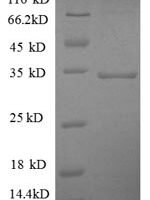
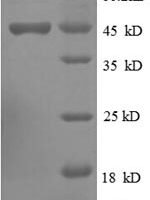
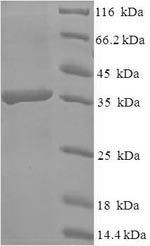
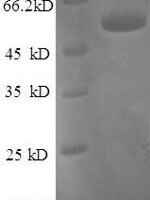
PurityGreater than 90% as determined by SDS-PAGE.
Expression SystemE.coli
Expression Region39-215aa
SpeciesHomo sapiens (Human)
Tag InfoN-terminal 6xHis-SUMO-tagged
Molecular weight36.7kDa
ActivityPlease contact us to obtain bioactivity data.
BufferIf the delivery form is liquid, the default storage buffer is Tris/PBS-based buffer, 5%-50% glycerol. If the delivery form is lyophilized powder, the buffer before lyophilization is Tris/PBS-based buffer, 6% Trehalose.
StorageStore at -20°C/-80°C upon receipt, aliquoting is necessary for mutiple use. Avoid repeated freeze-thaw cycles.
Research AreasImmunology

Function

Calcium-dependent lectin that acts as a pattern recognition receptor (PRR) of the innate immune system: recognizes damage-associated molecular patterns (DAMPs) of pathogen-associated molecular patterns (PAMPs) of bacteria and fungi. The PAMPs include alpha-mannans on C.albicans hypheas and mycobacterial trehalose 6,6'-dimycolate (TDM). Interacts with signaling adapter Fc receptor gamma chain/FCER1G, likely via CLEC4E, to form a functional complex in myeloid cells.

Biological Context

Subcellular Location: Cell membrane (Single-pass type II membrane protein)
Tissue Specificity: Expressed weakly in peripheral blood leukocytes, bone marrow and spleen. Expression is confined mostly in monocytes and macrophage and seems to be up-regulated by IL-6, IL-10, TNF and IFN-gamma

Product Specifications

Recombinant Human C-type lectin domain family 4 member D (CLEC4D), partial is a recombinant protein from Homo sapiens (Human), expressed in E.coli, covering amino acids 39-215aa, with N-terminal 6xHis-SUMO-tagged tag, molecular weight 36.7kDa, purity Greater than 90% as determined by SDS-PAGE.. Suitable for ELISA and Western Blot applications.
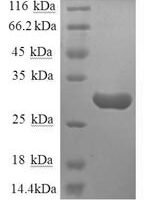
Recommended applications depend on the target, product format, and product-specific validation data. Refer to the product datasheet or Certificate of Analysis (CoA), or contact BioCrest Sci for application guidance.

Biological Activity: Please contact us to obtain bioactivity data.

Storage: Store at -20°C/-80°C upon receipt, aliquoting is necessary for mutiple use. Avoid repeated freeze-thaw cycles.

Shipping & Lead Time: Availability, shipping conditions, and estimated lead time are confirmed in the formal quotation or order confirmation based on the product format, destination, and order requirements.

Protein Biology

Function

Calcium-dependent lectin that acts as a pattern recognition receptor (PRR) of the innate immune system: recognizes damage-associated molecular patterns (DAMPs) of pathogen-associated molecular patterns (PAMPs) of bacteria and fungi (PubMed:23602766, PubMed:23911656). The PAMPs include alpha-mannans on C.albicans hypheas and mycobacterial trehalose 6,6'-dimycolate (TDM) (PubMed:23602766, PubMed:23911656). Interacts with signaling adapter Fc receptor gamma chain/FCER1G, likely via CLEC4E, to form a functional complex in myeloid cells (By similarity). Binding of mycobacterial TDM or C.albicans alpha-mannans to this receptor complex leads to phosphorylation of the immunoreceptor tyrosine-based activation motif (ITAM) of FCER1G, triggering activation of SYK, CARD9 and NF-kappa-B, consequently driving maturation of antigen-presenting cells and shaping antigen-specific priming of T-cells toward effector T-helper 1 and T-helper 17 cell subtypes (PubMed:23602766, PubMed:23911656). The heterodimer formed with CLEC6A is active against fungal infection (PubMed:23911656). Functions as an endocytic receptor (PubMed:14971047). May be involved in antigen uptake at the site of infection, either for clearance of the antigen, or for processing and further presentation to T-cells (PubMed:14971047)

Subcellular Location

Cell membrane (Single-pass type II membrane protein)

Tissue Specificity

Expressed weakly in peripheral blood leukocytes, bone marrow and spleen. Expression is confined mostly in monocytes and macrophage and seems to be up-regulated by IL-6, IL-10, TNF and IFN-gamma

Subunit

Heterodimer with CLEC4E; disulfide-linked (By similarity). CLEC4E acts as a bridge for interaction between CLEC4D and FCER1G to form a functional complex (By similarity). Heterodimer with CLEC6A; this heterodimer forms a pattern recognition receptor (PRR) against fungal infection (PubMed:23911656)

Gene: CLEC4D  |  Organism: Homo sapiens  |  Synonyms: C-type lectin superfamily member 8; C-type lectin-like receptor 6; Dendritic cell-associated C-type lectin 3
Key Publications

Frequently Asked Questions

How do I order or inquire about this product?

Submit the Online Inquiry form with your required quantity and specifications, or email sales@biocrestsci.com. Available sizes, pricing, stock status, documentation, and estimated lead time are confirmed in the formal quotation.

What is the shipping and delivery time?

Availability, dispatch timing, shipping conditions, and delivery estimates depend on the product format, destination, and order requirements. These details are confirmed in the formal quotation or order confirmation.

How should this product be stored?

Follow the storage and handling instructions in the product-specific datasheet and Certificate of Analysis (CoA). Requirements may vary by product form and formulation; contact BioCrest Sci if product-specific guidance is needed.

What quality controls are performed on your products?

Quality-control data such as identity, purity, endotoxin level, or biological activity are provided only when specified on this product page, the datasheet, or Certificate of Analysis (CoA). Biological activity is not implied unless explicitly stated.

Shopping Cart
Scroll to Top