Recombinant Human Collagen alpha-3 (VI) chain (COL6A3), partial Protein

Recombinant Human Collagen alpha-3 (VI) chain (COL6A3), partial Protein — recombinant protein from Homo sapiens (Human), expressed in in vitro E.coli expression system. Purity >85%.

SKU: BCRECP-00717TM Category:

Product Specifications

Uniprot No.P12111
Gene NamesCOL6A3
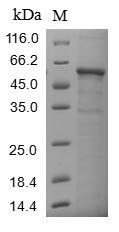
PurityGreater than 85% as determined by SDS-PAGE.
Expression Systemin vitro E.coli expression system
Expression Region2853-3176aa
SpeciesHomo sapiens (Human)
Tag InfoN-terminal 6xHis-SUMO-tagged
Molecular weight50.5kDa
BufferIf the delivery form is liquid, the default storage buffer is Tris/PBS-based buffer, 5%-50% glycerol.If the delivery form is lyophilized powder, the buffer before lyophilization is Tris/PBS-based buffer, 6% Trehalose.
StorageStore at -20°C/-80°C upon receipt, aliquoting is necessary for mutiple use. Avoid repeated freeze-thaw cycles.

Function

Collagen VI acts as a cell-binding protein.

Biological Context

Subcellular Location: Secreted, extracellular space, extracellular matrix
Disease Association: Bethlem myopathy 1C (BTHLM1C) : A form of Bethlem myopathy, a slowly progressive muscular dystrophy characterized by joint contractures, most frequently affecting the elbows and ankles, and muscle weakness and wasting involving the proximal and extensor muscles more than the distal and flexor ones. The clinical onset more often occurs in childhood or adulthood, but it can be prenatal with decreased fetal movements or neonatal with hypotonia. The hallmark of Bethlem myopathy is long finger flexion contractures. BTHLM1C inheritance is autosomal dominant. [The disease is caused by variants affecting the gene represented in this entry] | Ullrich congenital muscular dystrophy 1C (UCMD1C) : A form of Ullrich congenital muscular dystrophy, a disease characterized by generalized muscle weakness and striking hypermobility of distal joints in conjunction with variable contractures of more proximal joints and normal intelligence. Additional findings may include kyphoscoliosis, protruded calcanei, and follicular hyperkeratosis (rough skin). More severely affected patients manifest at birth and never achieve independent ambulation, while patients with milder phenotypes might maintain ambulation into adulthood. Inheritance can be autosomal dominant or autosomal recessive. [The disease is caused by variants affecting the gene represented in this entry] | Dystonia 27 (DYT27) : A form of dystonia, a disorder defined by the presence of sustained involuntary muscle contraction, often leading to abnormal postures. DYT27 is an autosomal recessive form characterized by segmental isolated dystonia involving the face, neck, bulbar muscles, and upper limbs. [The disease is caused by variants affecting the gene represented in this entry]

Product Specifications

Recombinant Human Collagen alpha-3 (VI) chain (COL6A3), partial Protein is a recombinant protein from Homo sapiens (Human), expressed in in vitro E.coli expression system, covering amino acids 2853-3176aa, with N-terminal 6xHis-SUMO-tagged tag, molecular weight 50.5kDa, purity Greater than 85% as determined by SDS-PAGE.. Suitable for ELISA and Western Blot applications.

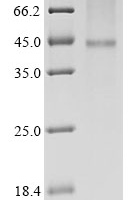
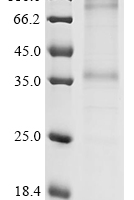
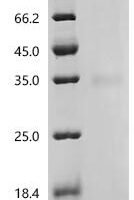
SDS-PAGE: Single band at expected molecular weight confirming purity.

ELISA: Suitable as coating antigen or detection standard.

Western Blot: Compatible with standard Western Blot protocols.

Protein Interaction: Validated for SPR (Surface Plasmon Resonance) and BLI (Bio-Layer Interferometry) studies.

Shipping: Shipped at ambient temperature. Lyophilized protein is stable during transit.

Storage: Store lyophilized protein at -20°C to -80°C. Reconstituted protein should be aliquoted and stored at -80°C. Avoid repeated freeze-thaw cycles.

Shelf Life: 12 months from date of receipt when stored as recommended.

Shipping Time: Orders placed before 2 PM EST ship same day. International orders typically deliver within 5-10 business days.

Protein Biology

Function

Collagen VI acts as a cell-binding protein

Subcellular Location

Secreted, extracellular space, extracellular matrix

Disease Association

Bethlem myopathy 1C (BTHLM1C) : A form of Bethlem myopathy, a slowly progressive muscular dystrophy characterized by joint contractures, most frequently affecting the elbows and ankles, and muscle weakness and wasting involving the proximal and extensor muscles more than the distal and flexor ones. The clinical onset more often occurs in childhood or adulthood, but it can be prenatal with decreased fetal movements or neonatal with hypotonia. The hallmark of Bethlem myopathy is long finger flexion contractures. BTHLM1C inheritance is autosomal dominant. [The disease is caused by variants affecting the gene represented in this entry] | Ullrich congenital muscular dystrophy 1C (UCMD1C) : A form of Ullrich congenital muscular dystrophy, a disease characterized by generalized muscle weakness and striking hypermobility of distal joints in conjunction with variable contractures of more proximal joints and normal intelligence. Additional findings may include kyphoscoliosis, protruded calcanei, and follicular hyperkeratosis (rough skin). More severely affected patients manifest at birth and never achieve independent ambulation, while patients with milder phenotypes might maintain ambulation into adulthood. Inheritance can be autosomal dominant or autosomal recessive. [The disease is caused by variants affecting the gene represented in this entry] | Dystonia 27 (DYT27) : A form of dystonia, a disorder defined by the presence of sustained involuntary muscle contraction, often leading to abnormal postures. DYT27 is an autosomal recessive form characterized by segmental isolated dystonia involving the face, neck, bulbar muscles, and upper limbs. [The disease is caused by variants affecting the gene represented in this entry]

Subunit

Trimers composed of three different chains: alpha-1(VI), alpha-2(VI), and alpha-3(VI) or alpha-5(VI) or alpha-6(VI)

Gene: COL6A3  |  Organism: Homo sapiens
Key Publications

Frequently Asked Questions

How do I order or inquire about this product?

Fill out the Online Inquiry form with your required quantity and specifications. You can also email sales@biocrestsci.com. Our team typically responds within 4 business hours with a quote and availability confirmation.

What is the shipping and delivery time?

Orders placed before 2 PM EST ship the same day. Domestic (US) delivery typically takes 2-3 business days. International orders deliver within 5-10 business days. All products are shipped at ambient temperature with appropriate packaging to ensure stability.

How should I store this recombinant protein?

Lyophilized proteins should be stored at -20°C to -80°C upon receipt. After reconstitution, aliquot and store at -80°C. Avoid repeated freeze-thaw cycles. Shelf life is 12 months from date of receipt when stored as recommended.

What quality controls are performed on your products?

Each product undergoes SDS-PAGE purity analysis (typically >85-95%), endotoxin testing, and bioactivity validation. Products are validated for ELISA, Western Blot, and SPR/BLI applications as specified on this product page. A Certificate of Analysis (CoA) is available upon request.

Shopping Cart
Scroll to Top