Recombinant Human Complement factor I (CFI)

Recombinant Human Complement factor I (CFI) — Trypsin-like serine protease that plays an essential role in regulating the immune response by controlling all complement pathways. Purity >85%.

SKU: BCRECP-000356 Category:

Product Specifications

Product SkuBCRECP-000356
Product DescriptionRecombinant Human Complement factor I (CFI) Protein is expressed from E.coli with N-terminal 6xHis-tagged. It contains 19-583aa. [Accession | P05156].
Uniprot No.P05156
Gene NamesCFI
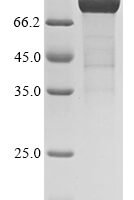
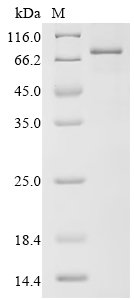
PurityGreater than 85% as determined by SDS-PAGE.
Expression SystemE.coli
Expression Region19-583aa
SpeciesHomo sapiens (Human)
Tag InfoN-terminal 6xHis-tagged
Molecular weight70.5kDa
ActivityPlease contact us to obtain bioactivity data.
BufferIf the delivery form is liquid, the default storage buffer is Tris/PBS-based buffer, 5%-50% glycerol. If the delivery form is lyophilized powder, the buffer before lyophilization is Tris/PBS-based buffer, 6% Trehalose.
StorageStore at -20°C/-80°C upon receipt, aliquoting is necessary for mutiple use. Avoid repeated freeze-thaw cycles.
Research AreasImmunology

Function

Trypsin-like serine protease that plays an essential role in regulating the immune response by controlling all complement pathways. Inhibits these pathways by cleaving three peptide bonds in the alpha-chain of C3b and two bonds in the alpha-chain of C4b thereby inactivating these proteins. Essential cofactors for these reactions include factor H and C4BP in the fluid phase and membrane cofactor protein/CD46 and CR1 on cell surfaces.

Biological Context

Subcellular Location: Secreted, extracellular space; Secreted
Tissue Specificity: Expressed in the liver by hepatocytes. Also present in other cells such as monocytes, fibroblasts or keratinocytes
Disease Association: Hemolytic uremic syndrome, atypical, 3 (AHUS3) : An atypical form of hemolytic uremic syndrome. It is a complex genetic disease characterized by microangiopathic hemolytic anemia, thrombocytopenia, renal failure and absence of episodes of enterocolitis and diarrhea. In contrast to typical hemolytic uremic syndrome, atypical forms have a poorer prognosis, with higher death rates and frequent progression to end-stage renal disease. [Disease susceptibility is associated with variants affecting the gene represented in this entry. Other genes may play a role in modifying the phenotype] | Complement factor I deficiency (CFI deficiency) : Autosomal recessive condition associated with a propensity to pyogenic infections. [The disease is caused by variants affecting the gene represented in this entry] | Macular degeneration, age-related, 13 (ARMD13) : A form of age-related macular degeneration, a multifactorial eye disease and the most common cause of irreversible vision loss in the developed world. In most patients, the disease is manifest as ophthalmoscopically visible yellowish accumulations of protein and lipid that lie beneath the retinal pigment epithelium and within an elastin-containing structure known as Bruch membrane. [Disease susceptibility is associated with variants affecting the gene represented in this entry]

Product Specifications

Recombinant Human Complement factor I (CFI) is a recombinant protein from Homo sapiens (Human), expressed in E.coli, covering amino acids 19-583aa, with N-terminal 6xHis-tagged tag, molecular weight 70.5kDa, purity Greater than 85% as determined by SDS-PAGE.. Suitable for ELISA and Western Blot applications.

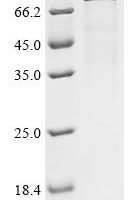
SDS-PAGE: Single band at expected molecular weight confirming purity.

ELISA: Suitable as coating antigen or detection standard.

Western Blot: Compatible with standard Western Blot protocols.

Protein Interaction: Validated for SPR (Surface Plasmon Resonance) and BLI (Bio-Layer Interferometry) studies.

Shipping: Shipped at ambient temperature. Lyophilized protein is stable during transit.

Storage: Store lyophilized protein at -20°C to -80°C. Reconstituted protein should be aliquoted and stored at -80°C. Avoid repeated freeze-thaw cycles.

Shelf Life: 12 months from date of receipt when stored as recommended.

Shipping Time: Orders placed before 2 PM EST ship same day. International orders typically deliver within 5-10 business days.

Protein Biology

Function

Trypsin-like serine protease that plays an essential role in regulating the immune response by controlling all complement pathways. Inhibits these pathways by cleaving three peptide bonds in the alpha-chain of C3b and two bonds in the alpha-chain of C4b thereby inactivating these proteins (PubMed:17320177, PubMed:7360115). Essential cofactors for these reactions include factor H and C4BP in the fluid phase and membrane cofactor protein/CD46 and CR1 on cell surfaces (PubMed:12055245, PubMed:2141838, PubMed:9605165). The presence of these cofactors on healthy cells allows degradation of deposited C3b by CFI in order to prevent undesired complement activation, while in apoptotic cells or microbes, the absence of such cofactors leads to C3b-mediated complement activation and subsequent opsonization (PubMed:28671664)

Subcellular Location

Secreted, extracellular space; Secreted

Disease Association

Hemolytic uremic syndrome, atypical, 3 (AHUS3) : An atypical form of hemolytic uremic syndrome. It is a complex genetic disease characterized by microangiopathic hemolytic anemia, thrombocytopenia, renal failure and absence of episodes of enterocolitis and diarrhea. In contrast to typical hemolytic uremic syndrome, atypical forms have a poorer prognosis, with higher death rates and frequent progression to end-stage renal disease. [Disease susceptibility is associated with variants affecting the gene represented in this entry. Other genes may play a role in modifying the phenotype] | Complement factor I deficiency (CFI deficiency) : Autosomal recessive condition associated with a propensity to pyogenic infections. [The disease is caused by variants affecting the gene represented in this entry] | Macular degeneration, age-related, 13 (ARMD13) : A form of age-related macular degeneration, a multifactorial eye disease and the most common cause of irreversible vision loss in the developed world. In most patients, the disease is manifest as ophthalmoscopically visible yellowish accumulations of protein and lipid that lie beneath the retinal pigment epithelium and within an elastin-containing structure known as Bruch membrane. [Disease susceptibility is associated with variants affecting the gene represented in this entry]

Tissue Specificity

Expressed in the liver by hepatocytes (PubMed:6327681). Also present in other cells such as monocytes, fibroblasts or keratinocytes (PubMed:17320177, PubMed:6444659)

Subunit

(Microbial infection) Interacts with Staphylococcus aureus clumping factor A/ClfA; this interaction enhances cleavage of C3b into iC3b by CFI

Gene: CFI  |  Organism: Homo sapiens  |  Synonyms: C3B/C4B inactivator
Key Publications

Frequently Asked Questions

How do I order or inquire about this product?

Fill out the Online Inquiry form with your required quantity and specifications. You can also email sales@biocrestsci.com. Our team typically responds within 4 business hours with a quote and availability confirmation.

What is the shipping and delivery time?

Orders placed before 2 PM EST ship the same day. Domestic (US) delivery typically takes 2-3 business days. International orders deliver within 5-10 business days. All products are shipped at ambient temperature with appropriate packaging to ensure stability.

How should I store this recombinant protein?

Lyophilized proteins should be stored at -20°C to -80°C upon receipt. After reconstitution, aliquot and store at -80°C. Avoid repeated freeze-thaw cycles. Shelf life is 12 months from date of receipt when stored as recommended.

What quality controls are performed on your products?

Each product undergoes SDS-PAGE purity analysis (typically >85-95%), endotoxin testing, and bioactivity validation. Products are validated for ELISA, Western Blot, and SPR/BLI applications as specified on this product page. A Certificate of Analysis (CoA) is available upon request.

Shopping Cart
Scroll to Top