Recombinant Human DCC-interacting protein 13-alpha (APPL1), partial

Recombinant Human DCC-interacting protein 13-alpha (APPL1), partial — Multifunctional adapter protein that binds to various membrane receptors, nuclear factors and signaling proteins to regulate many processes, such as cell proliferation, immune response, endosomal t… Purity >95%.

SKU: BCRECP-000114 Category:

Product Specifications

Product SkuBCRECP-000114
Product DescriptionRecombinant Human DCC-interacting protein 13-alpha (APPL1) Protein is expressed from E.coli with C-terminal 6xHis-tagged. It contains 5-377aa. [Accession | Q9UKG1].
Uniprot No.Q9UKG1
Gene NamesAPPL1
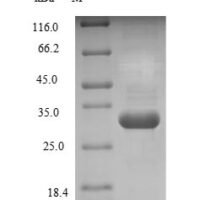
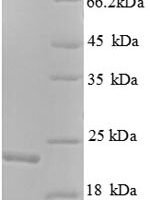
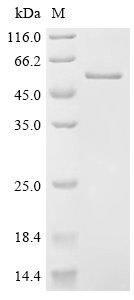
PurityGreater than 95% as determined by SDS-PAGE.
Expression SystemE.coli
Expression Region5-377aa
SpeciesHomo sapiens (Human)
Tag InfoC-terminal 6xHis-tagged
Molecular weight49.7kDa
ActivityPlease contact us to obtain bioactivity data.
BufferIf the delivery form is liquid, the default storage buffer is Tris/PBS-based buffer, 5%-50% glycerol. If the delivery form is lyophilized powder, the buffer before lyophilization is Tris/PBS-based buffer, 6% Trehalose.
StorageStore at -20°C/-80°C upon receipt, aliquoting is necessary for mutiple use. Avoid repeated freeze-thaw cycles.
Research AreasCell Biology

Function

Multifunctional adapter protein that binds to various membrane receptors, nuclear factors and signaling proteins to regulate many processes, such as cell proliferation, immune response, endosomal trafficking and cell metabolism. Regulates signaling pathway leading to cell proliferation through interaction with RAB5A and subunits of the NuRD/MeCP1 complex. Functions as a positive regulator of innate immune response via activation of AKT1 signaling pathway by forming a complex with APPL1 and PIK3R1.

Biological Context

Subcellular Location: Early endosome membrane (Peripheral membrane protein); Nucleus; Cytoplasm; Endosome; Cell projection, ruffle; Cytoplasmic vesicle, phagosome
Tissue Specificity: High levels in heart, ovary, pancreas and skeletal muscle
Disease Association: Maturity-onset diabetes of the young 14 (MODY14) : A form of diabetes that is characterized by an autosomal dominant mode of inheritance, onset in childhood or early adulthood (usually before 25 years of age), a primary defect in insulin secretion and frequent insulin-independence at the beginning of the disease. [The disease is caused by variants affecting the gene represented in this entry]

Product Specifications

Recombinant Human DCC-interacting protein 13-alpha (APPL1), partial is a recombinant protein from Homo sapiens (Human), expressed in E.coli, covering amino acids 5-377aa, with C-terminal 6xHis-tagged tag, molecular weight 49.7kDa, purity Greater than 95% as determined by SDS-PAGE.. Suitable for ELISA and Western Blot applications.
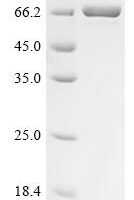
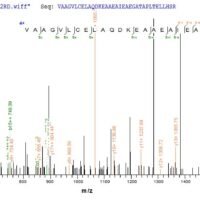
SDS-PAGE: Single band at expected molecular weight confirming purity.

ELISA: Suitable as coating antigen or detection standard.

Western Blot: Compatible with standard Western Blot protocols.

Protein Interaction: Validated for SPR (Surface Plasmon Resonance) and BLI (Bio-Layer Interferometry) studies.

Shipping: Shipped at ambient temperature. Lyophilized protein is stable during transit.

Storage: Store lyophilized protein at -20°C to -80°C. Reconstituted protein should be aliquoted and stored at -80°C. Avoid repeated freeze-thaw cycles.

Shelf Life: 12 months from date of receipt when stored as recommended.

Shipping Time: Orders placed before 2 PM EST ship same day. International orders typically deliver within 5-10 business days.

Protein Biology

Function

Multifunctional adapter protein that binds to various membrane receptors, nuclear factors and signaling proteins to regulate many processes, such as cell proliferation, immune response, endosomal trafficking and cell metabolism (PubMed:10490823, PubMed:15016378, PubMed:19661063, PubMed:26073777, PubMed:26583432). Regulates signaling pathway leading to cell proliferation through interaction with RAB5A and subunits of the NuRD/MeCP1 complex (PubMed:15016378). Functions as a positive regulator of innate immune response via activation of AKT1 signaling pathway by forming a complex with APPL1 and PIK3R1 (By similarity). Inhibits Fc-gamma receptor-mediated phagocytosis through PI3K/Akt signaling in macrophages (By similarity). Regulates TLR4 signaling in activated macrophages (By similarity). Involved in trafficking of the TGFBR1 from the endosomes to the nucleus via microtubules in a TRAF6-dependent manner (PubMed:26583432). Plays a role in cell metabolism by regulating adiponecting and insulin signaling pathways (PubMed:19661063, PubMed:24879834, PubMed:26073777). Required for fibroblast migration through HGF cell signaling (By similarity). Positive regulator of beta-catenin/TCF-dependent transcription through direct interaction with RUVBL2/reptin resulting in the relief of RUVBL2-mediated repression of beta-catenin/TCF target genes by modulating the interactions within the beta-catenin-reptin-HDAC complex (PubMed:19433865)

Subcellular Location

Early endosome membrane (Peripheral membrane protein); Nucleus; Cytoplasm; Endosome; Cell projection, ruffle; Cytoplasmic vesicle, phagosome

Disease Association

Maturity-onset diabetes of the young 14 (MODY14) : A form of diabetes that is characterized by an autosomal dominant mode of inheritance, onset in childhood or early adulthood (usually before 25 years of age), a primary defect in insulin secretion and frequent insulin-independence at the beginning of the disease. [The disease is caused by variants affecting the gene represented in this entry]

Tissue Specificity

High levels in heart, ovary, pancreas and skeletal muscle

Subunit

Homodimer (PubMed:18034774). Binds RAB5A/Rab5 through an N-terminal domain. This interaction is essential for its recruitment to endosomal membranes as well as its role in cell proliferation (PubMed:15016378). Binds DCC and the catalytic domain of the inactive form of AKT2 through its PID domain (PubMed:10490823, PubMed:12011067). Binds PIK3CA and subunits of the NuRD/MeCP1 complex (PubMed:10490823, PubMed:15016378). Interacts with OCRL and INPP5B (PubMed:17765681, PubMed:20133602, PubMed:21233288, PubMed:21666675). Interacts with NTRK2 (By similarity). Interacts with APPL2; interaction is independent of follicle stimulating hormone stimulation; interaction is decreased by adiponectin in a time-dependent manner (PubMed:17030088, PubMed:18034774, PubMed:19661063). Forms a complex with APPL2 and RUVBL2 (PubMed:19433865). Forms a complex comprising APPL2, RUVBL2, CTNNB1, HDAC1 and HDAC2; interaction reduces interaction between CTNNB1, HDAC1, HDAC2 and RUVBL2 leading to the decrease of deacetylase activity of this complex; affects the recruitment of repressive complexes to the Wnt target genes (PubMed:19433865). Interacts with ANXA2 (PubMed:21645192). Interacts with TGFBR1; interaction is TGF beta dependent; mediates trafficking of the TGFBR1 from the endosomes to the nucleus via microtubules in a TRAF6-dependent manner (PubMed:26583432). Interacts with PRKCZ (PubMed:26583432). Interacts with PIK3R1 and APPL2 (By similarity). Interacts with ADIPOR1; ADIPOQ enhances this interaction; inhibits adiponectin-stimulated binding of APPL2 to ADIPOR1 (By similarity)

Gene: APPL1  |  Organism: Homo sapiens  |  Synonyms: Adapter protein containing PH domain, PTB domain and leucine zipper motif 1
Key Publications

Frequently Asked Questions

How do I order or inquire about this product?

Fill out the Online Inquiry form with your required quantity and specifications. You can also email sales@biocrestsci.com. Our team typically responds within 4 business hours with a quote and availability confirmation.

What is the shipping and delivery time?

Orders placed before 2 PM EST ship the same day. Domestic (US) delivery typically takes 2-3 business days. International orders deliver within 5-10 business days. All products are shipped at ambient temperature with appropriate packaging to ensure stability.

How should I store this recombinant protein?

Lyophilized proteins should be stored at -20°C to -80°C upon receipt. After reconstitution, aliquot and store at -80°C. Avoid repeated freeze-thaw cycles. Shelf life is 12 months from date of receipt when stored as recommended.

What quality controls are performed on your products?

Each product undergoes SDS-PAGE purity analysis (typically >85-95%), endotoxin testing, and bioactivity validation. Products are validated for ELISA, Western Blot, and SPR/BLI applications as specified on this product page. A Certificate of Analysis (CoA) is available upon request.

Shopping Cart
Scroll to Top