Recombinant Human Disks large homolog 4 (DLG4)

Recombinant Human Disks large homolog 4 (DLG4) — Postsynaptic scaffolding protein that plays a critical role in synaptogenesis and synaptic plasticity by providing a platform for the postsynaptic clustering of crucial synaptic proteins. Purity >95%.

SKU: BCRECP-000514 Category:

Product Specifications

Product SkuBCRECP-000514
Product DescriptionRecombinant Human Disks large homolog 4 (DLG4) Protein is expressed from E.coli with N-terminal 6xHis-tagged. It contains 1-724aa. [Accession | P78352].
Uniprot No.P78352
Gene NamesDLG4
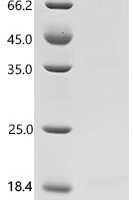
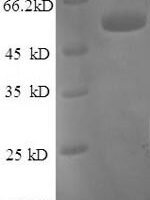
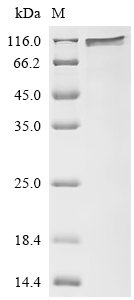
PurityGreater than 95% as determined by SDS-PAGE.
Expression SystemE.coli
Expression Region1-724aa
SpeciesHomo sapiens (Human)
Tag InfoN-terminal 6xHis-tagged
Molecular weight84.5kDa
ActivityPlease contact us to obtain bioactivity data.
BufferIf the delivery form is liquid, the default storage buffer is Tris/PBS-based buffer, 5%-50% glycerol. If the delivery form is lyophilized powder, the buffer before lyophilization is Tris/PBS-based buffer, 6% Trehalose.
StorageStore at -20°C/-80°C upon receipt, aliquoting is necessary for mutiple use. Avoid repeated freeze-thaw cycles.
Research AreasNeuroscience

Function

Postsynaptic scaffolding protein that plays a critical role in synaptogenesis and synaptic plasticity by providing a platform for the postsynaptic clustering of crucial synaptic proteins. Interacts with the cytoplasmic tail of NMDA receptor subunits and shaker-type potassium channels. Required for synaptic plasticity associated with NMDA receptor signaling.

Biological Context

Subcellular Location: Cell membrane (Lipid-anchor); Postsynaptic density; Synapse; Cytoplasm; Cell projection, axon; Cell projection, dendritic spine; Cell projection, dendrite; Presynapse
Tissue Specificity: Brain
Disease Association: Intellectual developmental disorder, autosomal dominant 62 (MRD62) : An autosomal dominant form of intellectual disability, a disorder characterized by significantly below average general intellectual functioning associated with impairments in adaptive behavior and manifested during the developmental period. MRD62 is characterized by mild to moderately impaired intellectual development. [The disease is caused by variants affecting the gene represented in this entry]

Product Specifications

Recombinant Human Disks large homolog 4 (DLG4) is a recombinant protein from Homo sapiens (Human), expressed in E.coli, covering amino acids 1-724aa, with N-terminal 6xHis-tagged tag, molecular weight 84.5kDa, purity Greater than 95% as determined by SDS-PAGE.. Suitable for ELISA and Western Blot applications.
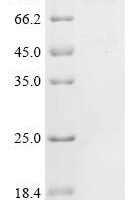
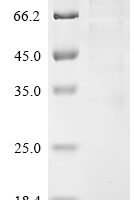
SDS-PAGE: Single band at expected molecular weight confirming purity.

ELISA: Suitable as coating antigen or detection standard.

Western Blot: Compatible with standard Western Blot protocols.

Protein Interaction: Validated for SPR (Surface Plasmon Resonance) and BLI (Bio-Layer Interferometry) studies.

Shipping: Shipped at ambient temperature. Lyophilized protein is stable during transit.

Storage: Store lyophilized protein at -20°C to -80°C. Reconstituted protein should be aliquoted and stored at -80°C. Avoid repeated freeze-thaw cycles.

Shelf Life: 12 months from date of receipt when stored as recommended.

Shipping Time: Orders placed before 2 PM EST ship same day. International orders typically deliver within 5-10 business days.

Protein Biology

Function

Postsynaptic scaffolding protein that plays a critical role in synaptogenesis and synaptic plasticity by providing a platform for the postsynaptic clustering of crucial synaptic proteins. Interacts with the cytoplasmic tail of NMDA receptor subunits and shaker-type potassium channels. Required for synaptic plasticity associated with NMDA receptor signaling. Overexpression or depletion of DLG4 changes the ratio of excitatory to inhibitory synapses in hippocampal neurons. May reduce the amplitude of ASIC3 acid-evoked currents by retaining the channel intracellularly. May regulate the intracellular trafficking of ADR1B. Also regulates AMPA-type glutamate receptor (AMPAR) immobilization at postsynaptic density keeping the channels in an activated state in the presence of glutamate and preventing synaptic depression (By similarity). Under basal conditions, cooperates with FYN to stabilize palmitoyltransferase ZDHHC5 at the synaptic membrane through FYN-mediated phosphorylation of ZDHHC5 and its subsequent inhibition of association with endocytic proteins (PubMed:26334723)

Subcellular Location

Cell membrane (Lipid-anchor); Postsynaptic density; Synapse; Cytoplasm; Cell projection, axon; Cell projection, dendritic spine; Cell projection, dendrite; Presynapse

Disease Association

Intellectual developmental disorder, autosomal dominant 62 (MRD62) : An autosomal dominant form of intellectual disability, a disorder characterized by significantly below average general intellectual functioning associated with impairments in adaptive behavior and manifested during the developmental period. MRD62 is characterized by mild to moderately impaired intellectual development. [The disease is caused by variants affecting the gene represented in this entry]

Tissue Specificity

Brain

Subunit

Interacts through its PDZ domains with ANO2 and NETO1 (By similarity). Interacts through its first two PDZ domains with GRIN2A, GRIN2B, GRIN2C, GRIN2D (By similarity). Interacts with ASIC3 (By similarity). Interacts with SEMA4C (By similarity). Interacts with CXADR (By similarity). Interacts with KCND2 (By similarity). Interacts with SYNGAP1 (By similarity). Interacts with LRRC4 and LRRC4B (By similarity). Interacts with ERBB4 (PubMed:10725395). Interacts with KCNA1, KCNA2, KCNA3 and KCNA4 (PubMed:7477295). Interacts through its first PDZ domain with GRIK2, KCNA4 and CRIPT (PubMed:11744724). Interacts through its second PDZ domain with the PDZ domain of NOS1 or the C-terminus of CAPON (By similarity). Interacts through its third PDZ domain with NLGN1 and CRIPT, and probably with NLGN2 and NLGN3 (PubMed:9278515). Interacts through its guanylate kinase-like domain with KIF13B (PubMed:10859302). Interacts through its guanylate kinase-like domain with DLGAP1/GKAP, DLGAP2, DLGAP3, DLGAP4, MAP1A, BEGAIN and SIPA1L1 (By similarity). Isoform 2 interacts through an L27 domain with HGS/HRS and the first L27 domain of CASK (PubMed:12151521). Interacts with ADR1B and ANKS1B (By similarity). May interact with HTR2A (By similarity). Interacts with ADAM22 (PubMed:27066583). Interacts with KLHL17 and LGI1 (By similarity). Interacts with FRMPD4 (via C-terminus) (PubMed:19118189). Interacts with LRFN1, LRFN2 and LRFN4 (PubMed:16630835). Interacts (via N-terminal tandem pair of PDZ domains) with GPER1 (via C-terminus tail motif); the interaction is direct and induces the increase of GPER1 protein levels residing at the plasma membrane surface in a estradiol-independent manner (By similarity). Interacts (via N-terminus tandem pair of PDZ domains) with NOS1 (via N-terminal domain) (By similarity). Interacts with SHANK3 (By similarity). Interacts with KCNJ4 (By similarity). Interacts with GPR85 (PubMed:25780553). Interacts with CACNG2 and MPP2 (via the SH3-Guanylate kinase-like sub-module) (By similarity). Interacts with ADGRB1 (PubMed:23782696). Found in a complex with PRR7 and GRIN1 (By similarity). Interacts (via PDZ3 domain and to lesser degree via PDZ2 domain) with PRR7 (By similarity). Component of the postsynaptic hippocampal AMPA-type glutamate receptor (AMPAR) complex, at least composed of pore forming AMPAR subunits GRIA1, GRIA2 and GRIA3 and AMPAR auxiliary proteins SHISA6 and SHISA7. Interacts (via its first two PDZ domains) with SHISA6 and SHISA7 (via PDZ-binding motif); the interaction is direct (By similarity). Interacts with RPH3A and GRIN2A; this ternary complex regulates NMDA receptor composition at postsynaptic membranes (By similarity). Interacts with ABR and BCR (PubMed:20962234). Interacts with DGKI (via PDZ-binding motif); controls the localization of DGKI to the synapse (PubMed:21119615). Interacts with C9orf72, SMCR8 and RAB39B (By similarity). Interacts with ZDHHC5 (PubMed:26334723). Interacts with PTEN (via PDZ domain-binding motif); the interaction is induced by NMDA and is required for PTEN location at postsynaptic density (By similarity). Found in a complex with GRIA1, GRIA2, GRIA3, GRIA4, CACNG8 and CNIH2 (By similarity). Interacts with FAM81A; the interaction facilitates condensate formation via liquid-liquid phase separation (By similarity). Interacts with ADGRL3 (By similarity). Interacts with SORCS3 (By similarity). Interacts with ABTB3; the interaction stabilizes DLG4 at glutamatergic synapses (By similarity)

Gene: DLG4  |  Organism: Homo sapiens  |  Synonyms: Postsynaptic density protein 95; Synapse-associated protein 90
Key Publications

Frequently Asked Questions

How do I order or inquire about this product?

Fill out the Online Inquiry form with your required quantity and specifications. You can also email sales@biocrestsci.com. Our team typically responds within 4 business hours with a quote and availability confirmation.

What is the shipping and delivery time?

Orders placed before 2 PM EST ship the same day. Domestic (US) delivery typically takes 2-3 business days. International orders deliver within 5-10 business days. All products are shipped at ambient temperature with appropriate packaging to ensure stability.

How should I store this recombinant protein?

Lyophilized proteins should be stored at -20°C to -80°C upon receipt. After reconstitution, aliquot and store at -80°C. Avoid repeated freeze-thaw cycles. Shelf life is 12 months from date of receipt when stored as recommended.

What quality controls are performed on your products?

Each product undergoes SDS-PAGE purity analysis (typically >85-95%), endotoxin testing, and bioactivity validation. Products are validated for ELISA, Western Blot, and SPR/BLI applications as specified on this product page. A Certificate of Analysis (CoA) is available upon request.

Shopping Cart
Scroll to Top