Recombinant Human DNA-directed RNA polymerase III subunit RPC10 (POLR3K)

Recombinant Human DNA-directed RNA polymerase III subunit RPC10 (POLR3K) — Core component of RNA polymerase III (Pol III) which synthesizes small non-coding RNAs using the four ribonucleoside triphosphates as substrates. Purity >90%.

SKU: BCRECP-001419 Category:

Product Specifications

Product SkuBCRECP-001419
Product DescriptionRecombinant Human DNA-directed RNA polymerase III subunit RPC10 (POLR3K) Protein is expressed from E.coli with N-terminal 6xHis-tagged. It contains 1-108aa. [Accession | Q9Y2Y1].
Uniprot No.Q9Y2Y1
Gene NamesPOLR3K
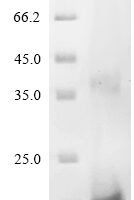
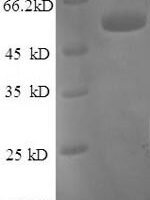
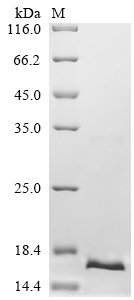
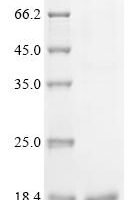
PurityGreater than 90% as determined by SDS-PAGE.
Expression SystemE.coli
Expression Region1-108aa
SpeciesHomo sapiens (Human)
Tag InfoN-terminal 6xHis-tagged
Molecular weight16.4kDa
ActivityPlease contact us to obtain bioactivity data.
BufferIf the delivery form is liquid, the default storage buffer is Tris/PBS-based buffer, 5%-50% glycerol. If the delivery form is lyophilized powder, the buffer before lyophilization is Tris/PBS-based buffer, 6% Trehalose.
StorageStore at -20°C/-80°C upon receipt, aliquoting is necessary for mutiple use. Avoid repeated freeze-thaw cycles.
Research AreasImmunology

Function

Core component of RNA polymerase III (Pol III) which synthesizes small non-coding RNAs using the four ribonucleoside triphosphates as substrates. Can mediate Pol I proofreading of the nascent RNA transcript. Anchors into the Pol III active site to constantly monitor transcription fidelity, cleaves mis-incorporated 5'-ribonucleotides and restarts the transcription process.

Biological Context

Subcellular Location: Nucleus
Disease Association: Leukodystrophy, hypomyelinating, 21 (HLD21) : An autosomal recessive neurodegenerative disorder characterized by global developmental delay, loss of motor, speech and cognitive milestones in the first decades of life, and diffuse hypomyelination of the white matter and atrophy of the cerebellum and corpus callosum observed on brain imaging. Clinical features include nystagmus, ataxia, dystonia, and spasticity. Other more variable features are feeding difficulties, poor overall growth with microcephaly, optic atrophy, and seizures. The disorder is progressive and may lead to premature death. [The disease is caused by variants affecting the gene represented in this entry]

Product Specifications

Recombinant Human DNA-directed RNA polymerase III subunit RPC10 (POLR3K) is a recombinant protein from Homo sapiens (Human), expressed in E.coli, covering amino acids 1-108aa, with N-terminal 6xHis-tagged tag, molecular weight 16.4kDa, purity Greater than 90% as determined by SDS-PAGE.. Suitable for ELISA and Western Blot applications.

Recommended applications depend on the target, product format, and product-specific validation data. Refer to the product datasheet or Certificate of Analysis (CoA), or contact BioCrest Sci for application guidance.

Biological Activity: Please contact us to obtain bioactivity data.

Storage: Store at -20°C/-80°C upon receipt, aliquoting is necessary for mutiple use. Avoid repeated freeze-thaw cycles.

Shipping & Lead Time: Availability, shipping conditions, and estimated lead time are confirmed in the formal quotation or order confirmation based on the product format, destination, and order requirements.

Protein Biology

Function

Core component of RNA polymerase III (Pol III) which synthesizes small non-coding RNAs using the four ribonucleoside triphosphates as substrates (PubMed:20413673, PubMed:30584594, PubMed:33335104, PubMed:33558764, PubMed:33558766, PubMed:33674783, PubMed:34675218). Can mediate Pol I proofreading of the nascent RNA transcript. Anchors into the Pol III active site to constantly monitor transcription fidelity, cleaves mis-incorporated 5'-ribonucleotides and restarts the transcription process. Once Pol III reaches the poly(dT) termination signal, can induce Pol III clamp opening and transcription termination (By similarity) (PubMed:33335104, PubMed:33558764, PubMed:33558766, PubMed:33674783, PubMed:34675218). Pol III plays an important role in sensing and limiting infection by intracellular bacteria and DNA viruses. Acts as a nuclear and cytosolic DNA sensor involved in innate immune response. Can sense non-self dsDNA that serves as template for transcription into dsRNA. The non-self RNA polymerase III transcripts, such as Epstein-Barr virus-encoded RNAs (EBERs) induce type I interferon and NF-kappa-B through the RIG-I pathway (PubMed:19609254, PubMed:19631370)

Subcellular Location

Nucleus

Disease Association

Leukodystrophy, hypomyelinating, 21 (HLD21) : An autosomal recessive neurodegenerative disorder characterized by global developmental delay, loss of motor, speech and cognitive milestones in the first decades of life, and diffuse hypomyelination of the white matter and atrophy of the cerebellum and corpus callosum observed on brain imaging. Clinical features include nystagmus, ataxia, dystonia, and spasticity. Other more variable features are feeding difficulties, poor overall growth with microcephaly, optic atrophy, and seizures. The disorder is progressive and may lead to premature death. [The disease is caused by variants affecting the gene represented in this entry]

Subunit

Component of the RNA polymerase III complex consisting of 17 subunits: a ten-subunit horseshoe-shaped catalytic core composed of POLR3A/RPC1, POLR3B/RPC2, POLR1C/RPAC1, POLR1D/RPAC2, POLR3K/RPC10, POLR2E/RPABC1, POLR2F/RPABC2, POLR2H/RPABC3, POLR2K/RPABC4 and POLR2L/RPABC5; a mobile stalk composed of two subunits POLR3H/RPC8 and CRCP/RPC9, protruding from the core and functioning primarily in transcription initiation; and additional subunits homologous to general transcription factors of the RNA polymerase II machinery, POLR3C/RPC3-POLR3F/RPC6-POLR3G/RPC7 heterotrimer required for transcription initiation and POLR3D/RPC4-POLR3E/RPC5 heterodimer involved in both transcription initiation and termination

Gene: POLR3K  |  Organism: Homo sapiens  |  Synonyms: DNA-directed RNA polymerase III subunit K; RNA polymerase III 12.5 kDa subunit; RNA polymerase III subunit C11
Key Publications

Frequently Asked Questions

How do I order or inquire about this product?

Submit the Online Inquiry form with your required quantity and specifications, or email sales@biocrestsci.com. Available sizes, pricing, stock status, documentation, and estimated lead time are confirmed in the formal quotation.

What is the shipping and delivery time?

Availability, dispatch timing, shipping conditions, and delivery estimates depend on the product format, destination, and order requirements. These details are confirmed in the formal quotation or order confirmation.

How should this product be stored?

Follow the storage and handling instructions in the product-specific datasheet and Certificate of Analysis (CoA). Requirements may vary by product form and formulation; contact BioCrest Sci if product-specific guidance is needed.

What quality controls are performed on your products?

Quality-control data such as identity, purity, endotoxin level, or biological activity are provided only when specified on this product page, the datasheet, or Certificate of Analysis (CoA). Biological activity is not implied unless explicitly stated.

Shopping Cart
Scroll to Top