Recombinant Human Double homeobox protein 4 (DUX4), partial

Recombinant Human Double homeobox protein 4 (DUX4), partial — Probably inactive as a transcriptional activator, due to the absence of the C-terminal region that is important for transcriptional activation. Purity >90%.

SKU: BCRECP-000549 Category:

Product Specifications

Product SkuBCRECP-000549
Product DescriptionRecombinant Human Double homeobox protein 4 (DUX4) Protein is expressed from Yeast with C-terminal 6xHis-tagged. It contains 327-424aa. [Accession | Q9UBX2].
Uniprot No.Q9UBX2
Gene NamesDUX4
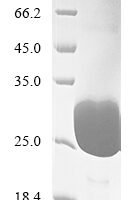
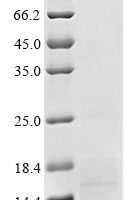
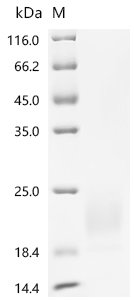
PurityGreater than 90% as determined by SDS-PAGE.
Expression SystemYeast
Expression Region327-424aa
SpeciesHomo sapiens (Human)
Tag InfoC-terminal 6xHis-tagged
Molecular weight11.7kDa
ActivityPlease contact us to obtain bioactivity data.
BufferIf the delivery form is liquid, the default storage buffer is Tris/PBS-based buffer, 5%-50% glycerol. If the delivery form is lyophilized powder, the buffer before lyophilization is Tris/PBS-based buffer, 6% Trehalose.
StorageStore at -20°C/-80°C upon receipt, aliquoting is necessary for mutiple use. Avoid repeated freeze-thaw cycles.
Research AreasStem Cells

Function

Probably inactive as a transcriptional activator, due to the absence of the C-terminal region that is important for transcriptional activation. Can inhibit transcriptional activation mediated by isoform 1. Heterologous expression of isoform 2 has no deleterious effect on cell survival.

Biological Context

Subcellular Location: Nucleus
Tissue Specificity: Isoform 1: Does not seem to be expressed in normal muscle, but is detected in muscle of individuals with FSHD, and also in testis (at protein level). Isoform 1: Does not seem to be expressed in normal muscle, but in muscle of individuals with FSHD, where it may be toxic to cells. Isoform 2: Detected in skeletal muscle, fibroblasts and testis from healthy individuals
Disease Association: Facioscapulohumeral muscular dystrophy 1 (FSHD1) : A degenerative muscle disease characterized by slowly progressive weakness of the muscles of the face, upper-arm, and shoulder girdle. The onset of symptoms usually occurs in the first or second decade of life. Affected individuals usually present with impairment of upper extremity elevation. This tends to be followed by facial weakness, primarily involving the orbicularis oris and orbicularis oculi muscles. [The gene represented in this entry is involved in disease pathogenesis. The disease is caused by deletion of an integral number of units of a 3.3-kb tandem repeats, termed D4Z4 macrosatellite, located on chromosome 4q35. In unaffected subjects, the D4Z4 array consists of 11-150 repeats, while in FSHD1 patients, the array is reduced to 1-10 repeats. DUX4 is located in D4Z4 macrosatellite which is epigenetically repressed in somatic tissues. D4Z4 chromatin relaxation in FSHD1 results in inefficient epigenetic repression of DUX4 and a variegated pattern of DUX4 protein expression in a subset of skeletal muscle nuclei. Ectopic expression of DUX4 in skeletal muscle activates the expression of stem cell and germline genes, and, when overexpressed in somatic cells, DUX4 can ultimately lead to cell death]

Product Specifications

Recombinant Human Double homeobox protein 4 (DUX4), partial is a recombinant protein from Homo sapiens (Human), expressed in Yeast, covering amino acids 327-424aa, with C-terminal 6xHis-tagged tag, molecular weight 11.7kDa, purity Greater than 90% as determined by SDS-PAGE.. Suitable for ELISA and Western Blot applications.
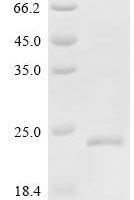
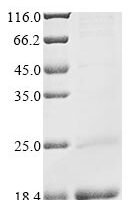
SDS-PAGE: Single band at expected molecular weight confirming purity.

ELISA: Suitable as coating antigen or detection standard.

Western Blot: Compatible with standard Western Blot protocols.

Protein Interaction: Validated for SPR (Surface Plasmon Resonance) and BLI (Bio-Layer Interferometry) studies.

Shipping: Shipped at ambient temperature. Lyophilized protein is stable during transit.

Storage: Store lyophilized protein at -20°C to -80°C. Reconstituted protein should be aliquoted and stored at -80°C. Avoid repeated freeze-thaw cycles.

Shelf Life: 12 months from date of receipt when stored as recommended.

Shipping Time: Orders placed before 2 PM EST ship same day. International orders typically deliver within 5-10 business days.

Protein Biology

Function

Probably inactive as a transcriptional activator, due to the absence of the C-terminal region that is important for transcriptional activation. Can inhibit transcriptional activation mediated by isoform 1. Heterologous expression of isoform 2 has no deleterious effect on cell survival

Subcellular Location

Nucleus

Disease Association

Facioscapulohumeral muscular dystrophy 1 (FSHD1) : A degenerative muscle disease characterized by slowly progressive weakness of the muscles of the face, upper-arm, and shoulder girdle. The onset of symptoms usually occurs in the first or second decade of life. Affected individuals usually present with impairment of upper extremity elevation. This tends to be followed by facial weakness, primarily involving the orbicularis oris and orbicularis oculi muscles. [The gene represented in this entry is involved in disease pathogenesis. The disease is caused by deletion of an integral number of units of a 3.3-kb tandem repeats, termed D4Z4 macrosatellite, located on chromosome 4q35. In unaffected subjects, the D4Z4 array consists of 11-150 repeats, while in FSHD1 patients, the array is reduced to 1-10 repeats (PubMed:19320656). DUX4 is located in D4Z4 macrosatellite which is epigenetically repressed in somatic tissues. D4Z4 chromatin relaxation in FSHD1 results in inefficient epigenetic repression of DUX4 and a variegated pattern of DUX4 protein expression in a subset of skeletal muscle nuclei. Ectopic expression of DUX4 in skeletal muscle activates the expression of stem cell and germline genes, and, when overexpressed in somatic cells, DUX4 can ultimately lead to cell death]

Tissue Specificity

Isoform 1: Does not seem to be expressed in normal muscle, but is detected in muscle of individuals with FSHD, and also in testis (at protein level) (PubMed:17984056, PubMed:21060811). Isoform 1: Does not seem to be expressed in normal muscle, but in muscle of individuals with FSHD, where it may be toxic to cells (PubMed:17984056, PubMed:21060811). Isoform 2: Detected in skeletal muscle, fibroblasts and testis from healthy individuals (PubMed:21060811)

Subunit

Binds DNA as a monomer (PubMed:30322619, PubMed:30540931). Interacts (via C-terminus) with EP300 and CREBBP (PubMed:26951377)

Gene: DUX4  |  Organism: Homo sapiens  |  Synonyms: Double homeobox protein 10
Key Publications

Frequently Asked Questions

How do I order or inquire about this product?

Fill out the Online Inquiry form with your required quantity and specifications. You can also email sales@biocrestsci.com. Our team typically responds within 4 business hours with a quote and availability confirmation.

What is the shipping and delivery time?

Orders placed before 2 PM EST ship the same day. Domestic (US) delivery typically takes 2-3 business days. International orders deliver within 5-10 business days. All products are shipped at ambient temperature with appropriate packaging to ensure stability.

How should I store this recombinant protein?

Lyophilized proteins should be stored at -20°C to -80°C upon receipt. After reconstitution, aliquot and store at -80°C. Avoid repeated freeze-thaw cycles. Shelf life is 12 months from date of receipt when stored as recommended.

What quality controls are performed on your products?

Each product undergoes SDS-PAGE purity analysis (typically >85-95%), endotoxin testing, and bioactivity validation. Products are validated for ELISA, Western Blot, and SPR/BLI applications as specified on this product page. A Certificate of Analysis (CoA) is available upon request.

Shopping Cart
Scroll to Top