Recombinant Human Double-stranded RNA-specific adenosine deaminase (ADAR), partial

Recombinant Human Double-stranded RNA-specific adenosine deaminase (ADAR), partial — Catalyzes the hydrolytic deamination of adenosine to inosine in double-stranded RNA (dsRNA) referred to as A-to-I RNA editing. Purity >85%.

SKU: BCRECP-000038 Category:

Product Specifications

Product SkuBCRECP-000038
Product DescriptionRecombinant Human Double-stranded RNA-specific adenosine deaminase (ADAR) Protein is expressed from E.coli with N-terminal 6xHis-tagged. It contains 1-176aa. [Accession | P55265].
Uniprot No.P55265
Gene NamesADAR
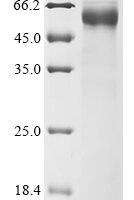
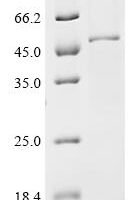
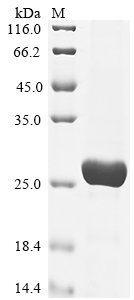
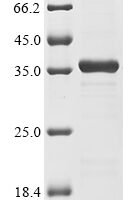
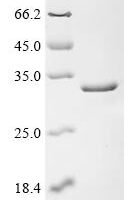
PurityGreater than 85% as determined by SDS-PAGE.
Expression SystemE.coli
Expression Region1-176aa
SpeciesHomo sapiens (Human)
Tag InfoN-terminal 6xHis-tagged
Molecular weight23.8kDa
ActivityPlease contact us to obtain bioactivity data.
BufferIf the delivery form is liquid, the default storage buffer is Tris/PBS-based buffer, 5%-50% glycerol. If the delivery form is lyophilized powder, the buffer before lyophilization is Tris/PBS-based buffer, 6% Trehalose.
StorageStore at -20°C/-80°C upon receipt, aliquoting is necessary for mutiple use. Avoid repeated freeze-thaw cycles.
Research AreasEpigenetics and Nuclear Signaling

Function

Catalyzes the hydrolytic deamination of adenosine to inosine in double-stranded RNA (dsRNA) referred to as A-to-I RNA editing. This may affect gene expression and function in a number of ways that include mRNA translation by changing codons and hence the amino acid sequence of proteins since the translational machinery read the inosine as a guanosine; pre-mRNA splicing by altering splice site recognition sequences; RNA stability by changing sequences involved in nuclease recognition; genetic stability in the case of RNA virus genomes by changing sequences during viral RNA replication; and RNA structure-dependent activities such as microRNA production or targeting or protein-RNA interactions. Can edit both viral and cellular RNAs and can edit RNAs at multiple sites (hyper-editing) or at specific sites (site-specific editing).

Biological Context

Subcellular Location: Cytoplasm; Nucleus; Nucleus, nucleolus
Tissue Specificity: Ubiquitously expressed, highest levels were found in brain and lung. Isoform 5 is expressed at higher levels in astrocytomas as compared to normal brain tissue and expression increases strikingly with the severity of the tumor, being higher in the most aggressive tumors
Disease Association: Dyschromatosis symmetrica hereditaria (DSH) : An autosomal dominant pigmentary genodermatosis characterized by a mixture of hyperpigmented and hypopigmented macules distributed on the face and the dorsal parts of the hands and feet, that appear in infancy or early childhood. [The disease is caused by variants affecting the gene represented in this entry] | Aicardi-Goutieres syndrome 6 (AGS6) : A form of Aicardi-Goutieres syndrome, a genetically heterogeneous disease characterized by cerebral atrophy, leukoencephalopathy, intracranial calcifications, chronic cerebrospinal fluid (CSF) lymphocytosis, increased CSF alpha-interferon, and negative serologic investigations for common prenatal infection. Clinical features as thrombocytopenia, hepatosplenomegaly and elevated hepatic transaminases along with intermittent fever may erroneously suggest an infective process. Severe neurological dysfunctions manifest in infancy as progressive microcephaly, spasticity, dystonic posturing and profound psychomotor retardation. Death often occurs in early childhood. [The disease is caused by variants affecting the gene represented in this entry]

Product Specifications

Recombinant Human Double-stranded RNA-specific adenosine deaminase (ADAR), partial is a recombinant protein from Homo sapiens (Human), expressed in E.coli, covering amino acids 1-176aa, with N-terminal 6xHis-tagged tag, molecular weight 23.8kDa, purity Greater than 85% as determined by SDS-PAGE.. Suitable for ELISA and Western Blot applications.
Recommended applications depend on the target, product format, and product-specific validation data. Refer to the product datasheet or Certificate of Analysis (CoA), or contact BioCrest Sci for application guidance.

Biological Activity: Please contact us to obtain bioactivity data.

Storage: Store at -20°C/-80°C upon receipt, aliquoting is necessary for mutiple use. Avoid repeated freeze-thaw cycles.

Shipping & Lead Time: Availability, shipping conditions, and estimated lead time are confirmed in the formal quotation or order confirmation based on the product format, destination, and order requirements.

Protein Biology

Function

Catalyzes the hydrolytic deamination of adenosine to inosine in double-stranded RNA (dsRNA) referred to as A-to-I RNA editing (PubMed:12618436, PubMed:7565688, PubMed:7972084). This may affect gene expression and function in a number of ways that include mRNA translation by changing codons and hence the amino acid sequence of proteins since the translational machinery read the inosine as a guanosine; pre-mRNA splicing by altering splice site recognition sequences; RNA stability by changing sequences involved in nuclease recognition; genetic stability in the case of RNA virus genomes by changing sequences during viral RNA replication; and RNA structure-dependent activities such as microRNA production or targeting or protein-RNA interactions. Can edit both viral and cellular RNAs and can edit RNAs at multiple sites (hyper-editing) or at specific sites (site-specific editing). Its cellular RNA substrates include: bladder cancer-associated protein (BLCAP), neurotransmitter receptors for glutamate (GRIA2) and serotonin (HTR2C) and GABA receptor (GABRA3). Site-specific RNA editing of transcripts encoding these proteins results in amino acid substitutions which consequently alters their functional activities. Exhibits low-level editing at the GRIA2 Q/R site, but edits efficiently at the R/G site and HOTSPOT1. Its viral RNA substrates include: hepatitis C virus (HCV), vesicular stomatitis virus (VSV), measles virus (MV), hepatitis delta virus (HDV), and human immunodeficiency virus type 1 (HIV-1). Exhibits either a proviral (HDV, MV, VSV and HIV-1) or an antiviral effect (HCV) and this can be editing-dependent (HDV and HCV), editing-independent (VSV and MV) or both (HIV-1). Impairs HCV replication via RNA editing at multiple sites. Enhances the replication of MV, VSV and HIV-1 through an editing-independent mechanism via suppression of EIF2AK2/PKR activation and function. Stimulates both the release and infectivity of HIV-1 viral particles by an editing-dependent mechanism where it associates with viral RNAs and edits adenosines in the 5'UTR and the Rev and Tat coding sequence. Can enhance viral replication of HDV via A-to-I editing at a site designated as amber/W, thereby changing an UAG amber stop codon to an UIG tryptophan (W) codon that permits synthesis of the large delta antigen (L-HDAg) which has a key role in the assembly of viral particles. However, high levels of ADAR1 inhibit HDV replication

Subcellular Location

Cytoplasm; Nucleus; Nucleus, nucleolus

Disease Association

Dyschromatosis symmetrica hereditaria (DSH) : An autosomal dominant pigmentary genodermatosis characterized by a mixture of hyperpigmented and hypopigmented macules distributed on the face and the dorsal parts of the hands and feet, that appear in infancy or early childhood. [The disease is caused by variants affecting the gene represented in this entry] | Aicardi-Goutieres syndrome 6 (AGS6) : A form of Aicardi-Goutieres syndrome, a genetically heterogeneous disease characterized by cerebral atrophy, leukoencephalopathy, intracranial calcifications, chronic cerebrospinal fluid (CSF) lymphocytosis, increased CSF alpha-interferon, and negative serologic investigations for common prenatal infection. Clinical features as thrombocytopenia, hepatosplenomegaly and elevated hepatic transaminases along with intermittent fever may erroneously suggest an infective process. Severe neurological dysfunctions manifest in infancy as progressive microcephaly, spasticity, dystonic posturing and profound psychomotor retardation. Death often occurs in early childhood. [The disease is caused by variants affecting the gene represented in this entry]

Tissue Specificity

Ubiquitously expressed, highest levels were found in brain and lung (PubMed:7972084). Isoform 5 is expressed at higher levels in astrocytomas as compared to normal brain tissue and expression increases strikingly with the severity of the tumor, being higher in the most aggressive tumors

Subunit

Homodimer. Homodimerization is essential for its catalytic activity (PubMed:12618436). Isoform 5 can form heterodimers with ADARB1/ADAR2. Isoform 1 interacts with ILF2/NF45 and ILF3/NF90 (PubMed:16055709). Binding to ILF3/NF90 up-regulates ILF3-mediated gene expression. Isoform 1 and isoform 5 (via DRBM 3 domain) interact with TNPO1 (PubMed:19124606, PubMed:24753571). Isoform 5 (via DRBM domains) interacts with XPO5 (PubMed:19124606). Isoform 1 and isoform 5 can interact with EIF2AK2/PKR and UPF1 (PubMed:17079286, PubMed:18362360)

Gene: ADAR  |  Organism: Homo sapiens  |  Synonyms: 136 kDa double-stranded RNA-binding protein; Interferon-inducible protein 4; K88DSRBP
Key Publications

Frequently Asked Questions

How do I order or inquire about this product?

Submit the Online Inquiry form with your required quantity and specifications, or email sales@biocrestsci.com. Available sizes, pricing, stock status, documentation, and estimated lead time are confirmed in the formal quotation.

What is the shipping and delivery time?

Availability, dispatch timing, shipping conditions, and delivery estimates depend on the product format, destination, and order requirements. These details are confirmed in the formal quotation or order confirmation.

How should this product be stored?

Follow the storage and handling instructions in the product-specific datasheet and Certificate of Analysis (CoA). Requirements may vary by product form and formulation; contact BioCrest Sci if product-specific guidance is needed.

What quality controls are performed on your products?

Quality-control data such as identity, purity, endotoxin level, or biological activity are provided only when specified on this product page, the datasheet, or Certificate of Analysis (CoA). Biological activity is not implied unless explicitly stated.

Shopping Cart
Scroll to Top