Recombinant Human Dystonin (DST), partial

Recombinant Human Dystonin (DST), partial — recombinant protein from Homo sapiens (Human), expressed in E.coli. Purity >90%.

SKU: BCRECP-000544 Category:

Product Specifications

Product SkuBCRECP-000544
Product DescriptionRecombinant Human Dystonin (DST) Protein is expressed from E.coli with N-terminal 6xHis-SUMO-tagged. It contains 1-195aa. [Accession | Q03001].
Uniprot No.Q03001
Gene NamesDST
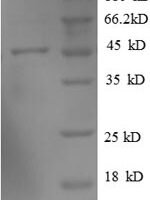
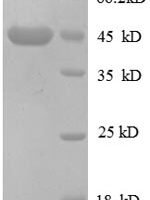
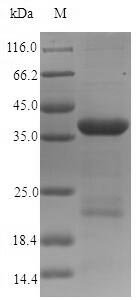
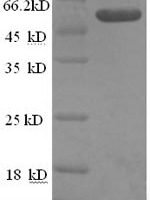
PurityGreater than 90% as determined by SDS-PAGE.
Expression SystemE.coli
Expression Region1-195aa
SpeciesHomo sapiens (Human)
Tag InfoN-terminal 6xHis-SUMO-tagged
Molecular weight39.1kDa
ActivityPlease contact us to obtain bioactivity data.
BufferIf the delivery form is liquid, the default storage buffer is Tris/PBS-based buffer, 5%-50% glycerol. If the delivery form is lyophilized powder, the buffer before lyophilization is Tris/PBS-based buffer, 6% Trehalose.
StorageStore at -20°C/-80°C upon receipt, aliquoting is necessary for mutiple use. Avoid repeated freeze-thaw cycles.
Research AreasSignal Transduction

Function

Regulates the organization and stability of the microtubule network of sensory neurons to allow axonal transport.

Biological Context

Subcellular Location: Cytoplasm, cytoskeleton; Cytoplasm, cell cortex; Cell membrane (Lipid-anchor)
Tissue Specificity: Isoform 1 is expressed in myoblasts (at protein level). Isoform 3 is expressed in the skin. Isoform 6 is expressed in the brain. Highly expressed in skeletal muscle and cultured keratinocytes
Disease Association: Neuropathy, hereditary sensory and autonomic, 6 (HSAN6) : A form of hereditary sensory and autonomic neuropathy, a genetically and clinically heterogeneous group of disorders characterized by degeneration of dorsal root and autonomic ganglion cells, and by sensory and/or autonomic abnormalities. HSAN6 is a severe autosomal recessive disorder characterized by neonatal hypotonia, respiratory and feeding difficulties, lack of psychomotor development, and autonomic abnormalities including labile cardiovascular function, lack of corneal reflexes leading to corneal scarring, areflexia, and absent axonal flare response after intradermal histamine injection. [The disease is caused by variants affecting the gene represented in this entry] | Epidermolysis bullosa simplex 3, localized or generalized intermediate, with BP230 deficiency (EBS3) : A form of epidermolysis bullosa, a genodermatosis characterized by recurrent blistering, fragility of the skin and mucosal epithelia, and erosions caused by minor mechanical trauma. EBS3 is an autosomal recessive disorder characterized by skin blistering mainly occurring on the feet and ankles. Ultrastructural analysis of skin biopsy shows abnormal hemidesmosomes with poorly formed inner plaques. [The disease is caused by variants affecting the gene represented in this entry]

Product Specifications

Recombinant Human Dystonin (DST), partial is a recombinant protein from Homo sapiens (Human), expressed in E.coli, covering amino acids 1-195aa, with N-terminal 6xHis-SUMO-tagged tag, molecular weight 39.1kDa, purity Greater than 90% as determined by SDS-PAGE.. Suitable for ELISA and Western Blot applications.

Recommended applications depend on the target, product format, and product-specific validation data. Refer to the product datasheet or Certificate of Analysis (CoA), or contact BioCrest Sci for application guidance.

Biological Activity: Please contact us to obtain bioactivity data.

Storage: Store at -20°C/-80°C upon receipt, aliquoting is necessary for mutiple use. Avoid repeated freeze-thaw cycles.

Shipping & Lead Time: Availability, shipping conditions, and estimated lead time are confirmed in the formal quotation or order confirmation based on the product format, destination, and order requirements.

Protein Biology

Function

Regulates the organization and stability of the microtubule network of sensory neurons to allow axonal transport

Subcellular Location

Cytoplasm, cytoskeleton; Cytoplasm, cell cortex; Cell membrane (Lipid-anchor)

Disease Association

Neuropathy, hereditary sensory and autonomic, 6 (HSAN6) : A form of hereditary sensory and autonomic neuropathy, a genetically and clinically heterogeneous group of disorders characterized by degeneration of dorsal root and autonomic ganglion cells, and by sensory and/or autonomic abnormalities. HSAN6 is a severe autosomal recessive disorder characterized by neonatal hypotonia, respiratory and feeding difficulties, lack of psychomotor development, and autonomic abnormalities including labile cardiovascular function, lack of corneal reflexes leading to corneal scarring, areflexia, and absent axonal flare response after intradermal histamine injection. [The disease is caused by variants affecting the gene represented in this entry] | Epidermolysis bullosa simplex 3, localized or generalized intermediate, with BP230 deficiency (EBS3) : A form of epidermolysis bullosa, a genodermatosis characterized by recurrent blistering, fragility of the skin and mucosal epithelia, and erosions caused by minor mechanical trauma. EBS3 is an autosomal recessive disorder characterized by skin blistering mainly occurring on the feet and ankles. Ultrastructural analysis of skin biopsy shows abnormal hemidesmosomes with poorly formed inner plaques. [The disease is caused by variants affecting the gene represented in this entry]

Tissue Specificity

Isoform 1 is expressed in myoblasts (at protein level). Isoform 3 is expressed in the skin. Isoform 6 is expressed in the brain. Highly expressed in skeletal muscle and cultured keratinocytes

Subunit

Homodimer. Isoform 1 interacts (via N-terminus) with PLEC (via N-terminus). Interacts with the neuronal intermediate filament protein, PRPH. Interacts with DES. Interacts with SYNE3 (By similarity). Isoform 1 and isoform 6 can homodimerize (via N-terminus). Isoform 1 interacts (via N-terminus) with ACTN2. Isoform 1 interacts (via N-terminus) with PLEC (via N-terminus). Isoform 3 interacts (via N-terminus) with COL17A1 (via cytoplasmic region). Isoform 3 interacts (via N-terminus) with ITGB4 isoform beta-4a (via cytoplasmic region). Isoform 3 interacts (via N-terminus) with ERBIN (via C-terminus). Isoform 3 associates (via C-terminal) with KRT5-KRT14 (via rod region) intermediate filaments of keratins. Interacts with MAPRE1; probably required for targeting to the growing microtubule plus ends. Interacts with TMIGD2. Isoform 9 interacts with TMEM108 (By similarity)

Gene: DST  |  Organism: Homo sapiens  |  Synonyms: 230 kDa bullous pemphigoid antigen; 230/240 kDa bullous pemphigoid antigen; Bullous pemphigoid antigen 1; Dystonia musculorum protein; Hemidesmosomal plaque protein
Key Publications

Frequently Asked Questions

How do I order or inquire about this product?

Submit the Online Inquiry form with your required quantity and specifications, or email sales@biocrestsci.com. Available sizes, pricing, stock status, documentation, and estimated lead time are confirmed in the formal quotation.

What is the shipping and delivery time?

Availability, dispatch timing, shipping conditions, and delivery estimates depend on the product format, destination, and order requirements. These details are confirmed in the formal quotation or order confirmation.

How should this product be stored?

Follow the storage and handling instructions in the product-specific datasheet and Certificate of Analysis (CoA). Requirements may vary by product form and formulation; contact BioCrest Sci if product-specific guidance is needed.

What quality controls are performed on your products?

Quality-control data such as identity, purity, endotoxin level, or biological activity are provided only when specified on this product page, the datasheet, or Certificate of Analysis (CoA). Biological activity is not implied unless explicitly stated.

Shopping Cart
Scroll to Top