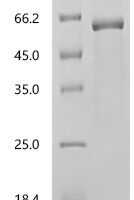
,

Recombinant Human E3 ubiquitin-protein ligase TRIM21 (TRIM21)

Recombinant Human E3 ubiquitin-protein ligase TRIM21 (TRIM21) — E3 ubiquitin-protein ligase whose activity is dependent on E2 enzymes, UBE2D1, UBE2D2, UBE2E1 and UBE2E2. Purity >90%.

SKU: BCRECP-001848 Categories: ,

Product Specifications

Product SkuBCRECP-001848
Product DescriptionRecombinant Human E3 ubiquitin-protein ligase TRIM21 (TRIM21) Protein is expressed from Baculovirus with C-terminal 6xHis-tagged. It contains 1-475aa. [Accession | P19474].
Uniprot No.P19474
Gene NamesTRIM21
PurityGreater than 90% as determined by SDS-PAGE.
Expression SystemBaculovirus
Expression Region1-475aa
SpeciesHomo sapiens (Human)
Tag InfoC-terminal 6xHis-tagged
Molecular weight57.7kDa
ActivityPlease contact us to obtain bioactivity data.
BufferIf the delivery form is liquid, the default storage buffer is Tris/PBS-based buffer, 5%-50% glycerol. If the delivery form is lyophilized powder, the buffer before lyophilization is Tris/PBS-based buffer, 6% Trehalose.
StorageStore at -20°C/-80°C upon receipt, aliquoting is necessary for mutiple use. Avoid repeated freeze-thaw cycles.
Research AreasEpigenetics and Nuclear Signaling

Function

E3 ubiquitin-protein ligase whose activity is dependent on E2 enzymes, UBE2D1, UBE2D2, UBE2E1 and UBE2E2. Forms a ubiquitin ligase complex in cooperation with the E2 UBE2D2 that is used not only for the ubiquitination of USP4 and IKBKB but also for its self-ubiquitination. Component of cullin-RING-based SCF (SKP1-CUL1-F-box protein) E3 ubiquitin-protein ligase complexes such as SCF(SKP2)-like complexes.

Biological Context

Subcellular Location: Cytoplasm; Cytoplasmic vesicle, autophagosome; Nucleus; Cytoplasm, P-body; Cytoplasm, Stress granule
Tissue Specificity: Isoform 1 and isoform 2 are expressed in fetal and adult heart and fetal lung
Pathway: Protein modification; protein ubiquitination

Product Specifications

Recombinant Human E3 ubiquitin-protein ligase TRIM21 (TRIM21) is a recombinant protein from Homo sapiens (Human), expressed in Baculovirus, covering amino acids 1-475aa, with C-terminal 6xHis-tagged tag, molecular weight 57.7kDa, purity Greater than 90% as determined by SDS-PAGE.. Suitable for ELISA and Western Blot applications.

Recommended applications depend on the target, product format, and product-specific validation data. Refer to the product datasheet or Certificate of Analysis (CoA), or contact BioCrest Sci for application guidance.

Biological Activity: Please contact us to obtain bioactivity data.

Storage: Store at -20°C/-80°C upon receipt, aliquoting is necessary for mutiple use. Avoid repeated freeze-thaw cycles.

Shipping & Lead Time: Availability, shipping conditions, and estimated lead time are confirmed in the formal quotation or order confirmation based on the product format, destination, and order requirements.

Protein Biology

Function

E3 ubiquitin-protein ligase whose activity is dependent on E2 enzymes, UBE2D1, UBE2D2, UBE2E1 and UBE2E2 (PubMed:16297862, PubMed:16316627, PubMed:16472766, PubMed:16880511, PubMed:18022694, PubMed:18361920, PubMed:18641315, PubMed:18845142, PubMed:19675099, PubMed:26347139). Forms a ubiquitin ligase complex in cooperation with the E2 UBE2D2 that is used not only for the ubiquitination of USP4 and IKBKB but also for its self-ubiquitination (PubMed:16880511, PubMed:19675099). Component of cullin-RING-based SCF (SKP1-CUL1-F-box protein) E3 ubiquitin-protein ligase complexes such as SCF(SKP2)-like complexes (PubMed:16880511). A TRIM21-containing SCF(SKP2)-like complex is shown to mediate ubiquitination of CDKN1B ('Thr-187' phosphorylated-form), thereby promoting its degradation by the proteasome (PubMed:16880511). Monoubiquitinates IKBKB that will negatively regulates Tax-induced NF-kappa-B signaling (PubMed:19675099). Negatively regulates IFN-beta production post-pathogen recognition by catalyzing polyubiquitin-mediated degradation of IRF3 (PubMed:18641315). Mediates the ubiquitin-mediated proteasomal degradation of IgG1 heavy chain, which is linked to the VCP-mediated ER-associated degradation (ERAD) pathway (PubMed:18022694). Promotes IRF8 ubiquitination, which enhanced the ability of IRF8 to stimulate cytokine genes transcription in macrophages (By similarity). Plays a role in the regulation of the cell cycle progression (PubMed:16880511). Enhances the decapping activity of DCP2 (PubMed:18361920). Exists as a ribonucleoprotein particle present in all mammalian cells studied and composed of a single polypeptide and one of four small RNA molecules (PubMed:1985094, PubMed:8666824). At least two isoforms are present in nucleated and red blood cells, and tissue specific differences in RO/SSA proteins have been identified (PubMed:8666824). The common feature of these proteins is their ability to bind HY RNAs.2 (PubMed:8666824). Involved in the regulation of innate immunity and the inflammatory response in response to IFNG/IFN-gamma (PubMed:26347139). Organizes autophagic machinery by serving as a platform for the assembly of ULK1, Beclin 1/BECN1 and ATG8 family members and recognizes specific autophagy targets, thus coordinating target recognition with assembly of the autophagic apparatus and initiation of autophagy (PubMed:26347139). Also regulates autophagy through FIP200/RB1CC1 ubiquitination and subsequent decreased protein stability (PubMed:36359729). Represses the innate antiviral response by facilitating the formation of the NMI-IFI35 complex through 'Lys-63'-linked ubiquitination of NMI (PubMed:26342464). During viral infection, promotes cell pyroptosis by mediating 'Lys-6'-linked ubiquitination of ISG12a/IFI27, facilitating its translocation into the mitochondria and subsequent CASP3 activation (PubMed:36426955). When up-regulated through the IFN/JAK/STAT signaling pathway, promotes 'Lys-27'-linked ubiquitination of MAVS, leading to the recruitment of TBK1 and up-regulation of innate immunity (PubMed:29743353). Mediates 'Lys-63'-linked polyubiquitination of G3BP1 in response to heat shock, leading to stress granule disassembly (PubMed:36692217)

Subcellular Location

Cytoplasm; Cytoplasmic vesicle, autophagosome; Nucleus; Cytoplasm, P-body; Cytoplasm, Stress granule

Tissue Specificity

Isoform 1 and isoform 2 are expressed in fetal and adult heart and fetal lung

Subunit

(Microbial infection) Interacts (via B30.2/SPRY domain) with severe fever with thrombocytopenia syndrome virus (SFTSV) NSs; this interaction activates NFE2L2-mediated transcriptional activation of antioxidant genes

Pathway

Protein modification; protein ubiquitination

Gene: TRIM21  |  Organism: Homo sapiens  |  Synonyms: 52 kDa Ro protein; 52 kDa ribonucleoprotein autoantigen Ro/SS-A; RING finger protein 81; Ro(SS-A); Sjoegren syndrome type A antigen; Tripartite motif-containing protein 21
Key Publications

Frequently Asked Questions

How do I order or inquire about this product?

Submit the Online Inquiry form with your required quantity and specifications, or email sales@biocrestsci.com. Available sizes, pricing, stock status, documentation, and estimated lead time are confirmed in the formal quotation.

What is the shipping and delivery time?

Availability, dispatch timing, shipping conditions, and delivery estimates depend on the product format, destination, and order requirements. These details are confirmed in the formal quotation or order confirmation.

How should this product be stored?

Follow the storage and handling instructions in the product-specific datasheet and Certificate of Analysis (CoA). Requirements may vary by product form and formulation; contact BioCrest Sci if product-specific guidance is needed.

What quality controls are performed on your products?

Quality-control data such as identity, purity, endotoxin level, or biological activity are provided only when specified on this product page, the datasheet, or Certificate of Analysis (CoA). Biological activity is not implied unless explicitly stated.

Shopping Cart
Scroll to Top