Function
Can convert androstan-3-alpha,17-beta-diol (3-alpha-diol) to androsterone in vitro, suggesting that it may participate in androgen metabolism during steroidogenesis. May act by metabolizing compounds that stimulate steroid synthesis and/or by generating metabolites that inhibit it. Has no activity toward DHEA (dehydroepiandrosterone), or A-dione (4-androste-3,17-dione), and only a slight activity toward testosterone to A-dione.
Biological Context
Subcellular Location: Endoplasmic reticulum; Lipid droplet
Tissue Specificity: Present at high level in steroidogenic cells such as syncytiotrophoblasts, sebaceous gland, Leydig cells, and granulosa cells of the dominant follicle and corpus luteum. In lung, it is detected in the ciliated epithelium and in acini of adult trachea, in bronchioles, but not in alveoli. In the eye, it is detected in the nonpigmented epithelium of the ciliary body and, at lower level, in the inner nuclear layer of the retina (at protein level). Widely expressed. Highly expressed in retina, pancreas, kidney, liver, lung, adrenal, small intestine, ovary and heart
Product Specifications
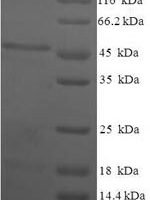
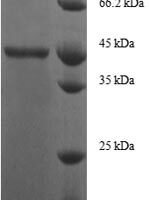
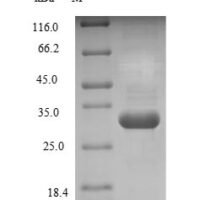
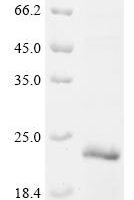
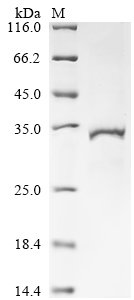
Recombinant Human Estradiol 17-beta-dehydrogenase 11 (HSD17B11) is a recombinant protein from Homo sapiens (Human), expressed in E.coli, covering amino acids 20-300aa, with N-terminal 10xHis-tagged and C-terminal Myc-tagged tag, molecular weight 35.8kDa, purity Greater than 85% as determined by SDS-PAGE.. Suitable for ELISA and Western Blot applications. Explore more Enzyme proteins →