Function
Promotes orthogonal branching of actin filaments and links actin filaments to membrane glycoproteins. Anchors various transmembrane proteins to the actin cytoskeleton and serves as a scaffold for a wide range of cytoplasmic signaling proteins. Interaction with FLNB may allow neuroblast migration from the ventricular zone into the cortical plate.
Biological Context
Subcellular Location: Cytoplasm, cell cortex; Cytoplasm, cytoskeleton; Perikaryon; Cell projection, growth cone; Cell projection, podosome
Tissue Specificity: Ubiquitous
Disease Association: Periventricular nodular heterotopia 1 (PVNH1) : A developmental disorder characterized by the presence of periventricular nodules of cerebral gray matter, resulting from a failure of neurons to migrate normally from the lateral ventricular proliferative zone, where they are formed, to the cerebral cortex. PVNH1 is an X-linked dominant form. Heterozygous females have normal intelligence but suffer from seizures and various manifestations outside the central nervous system, especially related to the vascular system. Hemizygous affected males die in the prenatal or perinatal period. [The disease is caused by variants affecting the gene represented in this entry] | Otopalatodigital syndrome 1 (OPD1) : X-linked dominant multiple congenital anomalies disease mainly characterized by a generalized skeletal dysplasia, mild intellectual disability, hearing loss, cleft palate, and typical facial anomalies. OPD1 belongs to a group of X-linked skeletal dysplasias known as oto-palato-digital syndrome spectrum disorders that also include OPD2, Melnick-Needles syndrome (MNS), and frontometaphyseal dysplasia (FMD). Remodeling of the cytoskeleton is central to the modulation of cell shape and migration. FLNA is a widely expressed protein that regulates re-organization of the actin cytoskeleton by interacting with integrins, transmembrane receptor complexes and second messengers. Males with OPD1 have cleft palate, malformations of the ossicles causing deafness and milder bone and limb defects than those associated with OPD2. Obligate female carriers of mutations causing both OPD1 and OPD2 have variable (often milder) expression of a similar phenotypic spectrum. [The disease is caused by variants affecting the gene represented in this entry] | Otopalatodigital syndrome 2 (OPD2) : Congenital bone disorder that is characterized by abnormally modeled, bowed bones, small or absent first digits and, more variably, cleft palate, posterior fossa brain anomalies, omphalocele and cardiac defects. [The disease is caused by variants affecting the gene represented in this entry] | Frontometaphyseal dysplasia 1 (FMD1) : An X-linked disease characterized by generalized skeletal dysplasia, deafness, and urogenital defects. [The disease is caused by variants affecting the gene represented in this entry] | Melnick-Needles syndrome (MNS) : Severe congenital bone disorder characterized by typical facies (exophthalmos, full cheeks, micrognathia and malalignment of teeth), flaring of the metaphyses of long bones, s-like curvature of bones of legs, irregular constrictions in the ribs, and sclerosis of base of skull. [The disease is caused by variants affecting the gene represented in this entry] | Intestinal pseudoobstruction, neuronal, chronic idiopathic, X-linked (CIIPX) : A disease characterized by a severe abnormality of gastrointestinal motility due to primary qualitative defects of enteric ganglia and nerve fibers. Affected individuals manifest recurrent signs of intestinal obstruction in the absence of any mechanical lesion. [The disease is caused by variants affecting the gene represented in this entry] | FG syndrome 2 (FGS2) : FG syndrome (FGS) is an X-linked disorder characterized by intellectual disability, relative macrocephaly, hypotonia and constipation. [The disease is caused by variants affecting the gene represented in this entry] | Terminal osseous dysplasia (TOD) : A rare X-linked dominant male-lethal disease characterized by skeletal dysplasia of the limbs, pigmentary defects of the skin and recurrent digital fibroma during infancy. A significant phenotypic variability is observed in affected females. [The disease is caused by variants affecting the gene represented in this entry] | Cardiac valvular dysplasia, X-linked (CVDPX) : A rare X-linked heart disease characterized by mitral and/or aortic valve regurgitation. The histologic features include fragmentation of collagenous bundles within the valve fibrosa and accumulation of proteoglycans, which produces excessive valve tissue leading to billowing of the valve leaflets. [The disease is caused by variants affecting the gene represented in this entry] | [Defects in FLNA may be a cause of macrothrombocytopenia, a disorder characterized by subnormal levels of blood platelets. Blood platelets are abnormally enlarged ] | Congenital short bowel syndrome, X-linked (CSBSX) : A disease characterized by a shortened small intestine, and malabsorption. The mean length of the small intestine in affected individuals is approximately 50 cm, compared with a normal length at birth of 190-280 cm. It is associated with significant mortality and morbidity. Infants usually present with failure to thrive, recurrent vomiting, and diarrhea. [The disease is caused by variants affecting the gene represented in this entry]
Product Specifications
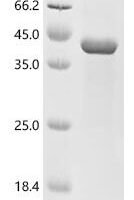
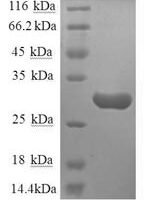
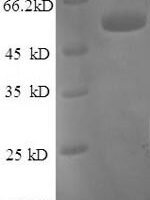
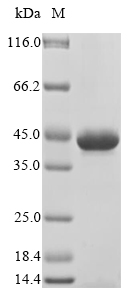
Recombinant Human Filamin-A (FLNA), partial is a recombinant protein from Homo sapiens (Human), expressed in E.coli, covering amino acids 2-274aa, with N-terminal 10xHis-tagged and C-terminal Myc-tagged tag, molecular weight 38.0kDa, purity Greater than 85% as determined by SDS-PAGE.. Suitable for ELISA and Western Blot applications.