Function
Binds to folate and reduced folic acid derivatives and mediates delivery of 5-methyltetrahydrofolate and folate analogs into the interior of cells. Has high affinity for folate and folic acid analogs at neutral pH. Exposure to slightly acidic pH after receptor endocytosis triggers a conformation change that strongly reduces its affinity for folates and mediates their release.
Biological Context
Subcellular Location: Cell membrane (Lipid-anchor, GPI-anchor); Apical cell membrane (Lipid-anchor, GPI-anchor); Basolateral cell membrane (Lipid-anchor, GPI-like-anchor); Secreted; Cytoplasmic vesicle; Cytoplasmic vesicle, clathrin-coated vesicle; Endosome
Tissue Specificity: Primarily expressed in tissues of epithelial origin. Expression is increased in malignant tissues. Expressed in kidney, lung and cerebellum. Detected in placenta and thymus epithelium
Disease Association: Neurodegeneration due to cerebral folate transport deficiency (NCFTD) : An autosomal recessive neurodegenerative disorder resulting from brain-specific folate deficiency early in life. Onset is apparent in late infancy with severe developmental regression, movement disturbances, epilepsy and leukodystrophy. [The disease is caused by variants affecting the gene represented in this entry]
Product Specifications
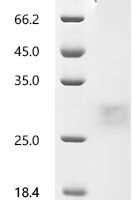
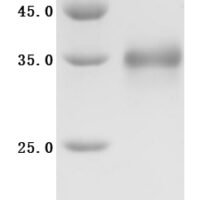
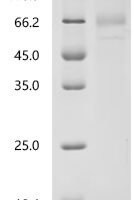
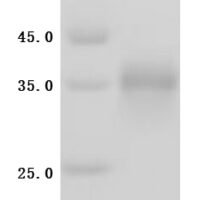
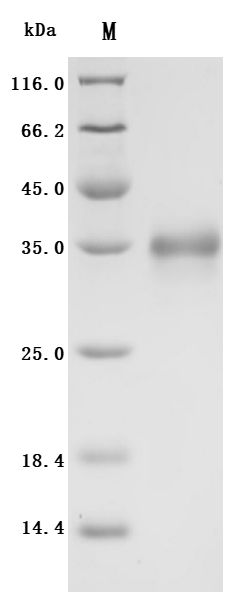
Recombinant Human Folate receptor alpha (FOLR1), partial (Active) is a recombinant protein from Homo sapiens (Human), expressed in Mammalian cell, covering amino acids 25-233aa, with C-terminal 10xHis-tagged tag, molecular weight 25.9kDa, purity Greater than 95% as determined by SDS-PAGE.. Suitable for ELISA and Western Blot applications.