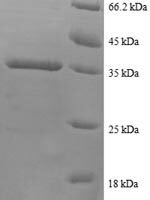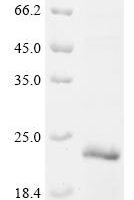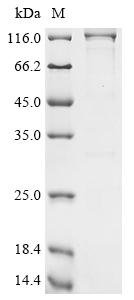
Recombinant Human General transcription and DNA repair factor IIH helicase subunit XPB (ERCC3)

Recombinant Human General transcription and DNA repair factor IIH helicase subunit XPB (ERCC3) — ATP-dependent 3′-5′ DNA helicase/translocase. Purity >85%.

SKU: BCRECP-000603 Category:

Product Specifications

Product SkuBCRECP-000603
Product DescriptionRecombinant Human General transcription and DNA repair factor IIH helicase subunit XPB (ERCC3) Protein is expressed from E.coli with N-terminal GST-tagged. It contains 1-782aa. [Accession | P19447].
Uniprot No.P19447
Gene NamesERCC3
PurityGreater than 85% as determined by SDS-PAGE.
Expression SystemE.coli
Expression Region1-782aa
SpeciesHomo sapiens (Human)
Tag InfoN-terminal GST-tagged
Molecular weight115.6kDa
ActivityPlease contact us to obtain bioactivity data.
BufferIf the delivery form is liquid, the default storage buffer is Tris/PBS-based buffer, 5%-50% glycerol. If the delivery form is lyophilized powder, the buffer before lyophilization is Tris/PBS-based buffer, 6% Trehalose.
StorageStore at -20°C/-80°C upon receipt, aliquoting is necessary for mutiple use. Avoid repeated freeze-thaw cycles.
Research AreasOthers

Function

ATP-dependent 3'-5' DNA helicase/translocase. Binds dsDNA rather than ssDNA, unzipping it in a translocase rather than classical helicase activity. Component of the general transcription and DNA repair factor IIH (TFIIH) core complex.

Biological Context

Subcellular Location: Nucleus
Disease Association: Xeroderma pigmentosum complementation group B (XP-B) : An autosomal recessive pigmentary skin disorder characterized by solar hypersensitivity of the skin, high predisposition for developing cancers on areas exposed to sunlight and, in some cases, neurological abnormalities. The skin develops marked freckling and other pigmentation abnormalities. Some XP-B patients present features of Cockayne syndrome, including cachectic dwarfism, pigmentary retinopathy, ataxia, decreased nerve conduction velocities. The phenotype combining xeroderma pigmentosum and Cockayne syndrome traits is referred to as XP-CS complex. [The disease is caused by variants affecting the gene represented in this entry] | Trichothiodystrophy 2, photosensitive (TTD2) : A form of trichothiodystrophy, an autosomal recessive disease characterized by sulfur-deficient brittle hair and multisystem variable abnormalities. The spectrum of clinical features varies from mild disease with only hair involvement to severe disease with cutaneous, neurologic and profound developmental defects. Ichthyosis, intellectual and developmental disabilities, decreased fertility, abnormal characteristics at birth, ocular abnormalities, short stature, and infections are common manifestations. There are both photosensitive and non-photosensitive forms of the disorder. [The disease is caused by variants affecting the gene represented in this entry]

Product Specifications

Recombinant Human General transcription and DNA repair factor IIH helicase subunit XPB (ERCC3) is a recombinant protein from Homo sapiens (Human), expressed in E.coli, covering amino acids 1-782aa, with N-terminal GST-tagged tag, molecular weight 115.6kDa, purity Greater than 85% as determined by SDS-PAGE.. Suitable for ELISA and Western Blot applications.
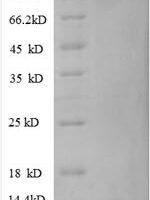
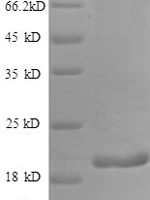
SDS-PAGE: Single band at expected molecular weight confirming purity.

ELISA: Suitable as coating antigen or detection standard.

Western Blot: Compatible with standard Western Blot protocols.

Protein Interaction: Validated for SPR (Surface Plasmon Resonance) and BLI (Bio-Layer Interferometry) studies.

Shipping: Shipped at ambient temperature. Lyophilized protein is stable during transit.

Storage: Store lyophilized protein at -20°C to -80°C. Reconstituted protein should be aliquoted and stored at -80°C. Avoid repeated freeze-thaw cycles.

Shelf Life: 12 months from date of receipt when stored as recommended.

Shipping Time: Orders placed before 2 PM EST ship same day. International orders typically deliver within 5-10 business days.

Protein Biology

Function

ATP-dependent 3'-5' DNA helicase/translocase (PubMed:17466626, PubMed:27193682, PubMed:33902107, PubMed:8465201, PubMed:8663148). Binds dsDNA rather than ssDNA, unzipping it in a translocase rather than classical helicase activity (PubMed:27193682, PubMed:33902107). Component of the general transcription and DNA repair factor IIH (TFIIH) core complex (PubMed:10024882, PubMed:17466626, PubMed:8157004, PubMed:8465201). When complexed to CDK-activating kinase (CAK), involved in RNA transcription by RNA polymerase II. The ATPase activity of XPB/ERCC3, but not its helicase activity, is required for DNA opening; it may wrap around the damaged DNA wedging it open, causing localized melting that allows XPD/ERCC2 helicase to anchor (PubMed:10024882, PubMed:17466626). In transcription, TFIIH has an essential role in transcription initiation (PubMed:30894545, PubMed:8157004). When the pre-initiation complex (PIC) has been established, TFIIH is required for promoter opening and promoter escape (PubMed:8157004). The ATP-dependent helicase activity of XPB/ERCC3 is required for promoter opening and promoter escape (PubMed:10024882). In transcription pre-initiation complexes induces and propagates a DNA twist to open DNA (PubMed:27193682, PubMed:33902107). Also involved in transcription-coupled nucleotide excision repair (NER) of damaged DNA (PubMed:17466626, PubMed:2111438, PubMed:8157004). In NER, TFIIH acts by opening DNA around the lesion to allow the excision of the damaged oligonucleotide and its replacement by a new DNA fragment. The structure of the TFIIH transcription complex differs from the NER-TFIIH complex; large movements by XPD/ERCC2 and XPB/ERCC3 are stabilized by XPA (PubMed:31253769, PubMed:33902107). XPA retains XPB/ERCC3 at the 5' end of a DNA bubble (mimicking DNA damage) (PubMed:31253769)

Subcellular Location

Nucleus

Disease Association

Xeroderma pigmentosum complementation group B (XP-B) : An autosomal recessive pigmentary skin disorder characterized by solar hypersensitivity of the skin, high predisposition for developing cancers on areas exposed to sunlight and, in some cases, neurological abnormalities. The skin develops marked freckling and other pigmentation abnormalities. Some XP-B patients present features of Cockayne syndrome, including cachectic dwarfism, pigmentary retinopathy, ataxia, decreased nerve conduction velocities. The phenotype combining xeroderma pigmentosum and Cockayne syndrome traits is referred to as XP-CS complex. [The disease is caused by variants affecting the gene represented in this entry] | Trichothiodystrophy 2, photosensitive (TTD2) : A form of trichothiodystrophy, an autosomal recessive disease characterized by sulfur-deficient brittle hair and multisystem variable abnormalities. The spectrum of clinical features varies from mild disease with only hair involvement to severe disease with cutaneous, neurologic and profound developmental defects. Ichthyosis, intellectual and developmental disabilities, decreased fertility, abnormal characteristics at birth, ocular abnormalities, short stature, and infections are common manifestations. There are both photosensitive and non-photosensitive forms of the disorder. [The disease is caused by variants affecting the gene represented in this entry]

Subunit

(Microbial infection) Interacts with Epstein-Barr virus EBNA2

Gene: ERCC3  |  Organism: Homo sapiens  |  Synonyms: Basic transcription factor 2 89 kDa subunit; DNA 3'-5' helicase/translocase XPB; DNA excision repair protein ERCC-3; DNA repair protein complementing XP-B cells; TFIIH basal transcription factor complex 89 kDa subunit; Xeroderma pigmentosum group B-complementing protein
Key Publications

Frequently Asked Questions

How do I order or inquire about this product?

Fill out the Online Inquiry form with your required quantity and specifications. You can also email sales@biocrestsci.com. Our team typically responds within 4 business hours with a quote and availability confirmation.

What is the shipping and delivery time?

Orders placed before 2 PM EST ship the same day. Domestic (US) delivery typically takes 2-3 business days. International orders deliver within 5-10 business days. All products are shipped at ambient temperature with appropriate packaging to ensure stability.

How should I store this recombinant protein?

Lyophilized proteins should be stored at -20°C to -80°C upon receipt. After reconstitution, aliquot and store at -80°C. Avoid repeated freeze-thaw cycles. Shelf life is 12 months from date of receipt when stored as recommended.

What quality controls are performed on your products?

Each product undergoes SDS-PAGE purity analysis (typically >85-95%), endotoxin testing, and bioactivity validation. Products are validated for ELISA, Western Blot, and SPR/BLI applications as specified on this product page. A Certificate of Analysis (CoA) is available upon request.

Shopping Cart
Scroll to Top