
Recombinant Human Glypican-3 (GPC3)(S359F), partial (Active)

Recombinant Human Glypican-3 (GPC3)(S359F), partial (Active) — Cell surface proteoglycan. Purity >90%.

SKU: BCACP-000279 Category:
Product SKUBCACP-000279
Product DescriptionRecombinant Human Glypican-3 (GPC3)(S359F) protein is expressed from Mammalian cell with C-terminal 10xHis-tagged. It contains 25-559aa(S359F). [Accession | P51654].
Uniprot No.P51654
Gene NamesGPC3
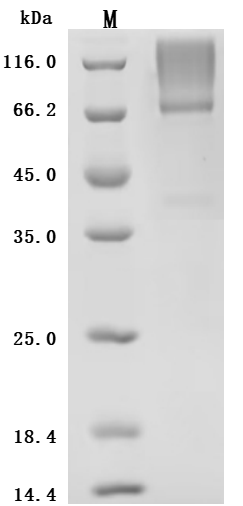
PurityGreater than 90% as determined by SDS-PAGE.
Expression SystemMammalian cell
Expression Region25-559aa(S359F)
SpeciesHomo sapiens (Human)
Tag InfoC-terminal 10xHis-tagged
Molecular weight62.2 kDa
ActivityMeasured by its binding ability in a functional ELISA. Immobilized Human CEACAM1 at 2 μg/mL can bind Anti-CEACAM1 recombinant antibody. The EC50 is 3.432 - 6.079 ng/mL.
BufferLyophilized from a 0.2 μm filtered 20 mM Tris-HCl, 0.5 M NaCl, 6% Trehalose, pH 8.0
StorageStore at -20°C/-80°C upon receipt, aliquoting is necessary for mutiple use. Avoid repeated freeze-thaw cycles.
Alternative NamesOCI5

Function

Cell surface proteoglycan. Negatively regulates the hedgehog signaling pathway when attached via the GPI-anchor to the cell surface by competing with the hedgehog receptor PTC1 for binding to hedgehog proteins. Binding to the hedgehog protein SHH triggers internalization of the complex by endocytosis and its subsequent lysosomal degradation.

Biological Context

Subcellular Location: Cell membrane (Lipid-anchor, GPI-anchor)
Tissue Specificity: Detected in placenta (at protein level). Highly expressed in lung, liver and kidney
Disease Association: Simpson-Golabi-Behmel syndrome 1 (SGBS1) : A condition characterized by pre- and postnatal overgrowth (gigantism), facial dysmorphism and a variety of inconstant visceral and skeletal malformations. Characteristic dysmorphic features include macrocephaly with coarse, distinctive facies with a large protruding jaw, broad nasal bridge and cleft palate. Cardiac defects are frequent. [The disease is caused by variants affecting the gene represented in this entry]

Product Specifications

Recombinant Human Glypican-3 (GPC3)(S359F), partial (Active) is a recombinant protein from Homo sapiens (Human), expressed in Mammalian cell, covering amino acids 25-559aa(S359F), with C-terminal 10xHis-tagged tag, molecular weight 62.2 kDa, purity Greater than 90% as determined by SDS-PAGE.. Suitable for ELISA and Western Blot applications.

Recommended applications depend on the target, product format, and product-specific validation data. Refer to the product datasheet or Certificate of Analysis (CoA), or contact BioCrest Sci for application guidance.

Biological Activity: Measured by its binding ability in a functional ELISA. Immobilized Human CEACAM1 at 2 μg/mL can bind Anti-CEACAM1 recombinant antibody. The EC50 is 3.432 - 6.079 ng/mL.

Storage: Store at -20°C/-80°C upon receipt, aliquoting is necessary for mutiple use. Avoid repeated freeze-thaw cycles.

Shipping & Lead Time: Availability, shipping conditions, and estimated lead time are confirmed in the formal quotation or order confirmation based on the product format, destination, and order requirements.

Protein Biology

Function

Cell surface proteoglycan (PubMed:14610063). Negatively regulates the hedgehog signaling pathway when attached via the GPI-anchor to the cell surface by competing with the hedgehog receptor PTC1 for binding to hedgehog proteins (By similarity). Binding to the hedgehog protein SHH triggers internalization of the complex by endocytosis and its subsequent lysosomal degradation (By similarity). Positively regulates the canonical Wnt signaling pathway by binding to the Wnt receptor Frizzled and stimulating the binding of the Frizzled receptor to Wnt ligands (PubMed:16227623, PubMed:24496449). Positively regulates the non-canonical Wnt signaling pathway (By similarity). Binds to CD81 which decreases the availability of free CD81 for binding to the transcriptional repressor HHEX, resulting in nuclear translocation of HHEX and transcriptional repression (By similarity). Inhibits the dipeptidyl peptidase activity of DPP4 (PubMed:17549790). Plays a role in limb patterning and skeletal development by controlling the cellular response to BMP4 (By similarity). Modulates the effects of growth factors BMP2, BMP7 and FGF7 on renal branching morphogenesis (By similarity). Required for coronary vascular development (By similarity). Plays a role in regulating cell movements during gastrulation (By similarity)

Subcellular Location

Cell membrane (Lipid-anchor, GPI-anchor)

Disease Association

Simpson-Golabi-Behmel syndrome 1 (SGBS1) : A condition characterized by pre- and postnatal overgrowth (gigantism), facial dysmorphism and a variety of inconstant visceral and skeletal malformations. Characteristic dysmorphic features include macrocephaly with coarse, distinctive facies with a large protruding jaw, broad nasal bridge and cleft palate. Cardiac defects are frequent. [The disease is caused by variants affecting the gene represented in this entry]

Tissue Specificity

Detected in placenta (at protein level) (PubMed:32337544). Highly expressed in lung, liver and kidney

Subunit

Heterodimer; disulfide-linked (PubMed:14610063). Cleavage by a furin-like convertase results in production of alpha and beta chains which form a disulfide-linked heterodimer (PubMed:14610063). Interacts with DPP4 (PubMed:17549790). Interacts with FGF2 (By similarity). Interacts with WNT5A (PubMed:14610063). Also interacts with WNT3A and WNT7B (PubMed:16227623). Interacts with hedgehog protein SHH; the heparan sulfate chains are not required for the interaction (By similarity). Also interacts with hedgehog protein IHH (By similarity). Interacts with CD81 (By similarity). Interacts with Wnt receptors FZD4, FZD7 and FZD8; the heparan sulfate chains are required for the interaction (PubMed:24496449)

Gene: GPC3  |  Organism: Homo sapiens  |  Synonyms: GTR2-2; Intestinal protein OCI-5; MXR7
Key Publications

Frequently Asked Questions

How do I order or inquire about this product?

Submit the Online Inquiry form with your required quantity and specifications, or email sales@biocrestsci.com. Available sizes, pricing, stock status, documentation, and estimated lead time are confirmed in the formal quotation.

What is the shipping and delivery time?

Availability, dispatch timing, shipping conditions, and delivery estimates depend on the product format, destination, and order requirements. These details are confirmed in the formal quotation or order confirmation.

How should this product be stored?

Follow the storage and handling instructions in the product-specific datasheet and Certificate of Analysis (CoA). Requirements may vary by product form and formulation; contact BioCrest Sci if product-specific guidance is needed.

What quality controls are performed on your products?

Quality-control data such as identity, purity, endotoxin level, or biological activity are provided only when specified on this product page, the datasheet, or Certificate of Analysis (CoA). Biological activity is not implied unless explicitly stated.

Shopping Cart
Scroll to Top