Recombinant Human Guanine nucleotide-binding protein G (q) subunit alpha (GNAQ)

Recombinant Human Guanine nucleotide-binding protein G (q) subunit alpha (GNAQ) — Guanine nucleotide-binding proteins (G proteins) function as transducers downstream of G protein-coupled receptors (GPCRs) in numerous signaling cascades. Purity >95%.

SKU: BCRECP-000764 Category:

Product Specifications

Product SkuBCRECP-000764
Product DescriptionRecombinant Human Guanine nucleotide-binding protein G (q) subunit alpha (GNAQ) Protein is expressed from E.coli with N-terminal 6xHis-tagged. It contains 1-359aa. [Accession | P50148].
Uniprot No.P50148
Gene NamesGNAQ
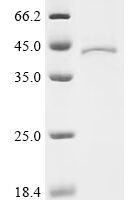
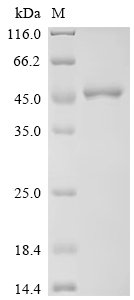
PurityGreater than 95% as determined by SDS-PAGE.
Expression SystemE.coli
Expression Region1-359aa
SpeciesHomo sapiens (Human)
Tag InfoN-terminal 6xHis-tagged
Molecular weight48.1kDa
ActivityPlease contact us to obtain bioactivity data.
BufferIf the delivery form is liquid, the default storage buffer is Tris/PBS-based buffer, 5%-50% glycerol. If the delivery form is lyophilized powder, the buffer before lyophilization is Tris/PBS-based buffer, 6% Trehalose.
StorageStore at -20°C/-80°C upon receipt, aliquoting is necessary for mutiple use. Avoid repeated freeze-thaw cycles.
Research AreasCardiovascular

Function

Guanine nucleotide-binding proteins (G proteins) function as transducers downstream of G protein-coupled receptors (GPCRs) in numerous signaling cascades. The alpha chain contains the guanine nucleotide binding site and alternates between an active, GTP-bound state and an inactive, GDP-bound state. Signaling by an activated GPCR promotes GDP release and GTP binding.

Biological Context

Subcellular Location: Cell membrane (Peripheral membrane protein); Golgi apparatus; Nucleus; Nucleus membrane
Tissue Specificity: Predominantly expressed in ovary, prostate, testis and colon. Down-regulated in the peripheral blood lymphocytes (PBLs) of rheumatoid arthritis patients (at protein level)
Disease Association: Capillary malformations, congenital (CMC) : A form of vascular malformations that are present from birth, tend to grow with the individual, do not regress spontaneously, and show normal rates of endothelial cell turnover. Capillary malformations are distinct from capillary hemangiomas, which are highly proliferative lesions that appear shortly after birth and show rapid growth, slow involution, and endothelial hypercellularity. [The disease is caused by variants affecting the gene represented in this entry] | Sturge-Weber syndrome (SWS) : A syndrome characterized by an intracranial vascular anomaly, leptomeningeal angiomatosis, most often involving the occipital and posterior parietal lobes. The most common features are facial cutaneous vascular malformations (port-wine stains), seizures, and glaucoma. Stasis results in ischemia underlying the leptomeningeal angiomatosis, leading to calcification and laminar cortical necrosis. The clinical course is highly variable and some children experience intractable seizures, intellectual disability, and recurrent stroke-like episodes. [The disease is caused by variants affecting the gene represented in this entry]

Product Specifications

Recombinant Human Guanine nucleotide-binding protein G (q) subunit alpha (GNAQ) is a recombinant protein from Homo sapiens (Human), expressed in E.coli, covering amino acids 1-359aa, with N-terminal 6xHis-tagged tag, molecular weight 48.1kDa, purity Greater than 95% as determined by SDS-PAGE.. Suitable for ELISA and Western Blot applications.
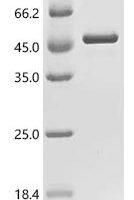
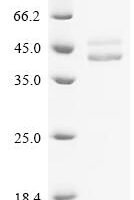
SDS-PAGE: Single band at expected molecular weight confirming purity.

ELISA: Suitable as coating antigen or detection standard.

Western Blot: Compatible with standard Western Blot protocols.

Protein Interaction: Validated for SPR (Surface Plasmon Resonance) and BLI (Bio-Layer Interferometry) studies.

Shipping: Shipped at ambient temperature. Lyophilized protein is stable during transit.

Storage: Store lyophilized protein at -20°C to -80°C. Reconstituted protein should be aliquoted and stored at -80°C. Avoid repeated freeze-thaw cycles.

Shelf Life: 12 months from date of receipt when stored as recommended.

Shipping Time: Orders placed before 2 PM EST ship same day. International orders typically deliver within 5-10 business days.

Protein Biology

Function

Guanine nucleotide-binding proteins (G proteins) function as transducers downstream of G protein-coupled receptors (GPCRs) in numerous signaling cascades (PubMed:34556863, PubMed:35672283, PubMed:37991948). The alpha chain contains the guanine nucleotide binding site and alternates between an active, GTP-bound state and an inactive, GDP-bound state (PubMed:37991948). Signaling by an activated GPCR promotes GDP release and GTP binding (PubMed:37991948). The alpha subunit has a low GTPase activity that converts bound GTP to GDP, thereby terminating the signal (PubMed:37991948). Both GDP release and GTP hydrolysis are modulated by numerous regulatory proteins (PubMed:37991948). Signaling is mediated via phospholipase C-beta-dependent inositol lipid hydrolysis for signal propagation: activates phospholipase C-beta: following GPCR activation, GNAQ activates PLC-beta (PLCB1, PLCB2, PLCB3 or PLCB4), leading to production of diacylglycerol (DAG) and inositol 1,4,5-trisphosphate (IP3) (PubMed:37991948). Required for platelet activation (By similarity). Regulates B-cell selection and survival and is required to prevent B-cell-dependent autoimmunity (By similarity). Regulates chemotaxis of BM-derived neutrophils and dendritic cells (in vitro) (By similarity). Transduces FFAR4 signaling in response to long-chain fatty acids (LCFAs) (PubMed:27852822). Together with GNA11, required for heart development (By similarity)

Subcellular Location

Cell membrane (Peripheral membrane protein); Golgi apparatus; Nucleus; Nucleus membrane

Disease Association

Capillary malformations, congenital (CMC) : A form of vascular malformations that are present from birth, tend to grow with the individual, do not regress spontaneously, and show normal rates of endothelial cell turnover. Capillary malformations are distinct from capillary hemangiomas, which are highly proliferative lesions that appear shortly after birth and show rapid growth, slow involution, and endothelial hypercellularity. [The disease is caused by variants affecting the gene represented in this entry] | Sturge-Weber syndrome (SWS) : A syndrome characterized by an intracranial vascular anomaly, leptomeningeal angiomatosis, most often involving the occipital and posterior parietal lobes. The most common features are facial cutaneous vascular malformations (port-wine stains), seizures, and glaucoma. Stasis results in ischemia underlying the leptomeningeal angiomatosis, leading to calcification and laminar cortical necrosis. The clinical course is highly variable and some children experience intractable seizures, intellectual disability, and recurrent stroke-like episodes. [The disease is caused by variants affecting the gene represented in this entry]

Tissue Specificity

Predominantly expressed in ovary, prostate, testis and colon. Down-regulated in the peripheral blood lymphocytes (PBLs) of rheumatoid arthritis patients (at protein level)

Subunit

G proteins are composed of 3 units; alpha, beta and gamma. The alpha chain contains the guanine nucleotide binding site (PubMed:37991948). Interacts (GDP-bound form) with RIC8A (via C-terminus); promoting GNAQ folding and association with the plasma membrane (PubMed:32126208). Binds NHERF1 (PubMed:12193606). Forms a complex with PECAM1 and BDKRB2 (PubMed:18672896). Interacts with GAS2L2 (PubMed:23994616). Interacts with CCKBR (PubMed:34556863, PubMed:35672283)

Gene: GNAQ  |  Organism: Homo sapiens  |  Synonyms: Guanine nucleotide-binding protein alpha-q
Key Publications

Frequently Asked Questions

How do I order or inquire about this product?

Fill out the Online Inquiry form with your required quantity and specifications. You can also email sales@biocrestsci.com. Our team typically responds within 4 business hours with a quote and availability confirmation.

What is the shipping and delivery time?

Orders placed before 2 PM EST ship the same day. Domestic (US) delivery typically takes 2-3 business days. International orders deliver within 5-10 business days. All products are shipped at ambient temperature with appropriate packaging to ensure stability.

How should I store this recombinant protein?

Lyophilized proteins should be stored at -20°C to -80°C upon receipt. After reconstitution, aliquot and store at -80°C. Avoid repeated freeze-thaw cycles. Shelf life is 12 months from date of receipt when stored as recommended.

What quality controls are performed on your products?

Each product undergoes SDS-PAGE purity analysis (typically >85-95%), endotoxin testing, and bioactivity validation. Products are validated for ELISA, Western Blot, and SPR/BLI applications as specified on this product page. A Certificate of Analysis (CoA) is available upon request.

Shopping Cart
Scroll to Top