Function
Core component of nucleosome. Nucleosomes wrap and compact DNA into chromatin, limiting DNA accessibility to the cellular machineries which require DNA as a template. Histones thereby play a central role in transcription regulation, DNA repair, DNA replication and chromosomal stability.
Biological Context
Subcellular Location: Nucleus; Chromosome
Disease Association: Tessadori-Bicknell-Van Haaften neurodevelopmental syndrome 1 (TEBIVANED1) : An autosomal dominant disorder with onset in infancy, characterized by poor overall growth, microcephaly, hypotonia, profound global developmental delay, impaired intellectual development, poor or absent speech, and characteristic dysmorphic facial features, including hypertelorism and abnormal nose. Other variable neurologic and systemic features may also occur. [The disease is caused by variants affecting the gene represented in this entry. TEBIVANED1 is caused by variants in H4C3] | Tessadori-Bicknell-Van Haaften neurodevelopmental syndrome 2 (TEBIVANED2) : An autosomal dominant disorder characterized by poor overall growth, microcephaly, hypotonia, profound global developmental delay, impaired intellectual development, absent speech, and characteristic dysmorphic facial features, including hypertelorism, abnormal nose, and wide mouth. [The disease is caused by variants affecting the gene represented in this entry. TEBIVANED2 is caused by variants in H4C11] | Tessadori-Bicknell-Van Haaften neurodevelopmental syndrome 3 (TEBIVANED3) : An autosomal dominant disorder characterized by global developmental delay with poor overall growth, impaired intellectual development, and speech difficulties. More variable features include hypotonia, microcephaly, and dysmorphic facies. [The disease is caused by variants affecting the gene represented in this entry. TEBIVANED3 is caused by variants in H4C5] | Tessadori-Bicknell-Van Haaften neurodevelopmental syndrome 4 (TEBIVANED4) : An autosomal dominant disorder characterized by global developmental delay with poor overall growth, variably impaired intellectual development, learning difficulties, distal skeletal anomalies, and dysmorphic facies. Some patients have visual or hearing deficits. [The disease is caused by variants affecting the gene represented in this entry. TEBIVANED4 is caused by variants in H4C9] | [Chromosomal aberrations involving HISTONE H4 is a cause of B-cell non-Hodgkin lymphomas (B-cell NHL). Translocation t(3;6)(q27;p21), with BCL6]
Product Specifications
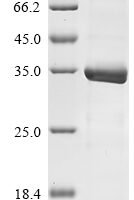
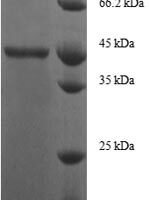
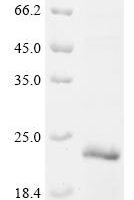
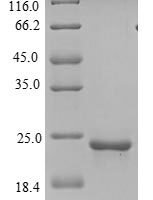
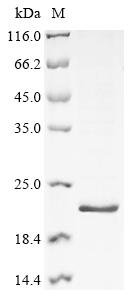
Recombinant Human Histone H4 (H4C1) is a recombinant protein from Homo sapiens (Human), expressed in E.coli, covering amino acids 2-103aa, with C-terminal 6xHis-tagged tag, molecular weight 18.1kDa, purity Greater than 85% as determined by SDS-PAGE.. Suitable for ELISA and Western Blot applications.