Recombinant Human Ig gamma-1 chain C region (IGHG1)

Recombinant Human Ig gamma-1 chain C region (IGHG1) — Constant region of immunoglobulin (Ig) heavy chains. Purity >85%.

SKU: BCRECP-000921 Category:

Product Specifications

Product SkuBCRECP-000921
Product DescriptionRecombinant Human Ig gamma-1 chain C region (IGHG1) Protein is expressed from E.coli with N-terminal 6xHis-SUMO-tagged. It contains 1-479aa. [Accession | P01857].
Uniprot No.P01857
Gene NamesIGHG1
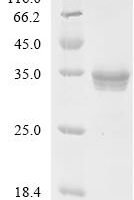
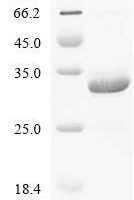
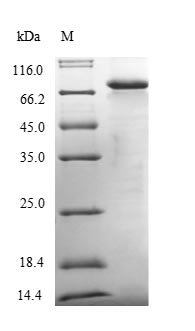
PurityGreater than 85% as determined by SDS-PAGE.
Expression SystemE.coli
Expression Region1-479aa
SpeciesHomo sapiens (Human)
Tag InfoN-terminal 6xHis-SUMO-tagged
Molecular weight68.5kDa
ActivityPlease contact us to obtain bioactivity data.
BufferIf the delivery form is liquid, the default storage buffer is Tris/PBS-based buffer, 5%-50% glycerol. If the delivery form is lyophilized powder, the buffer before lyophilization is Tris/PBS-based buffer, 6% Trehalose.
StorageStore at -20°C/-80°C upon receipt, aliquoting is necessary for mutiple use. Avoid repeated freeze-thaw cycles.
Research AreasImmunology

Function

Constant region of immunoglobulin (Ig) heavy chains. Igs are membrane-bound or secreted glycoproteins produced by B lymphocytes. In the recognition phase of humoral immunity, the membrane-bound Igs serve as receptors, which upon binding to a specific antigen trigger the clonal expansion and differentiation of B lymphocytes into Ig-secreting plasma cells.

Biological Context

Subcellular Location: Cell membrane (Single-pass membrane protein)
Disease Association: Multiple myeloma (MM) : A malignant tumor of plasma cells usually arising in the bone marrow and characterized by diffuse involvement of the skeletal system, hyperglobulinemia, Bence-Jones proteinuria and anemia. Complications of multiple myeloma are bone pain, hypercalcemia, renal failure and spinal cord compression. The aberrant antibodies that are produced lead to impaired humoral immunity and patients have a high prevalence of infection. Amyloidosis may develop in some patients. Multiple myeloma is part of a spectrum of diseases ranging from monoclonal gammopathy of unknown significance (MGUS) to plasma cell leukemia. [The disease is caused by variants affecting the gene represented in this entry. A chromosomal aberration involving IGHG1 is found in multiple myeloma. Translocation t(11;14)(q13;q32) with the IgH locus. Translocation t(11;14)(q13;q32) with CCND1; translocation t(4;14)(p16.3;q32.3) with FGFR3; translocation t(6;14)(p25;q32) with IRF4]

Product Specifications

Recombinant Human Ig gamma-1 chain C region (IGHG1) is a recombinant protein from Homo sapiens (Human), expressed in E.coli, covering amino acids 1-479aa, with N-terminal 6xHis-SUMO-tagged tag, molecular weight 68.5kDa, purity Greater than 85% as determined by SDS-PAGE.. Suitable for ELISA and Western Blot applications.
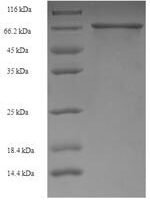
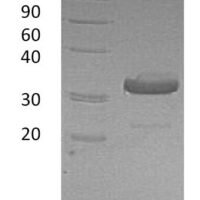
SDS-PAGE: Single band at expected molecular weight confirming purity.

ELISA: Suitable as coating antigen or detection standard.

Western Blot: Compatible with standard Western Blot protocols.

Protein Interaction: Validated for SPR (Surface Plasmon Resonance) and BLI (Bio-Layer Interferometry) studies.

Shipping: Shipped at ambient temperature. Lyophilized protein is stable during transit.

Storage: Store lyophilized protein at -20°C to -80°C. Reconstituted protein should be aliquoted and stored at -80°C. Avoid repeated freeze-thaw cycles.

Shelf Life: 12 months from date of receipt when stored as recommended.

Shipping Time: Orders placed before 2 PM EST ship same day. International orders typically deliver within 5-10 business days.

Protein Biology

Function

Constant region of immunoglobulin (Ig) heavy chains. Igs are membrane-bound or secreted glycoproteins produced by B lymphocytes. In the recognition phase of humoral immunity, the membrane-bound Igs serve as receptors, which upon binding to a specific antigen trigger the clonal expansion and differentiation of B lymphocytes into Ig-secreting plasma cells. Secreted Igs known as antibodies mediate the effector phase of humoral immunity by blocking the interaction of infectious antigens with cellular receptors (via the antigen-binding region) and eliciting effector mechanisms that lead to pathogen neutralization (via the constant region) (PubMed:17576170, PubMed:20176268, PubMed:22158414). The antigen-binding region is formed by the variable domain of one heavy chain paired with the variable domain of its associated light chain. Each Ig molecule has two antigen-binding sites with remarkable affinity for a particular antigen due to V-(D)-J rearrangement, somatic hypermutations and affinity maturation of the variable domains upon antigen exposure (PubMed:17576170, PubMed:20176268, PubMed:22158414). The constant region defines the Ig isotype that perform distinct sets of effector functions. B cells diversify and rearrange their Ig constant regions through class-switch recombination, a process by which the constant region is switched from one Ig isotype to another, namely from IgM and IgD to IgG, IgA and IgE (PubMed:17576170, PubMed:20176268, PubMed:22158414). The constant region of Ig gamma-1 (IgG1) isotype interacts (via the fragment crystallizable, Fc) with receptors on innate immune cells and the complement system to mediate humoral effector functions, including antibody-dependent cellular cytotoxicity or phagocytosis, complement-dependent cytotoxicity and inflammatory responses

Subcellular Location

Cell membrane (Single-pass membrane protein)

Disease Association

Multiple myeloma (MM) : A malignant tumor of plasma cells usually arising in the bone marrow and characterized by diffuse involvement of the skeletal system, hyperglobulinemia, Bence-Jones proteinuria and anemia. Complications of multiple myeloma are bone pain, hypercalcemia, renal failure and spinal cord compression. The aberrant antibodies that are produced lead to impaired humoral immunity and patients have a high prevalence of infection. Amyloidosis may develop in some patients. Multiple myeloma is part of a spectrum of diseases ranging from monoclonal gammopathy of unknown significance (MGUS) to plasma cell leukemia. [The disease is caused by variants affecting the gene represented in this entry. A chromosomal aberration involving IGHG1 is found in multiple myeloma. Translocation t(11;14)(q13;q32) with the IgH locus. Translocation t(11;14)(q13;q32) with CCND1; translocation t(4;14)(p16.3;q32.3) with FGFR3; translocation t(6;14)(p25;q32) with IRF4]

Subunit

(Microbial infection) Interacts (via Fc region) with S. aureus spa/protein A (via B domain); spa interferes with the formation of IgG:C1q complexes preventing complement activation and protecting bacteria from phagocytic killing

Gene: IGHG1  |  Organism: Homo sapiens  |  Synonyms: Ig gamma-1 chain C region; Ig gamma-1 chain C region EU; Ig gamma-1 chain C region KOL; Ig gamma-1 chain C region NIE
Key Publications

Frequently Asked Questions

How do I order or inquire about this product?

Fill out the Online Inquiry form with your required quantity and specifications. You can also email sales@biocrestsci.com. Our team typically responds within 4 business hours with a quote and availability confirmation.

What is the shipping and delivery time?

Orders placed before 2 PM EST ship the same day. Domestic (US) delivery typically takes 2-3 business days. International orders deliver within 5-10 business days. All products are shipped at ambient temperature with appropriate packaging to ensure stability.

How should I store this recombinant protein?

Lyophilized proteins should be stored at -20°C to -80°C upon receipt. After reconstitution, aliquot and store at -80°C. Avoid repeated freeze-thaw cycles. Shelf life is 12 months from date of receipt when stored as recommended.

What quality controls are performed on your products?

Each product undergoes SDS-PAGE purity analysis (typically >85-95%), endotoxin testing, and bioactivity validation. Products are validated for ELISA, Western Blot, and SPR/BLI applications as specified on this product page. A Certificate of Analysis (CoA) is available upon request.

Shopping Cart
Scroll to Top