Function
Catalyzes the first and rate limiting step of the catabolism of the essential amino acid tryptophan along the kynurenine pathway. Involved in the peripheral immune tolerance, contributing to maintain homeostasis by preventing autoimmunity or immunopathology that would result from uncontrolled and overreacting immune responses. Tryptophan shortage inhibits T lymphocytes division and accumulation of tryptophan catabolites induces T-cell apoptosis and differentiation of regulatory T-cells.
Biological Context
Subcellular Location: Cytoplasm, cytosol
Tissue Specificity: Expressed in mature dendritic cells located in lymphoid organs (including lymph nodes, spleen, tonsils, Peyers's patches, the gut lamina propria, and the thymic medulla), in some epithelial cells of the female genital tract, as well as in endothelial cells of term placenta and in lung parenchyma. Weakly or not expressed in most normal tissues, but mostly inducible in most tissues. Expressed in more than 50% of tumors, either by tumoral, stromal, or endothelial cells (expression in tumor is associated with a worse clinical outcome). Not overexpressed in tumor-draining lymph nodes
Pathway: Amino-acid degradation; L-tryptophan degradation via kynurenine pathway; L-kynurenine from L-tryptophan: step 1/2
Product Specifications
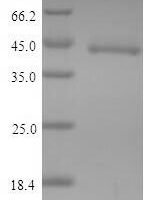
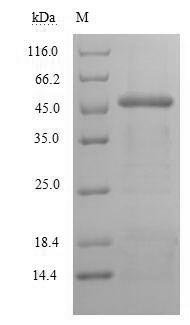
Recombinant Human Indoleamine 2,3-dioxygenase 1 (IDO1) is a recombinant protein from Homo sapiens (Human), expressed in Yeast, covering amino acids 1-403aa, with N-terminal 6xHis-tagged tag, molecular weight 47.3kDa, purity Greater than 90% as determined by SDS-PAGE.. Suitable for ELISA and Western Blot applications.