,

Recombinant Human Insulin-like growth factor 2 mRNA-binding protein 1 (IGF2BP1)

Recombinant Human Insulin-like growth factor 2 mRNA-binding protein 1 (IGF2BP1) — RNA-binding factor that recruits target transcripts to cytoplasmic protein-RNA complexes (mRNPs). Purity >85%.

SKU: BCRECP-000914 Categories: ,

Product Specifications

Product SkuBCRECP-000914
Product DescriptionRecombinant Human Insulin-like growth factor 2 mRNA-binding protein 1 (IGF2BP1) Protein is expressed from E.coli with N-terminal 10xHis-tagged and C-terminal Myc-tagged. It contains 1-577aa. [Accession | Q9NZI8].
Uniprot No.Q9NZI8
Gene NamesIGF2BP1
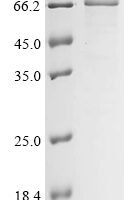
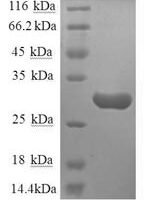
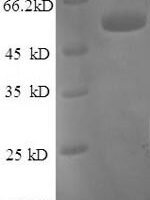
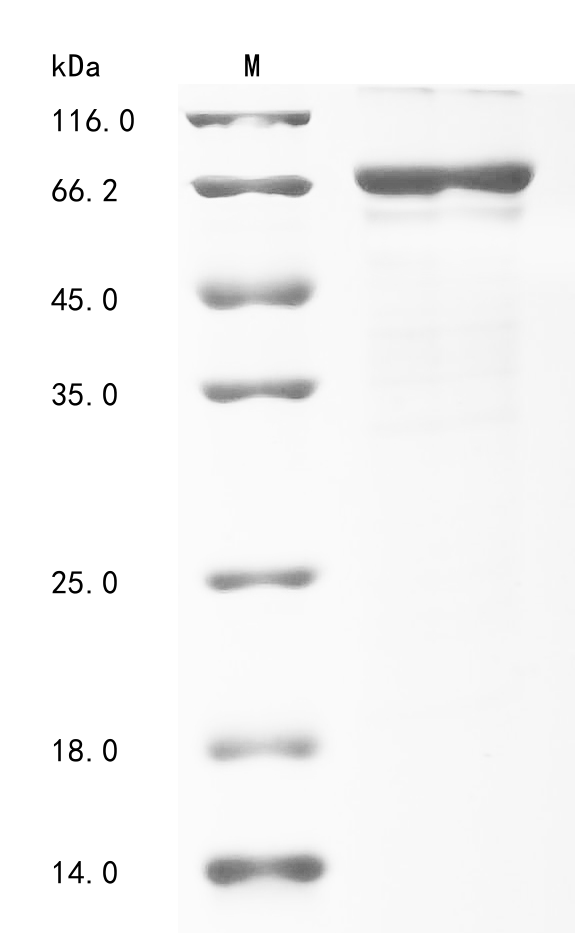
PurityGreater than 85% as determined by SDS-PAGE.
Expression SystemE.coli
Expression Region1-577aa
SpeciesHomo sapiens (Human)
Tag InfoN-terminal 10xHis-tagged and C-terminal Myc-tagged
Molecular weight69.5kDa
ActivityPlease contact us to obtain bioactivity data.
BufferIf the delivery form is liquid, the default storage buffer is Tris/PBS-based buffer, 5%-50% glycerol. If the delivery form is lyophilized powder, the buffer before lyophilization is Tris/PBS-based buffer, 6% Trehalose.
StorageStore at -20°C/-80°C upon receipt, aliquoting is necessary for mutiple use. Avoid repeated freeze-thaw cycles.
Research AreasEpigenetics and Nuclear Signaling

Function

RNA-binding factor that recruits target transcripts to cytoplasmic protein-RNA complexes (mRNPs). This transcript 'caging' into mRNPs allows mRNA transport and transient storage. It also modulates the rate and location at which target transcripts encounter the translational apparatus and shields them from endonuclease attacks or microRNA-mediated degradation.

Biological Context

Subcellular Location: Nucleus; Cytoplasm; Cytoplasm, perinuclear region; Cytoplasm, P-body; Cytoplasm, Stress granule; Cell projection, lamellipodium; Cell projection, dendrite; Cell projection, dendritic spine; Cell projection, growth cone; Cell projection, filopodium; Cell projection, axon
Tissue Specificity: Mainly expressed in the embryo, including in fetal liver, fetal lung, fetal kidney, fetal thymus (at protein level). Also expressed follicles of ovary, as well as in gonocytes of testis, spermatogonia, semen, oocytes and placenta (at protein level). Expressed in various cancers, including testis and lung cancers (at protein level), as well as kidney, prostate and trachea cancers

Product Specifications

Recombinant Human Insulin-like growth factor 2 mRNA-binding protein 1 (IGF2BP1) is a recombinant protein from Homo sapiens (Human), expressed in E.coli, covering amino acids 1-577aa, with N-terminal 10xHis-tagged and C-terminal Myc-tagged tag, molecular weight 69.5kDa, purity Greater than 85% as determined by SDS-PAGE.. Suitable for ELISA and Western Blot applications.

SDS-PAGE: Single band at expected molecular weight confirming purity.

ELISA: Suitable as coating antigen or detection standard.

Western Blot: Compatible with standard Western Blot protocols.

Protein Interaction: Validated for SPR (Surface Plasmon Resonance) and BLI (Bio-Layer Interferometry) studies.

Shipping: Shipped at ambient temperature. Lyophilized protein is stable during transit.

Storage: Store lyophilized protein at -20°C to -80°C. Reconstituted protein should be aliquoted and stored at -80°C. Avoid repeated freeze-thaw cycles.

Shelf Life: 12 months from date of receipt when stored as recommended.

Shipping Time: Orders placed before 2 PM EST ship same day. International orders typically deliver within 5-10 business days.

Protein Biology

Function

RNA-binding factor that recruits target transcripts to cytoplasmic protein-RNA complexes (mRNPs). This transcript 'caging' into mRNPs allows mRNA transport and transient storage. It also modulates the rate and location at which target transcripts encounter the translational apparatus and shields them from endonuclease attacks or microRNA-mediated degradation. Preferentially binds to N6-methyladenosine (m6A)-containing mRNAs and increases their stability (PubMed:29476152, PubMed:32245947). Plays a direct role in the transport and translation of transcripts required for axonal regeneration in adult sensory neurons (By similarity). Regulates localized beta-actin/ACTB mRNA translation, a crucial process for cell polarity, cell migration and neurite outgrowth. Co-transcriptionally associates with the ACTB mRNA in the nucleus. This binding involves a conserved 54-nucleotide element in the ACTB mRNA 3'-UTR, known as the 'zipcode'. The RNP thus formed is exported to the cytoplasm, binds to a motor protein and is transported along the cytoskeleton to the cell periphery. During transport, prevents ACTB mRNA from being translated into protein. When the RNP complex reaches its destination near the plasma membrane, IGF2BP1 is phosphorylated. This releases the mRNA, allowing ribosomal 40S and 60S subunits to assemble and initiate ACTB protein synthesis. Monomeric ACTB then assembles into the subcortical actin cytoskeleton (By similarity). During neuronal development, key regulator of neurite outgrowth, growth cone guidance and neuronal cell migration, presumably through the spatiotemporal fine tuning of protein synthesis, such as that of ACTB (By similarity). May regulate mRNA transport to activated synapses (By similarity). Binds to and stabilizes ABCB1/MDR-1 mRNA (By similarity). During interstinal wound repair, interacts with and stabilizes PTGS2 transcript. PTGS2 mRNA stabilization may be crucial for colonic mucosal wound healing (By similarity). Binds to the 3'-UTR of IGF2 mRNA by a mechanism of cooperative and sequential dimerization and regulates IGF2 mRNA subcellular localization and translation. Binds to MYC mRNA, in the coding region instability determinant (CRD) of the open reading frame (ORF), hence preventing MYC cleavage by endonucleases and possibly microRNA targeting to MYC-CRD (PubMed:29476152). Binding to MYC mRNA is enhanced by m6A-modification of the CRD (PubMed:29476152). Binds to the 3'-UTR of CD44 mRNA and stabilizes it, hence promotes cell adhesion and invadopodia formation in cancer cells. Binds to the oncofetal H19 transcript and to the neuron-specific TAU mRNA and regulates their localizations. Binds to and stabilizes BTRC/FBW1A mRNA. Binds to the adenine-rich autoregulatory sequence (ARS) located in PABPC1 mRNA and represses its translation. PABPC1 mRNA-binding is stimulated by PABPC1 protein. Prevents BTRC/FBW1A mRNA degradation by disrupting microRNA-dependent interaction with AGO2. Promotes the directed movement of tumor-derived cells by fine-tuning intracellular signaling networks. Binds to MAPK4 3'-UTR and inhibits its translation. Interacts with PTEN transcript open reading frame (ORF) and prevents mRNA decay. This combined action on MAPK4 (down-regulation) and PTEN (up-regulation) antagonizes HSPB1 phosphorylation, consequently it prevents G-actin sequestration by phosphorylated HSPB1, allowing F-actin polymerization. Hence enhances the velocity of cell migration and stimulates directed cell migration by PTEN-modulated polarization. Interacts with Hepatitis C virus (HCV) 5'-UTR and 3'-UTR and specifically enhances translation at the HCV IRES, but not 5'-cap-dependent translation, possibly by recruiting eIF3. Interacts with HIV-1 GAG protein and blocks the formation of infectious HIV-1 particles. Reduces HIV-1 assembly by inhibiting viral RNA packaging, as well as assembly and processing of GAG protein on cellular membranes. During cellular stress, such as oxidative stress or heat shock, stabilizes target mRNAs that are recruited to stress granules, including CD44, IGF2, MAPK4, MYC, PTEN, RAPGEF2 and RPS6KA5 transcripts

Subcellular Location

Nucleus; Cytoplasm; Cytoplasm, perinuclear region; Cytoplasm, P-body; Cytoplasm, Stress granule; Cell projection, lamellipodium; Cell projection, dendrite; Cell projection, dendritic spine; Cell projection, growth cone; Cell projection, filopodium; Cell projection, axon

Tissue Specificity

Mainly expressed in the embryo, including in fetal liver, fetal lung, fetal kidney, fetal thymus (at protein level). Also expressed follicles of ovary, as well as in gonocytes of testis, spermatogonia, semen, oocytes and placenta (at protein level). Expressed in various cancers, including testis and lung cancers (at protein level), as well as kidney, prostate and trachea cancers

Subunit

Can form homodimers and heterodimers with IGF2BP1 and IGF2BP3. Component of the coding region determinant (CRD)-mediated complex, composed of DHX9, HNRNPU, IGF2BP1, SYNCRIP and YBX1. During HCV infection, identified in a HCV IRES-mediated translation complex, at least composed of EIF3C, IGF2BP1, RPS3 and HCV RNA-replicon. Interacts (via the KH domains) with HIV-1 GAG (via the second zinc finger motif of NC). Associates (via the RRM domains and KH domains) with HIV-1 particles. Identified in a mRNP complex, composed of at least DHX9, DDX3X, ELAVL1, HNRNPU, IGF2BP1, ILF3, PABPC1, PCBP2, PTBP2, STAU1, STAU2, SYNCRIP and YBX1. Identified in a IGF2BP1-dependent mRNP granule complex containing untranslated mRNAs. Interacts with DHX9, ELAVL2, HNRNPA2B1, HNRNPC, HNRNPH1, HNRNPU, IGF2BP2, ILF2, and YBX1. Interacts with FMR1. Component of a multisubunit autoregulatory RNP complex (ARC), at least composed of IGF2BP1, PABPC1 and CSDE1/UNR. Directly interacts with PABPC1 (PubMed:17212783, PubMed:29476152, PubMed:32245947). Component of a TAU mRNP complex, at least composed of IGF2BP1, ELAVL4 and G3BP. Interacts with ELAVL4 in an RNA-dependent manner. Associates with microtubules and polysomes. Interacts with AGO1 and AGO2. Interacts with ELAVL1 and MATR3 (PubMed:29476152, PubMed:32245947). Interacts (via KH3 and KH4 domains) with SEPIN14P20 peptide RBRP; the interaction results in increased binding of IGF2BP1 to N6-methyladenosine (m6A)-containing mRNAs (PubMed:32245947)

Gene: IGF2BP1  |  Organism: Homo sapiens  |  Synonyms: Coding region determinant-binding protein; IGF-II mRNA-binding protein 1; VICKZ family member 1; Zipcode-binding protein 1
Key Publications

Frequently Asked Questions

How do I order or inquire about this product?

Fill out the Online Inquiry form with your required quantity and specifications. You can also email sales@biocrestsci.com. Our team typically responds within 4 business hours with a quote and availability confirmation.

What is the shipping and delivery time?

Orders placed before 2 PM EST ship the same day. Domestic (US) delivery typically takes 2-3 business days. International orders deliver within 5-10 business days. All products are shipped at ambient temperature with appropriate packaging to ensure stability.

How should I store this recombinant protein?

Lyophilized proteins should be stored at -20°C to -80°C upon receipt. After reconstitution, aliquot and store at -80°C. Avoid repeated freeze-thaw cycles. Shelf life is 12 months from date of receipt when stored as recommended.

What quality controls are performed on your products?

Each product undergoes SDS-PAGE purity analysis (typically >85-95%), endotoxin testing, and bioactivity validation. Products are validated for ELISA, Western Blot, and SPR/BLI applications as specified on this product page. A Certificate of Analysis (CoA) is available upon request.

Shopping Cart
Scroll to Top