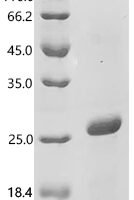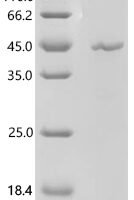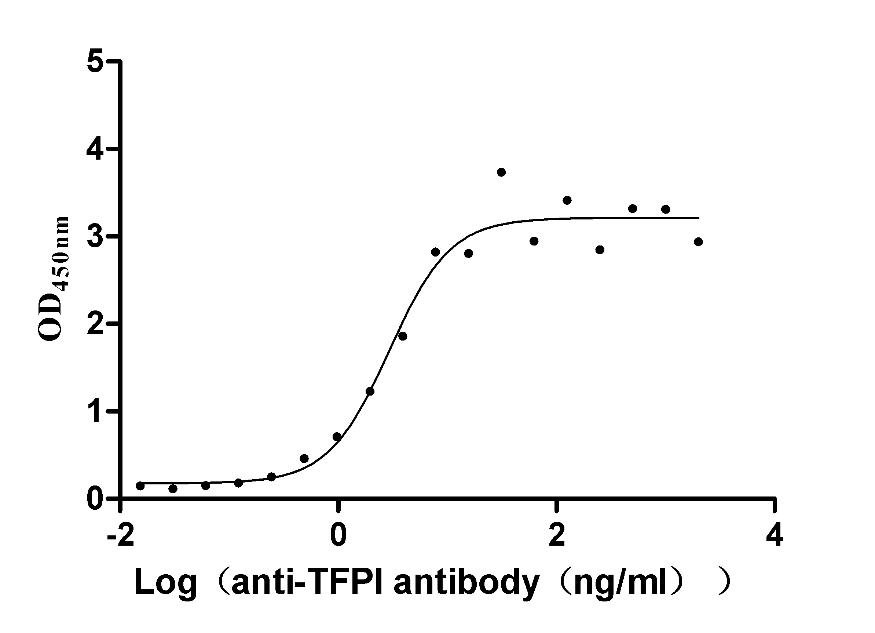
Recombinant Human Leptin protein (LEP)

Recombinant Human Leptin protein (LEP) — Key player in the regulation of energy balance and body weight control. Purity >97%.

SKU: BCACP-000844 Category:
Product SKUBCACP-000844
Product DescriptionRecombinant Human Leptin protein (LEP) protein is expressed from E.Coli with Tag-Free. It contains 22-167aa. [Accession | P41159].
Uniprot No.P41159
Gene NamesLEP
Purity>97% as determined by SDS-PAGE.
Expression SystemE.Coli
Expression Region22-167aa
SpeciesHomo sapiens (Human)
Tag InfoTag-Free
Molecular weight16.0 kDa
ActivityThiol Protein Reductase Activity is 0.001 Δ650nm/ min-2, determined by measuring the turbidityincrease at 650 nm due to insulin reduction.The activity is expressed as the ratio of the slope of a linear part of the turbidity curve to the lag time.
BufferLyophilized from a 0.2 μm filtered 20 mM Tris-HCl, 0.5 M NaCl, 6% Trehalose, pH 8.0
StorageStore at -20°C/-80°C upon receipt, aliquoting is necessary for mutiple use. Avoid repeated freeze-thaw cycles.
Alternative NamesFLJ94114; LEP; LEP_HUMAN; LEPD; Leptin (murine obesity homolog); Leptin (obesity homolog, mouse); Leptin; Leptin Murine Obesity Homolog; Leptin Precursor Obesity Factor; OB; Obese protein; Obese, mouse, homolog of; Obesity; Obesity factor; Obesity homolog mouse; Obesity Murine Homolog Leptin; OBS; OTTHUMP00000212285

Function

Key player in the regulation of energy balance and body weight control. Once released into the circulation, has central and peripheral effects by binding LEPR, found in many tissues, which results in the activation of several major signaling pathways. In the hypothalamus, acts as an appetite-regulating factor that induces a decrease in food intake and an increase in energy consumption by inducing anorexinogenic factors and suppressing orexigenic neuropeptides, also regulates bone mass and secretion of hypothalamo-pituitary-adrenal hormones.

Biological Context

Subcellular Location: Secreted
Tissue Specificity: Adipose tissue is the main source of leptin. It is also produced by other peripheral tissues such as the skeletal muscle. Expressed by intercalated and striated tracts of submandibular and parotid salivary gland intralobular ducts. Detected by fundic epithelium of the gastric mucosa. Secreted into blood and gastric juice
Disease Association: Leptin deficiency (LEPD) : A rare disease characterized by low levels of serum leptin, severe hyperphagia and intractable obesity from an early age. [The disease is caused by variants affecting the gene represented in this entry]

Product Specifications

Recombinant Human Leptin protein (LEP) is a recombinant protein from Homo sapiens (Human), expressed in E.Coli, covering amino acids 22-167aa, with Tag-Free tag, molecular weight 16.0 kDa, purity >97% as determined by SDS-PAGE.. Suitable for ELISA and Western Blot applications.
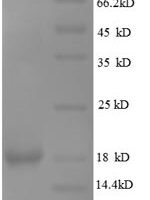
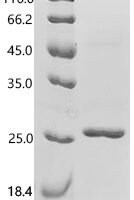
SDS-PAGE: Single band at expected molecular weight confirming purity.

ELISA: Suitable as coating antigen or detection standard.

Western Blot: Compatible with standard Western Blot protocols.

Protein Interaction: Validated for SPR (Surface Plasmon Resonance) and BLI (Bio-Layer Interferometry) studies.

Shipping: Shipped at ambient temperature. Lyophilized protein is stable during transit.

Storage: Store lyophilized protein at -20°C to -80°C. Reconstituted protein should be aliquoted and stored at -80°C. Avoid repeated freeze-thaw cycles.

Shelf Life: 12 months from date of receipt when stored as recommended.

Shipping Time: Orders placed before 2 PM EST ship same day. International orders typically deliver within 5-10 business days.

Protein Biology

Function

Key player in the regulation of energy balance and body weight control. Once released into the circulation, has central and peripheral effects by binding LEPR, found in many tissues, which results in the activation of several major signaling pathways (PubMed:15899045, PubMed:17344214, PubMed:19688109). In the hypothalamus, acts as an appetite-regulating factor that induces a decrease in food intake and an increase in energy consumption by inducing anorexinogenic factors and suppressing orexigenic neuropeptides, also regulates bone mass and secretion of hypothalamo-pituitary-adrenal hormones. In the periphery, increases basal metabolism, influences reproductive function, regulates pancreatic beta-cell function and insulin secretion, is pro-angiogenic for endothelial cell and affects innate and adaptive immunity (By similarity) (PubMed:11460888, PubMed:19688109, PubMed:24340098, PubMed:25060689, PubMed:8589726). In the arcuate nucleus of the hypothalamus, activates by depolarization POMC neurons inducing FOS and SOCS3 expression to release anorexigenic peptides and inhibits by hyperpolarization NPY neurons inducing SOCS3 with a consequent reduction on release of orexigenic peptides (By similarity). In addition to its known satiety inducing effect, has a modulatory role in nutrient absorption. In the intestine, reduces glucose absorption by enterocytes by activating PKC and leading to a sequential activation of p38, PI3K and ERK signaling pathways which exerts an inhibitory effect on glucose absorption (PubMed:24340098). Acts as a growth factor on certain tissues, through the activation of different signaling pathways increases expression of genes involved in cell cycle regulation such as CCND1, via JAK2-STAT3 pathway, or VEGFA, via MAPK1/3 and PI3K-AKT1 pathways (By similarity) (PubMed:17344214). May also play an apoptotic role via JAK2-STAT3 pathway and up-regulation of BIRC5 expression (PubMed:18242580). Pro-angiogenic, has mitogenic activity on vascular endothelial cells and plays a role in matrix remodeling by regulating the expression of matrix metalloproteinases (MMPs) and tissue inhibitors of metalloproteinases (TIMPs) (PubMed:11460888). In innate immunity, modulates the activity and function of neutrophils by increasing chemotaxis and the secretion of oxygen radicals. Increases phagocytosis by macrophages and enhances secretion of pro-inflammatory mediators. Increases cytotoxic ability of NK cells (PubMed:12504075). Plays a pro-inflammatory role, in synergy with IL1B, by inducing NOS2 which promotes the production of IL6, IL8 and Prostaglandin E2, through a signaling pathway that involves JAK2, PI3K, MAP2K1/MEK1 and MAPK14/p38 (PubMed:15899045, PubMed:19688109). In adaptive immunity, promotes the switch of memory T-cells towards T helper-1 cell immune responses (By similarity). Increases CD4(+)CD25(-) T-cell proliferation and reduces autophagy during TCR (T-cell receptor) stimulation, through MTOR signaling pathway activation and BCL2 up-regulation (PubMed:25060689)

Subcellular Location

Secreted

Disease Association

Leptin deficiency (LEPD) : A rare disease characterized by low levels of serum leptin, severe hyperphagia and intractable obesity from an early age. [The disease is caused by variants affecting the gene represented in this entry]

Tissue Specificity

Adipose tissue is the main source of leptin. It is also produced by other peripheral tissues such as the skeletal muscle (PubMed:12448771, PubMed:16052473, PubMed:7789654). Expressed by intercalated and striated tracts of submandibular and parotid salivary gland intralobular ducts (PubMed:12448771). Detected by fundic epithelium of the gastric mucosa (PubMed:10896907). Secreted into blood and gastric juice (PubMed:10896907)

Subunit

Interacts with SIGLEC6

Gene: LEP  |  Organism: Homo sapiens  |  Synonyms: Obese protein; Obesity factor

Frequently Asked Questions

How do I order or inquire about this product?

Fill out the Online Inquiry form with your required quantity and specifications. You can also email sales@biocrestsci.com. Our team typically responds within 4 business hours with a quote and availability confirmation.

What is the shipping and delivery time?

Orders placed before 2 PM EST ship the same day. Domestic (US) delivery typically takes 2-3 business days. International orders deliver within 5-10 business days. All products are shipped at ambient temperature with appropriate packaging to ensure stability.

How should I store this recombinant protein?

Lyophilized proteins should be stored at -20°C to -80°C upon receipt. After reconstitution, aliquot and store at -80°C. Avoid repeated freeze-thaw cycles. Shelf life is 12 months from date of receipt when stored as recommended.

What quality controls are performed on your products?

Each product undergoes SDS-PAGE purity analysis (typically >85-95%), endotoxin testing, and bioactivity validation. Products are validated for ELISA, Western Blot, and SPR/BLI applications as specified on this product page. A Certificate of Analysis (CoA) is available upon request.

Shopping Cart
Scroll to Top