, ,

Recombinant Human Lon protease homolog, mitochondrial (LONP1), partial

Recombinant Human Lon protease homolog, mitochondrial (LONP1), partial — ATP-dependent serine protease that mediates the selective degradation of misfolded, unassembled or oxidatively damaged polypeptides as well as certain short-lived regulatory proteins in the mitocho… Purity >90%.

SKU: BCRECP-001077 Categories: , ,

Product Specifications

Product SkuBCRECP-001077
Product DescriptionRecombinant Human Lon protease homolog, mitochondrial (LONP1) Protein is expressed from E.coli with N-terminal 10xHis-tagged and C-terminal Myc-tagged. It contains 124-368aa. [Accession | P36776].
Uniprot No.P36776
Gene NamesLONP1
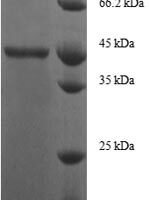
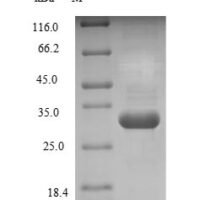
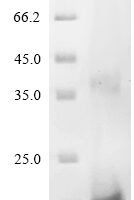
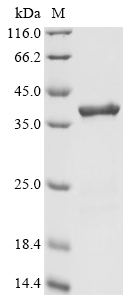
PurityGreater than 90% as determined by SDS-PAGE.
Expression SystemE.coli
Expression Region124-368aa
SpeciesHomo sapiens (Human)
Tag InfoN-terminal 10xHis-tagged and C-terminal Myc-tagged
Molecular weight35.6kDa
ActivityPlease contact us to obtain bioactivity data.
BufferIf the delivery form is liquid, the default storage buffer is Tris/PBS-based buffer, 5%-50% glycerol. If the delivery form is lyophilized powder, the buffer before lyophilization is Tris/PBS-based buffer, 6% Trehalose.
StorageStore at -20°C/-80°C upon receipt, aliquoting is necessary for mutiple use. Avoid repeated freeze-thaw cycles.
Research AreasCancer

Function

ATP-dependent serine protease that mediates the selective degradation of misfolded, unassembled or oxidatively damaged polypeptides as well as certain short-lived regulatory proteins in the mitochondrial matrix. Endogenous substrates include mitochondrial steroidogenic acute regulatory (StAR) protein, DELE1, helicase Twinkle (TWNK) and the large ribosomal subunit protein MRPL32/bL32m. MRPL32/bL32m is protected from degradation by LONP1 when it is bound to a nucleic acid (RNA), but TWNK is not.

Biological Context

Subcellular Location: Mitochondrion matrix
Tissue Specificity: Duodenum, heart, lung and liver, but not thymus
Disease Association: CODAS syndrome (CODASS) : A rare syndrome characterized by the combination of cerebral, ocular, dental, auricular, and skeletal features. These include developmental delay, craniofacial anomalies, cataracts, ptosis, median nasal groove, delayed tooth eruption, hearing loss, short stature, delayed epiphyseal ossification, metaphyseal hip dysplasia, and vertebral coronal clefts. [The disease is caused by variants affecting the gene represented in this entry]

Product Specifications

Recombinant Human Lon protease homolog, mitochondrial (LONP1), partial is a recombinant protein from Homo sapiens (Human), expressed in E.coli, covering amino acids 124-368aa, with N-terminal 10xHis-tagged and C-terminal Myc-tagged tag, molecular weight 35.6kDa, purity Greater than 90% as determined by SDS-PAGE.. Suitable for ELISA and Western Blot applications.

SDS-PAGE: Single band at expected molecular weight confirming purity.

ELISA: Suitable as coating antigen or detection standard.

Western Blot: Compatible with standard Western Blot protocols.

Protein Interaction: Validated for SPR (Surface Plasmon Resonance) and BLI (Bio-Layer Interferometry) studies.

Shipping: Shipped at ambient temperature. Lyophilized protein is stable during transit.

Storage: Store lyophilized protein at -20°C to -80°C. Reconstituted protein should be aliquoted and stored at -80°C. Avoid repeated freeze-thaw cycles.

Shelf Life: 12 months from date of receipt when stored as recommended.

Shipping Time: Orders placed before 2 PM EST ship same day. International orders typically deliver within 5-10 business days.

Protein Biology

Function

ATP-dependent serine protease that mediates the selective degradation of misfolded, unassembled or oxidatively damaged polypeptides as well as certain short-lived regulatory proteins in the mitochondrial matrix (PubMed:12198491, PubMed:15870080, PubMed:17579211, PubMed:37327776, PubMed:8248235, PubMed:35870450, PubMed:38688959). Endogenous substrates include mitochondrial steroidogenic acute regulatory (StAR) protein, DELE1, helicase Twinkle (TWNK) and the large ribosomal subunit protein MRPL32/bL32m (PubMed:17579211, PubMed:28377575, PubMed:37327776). MRPL32/bL32m is protected from degradation by LONP1 when it is bound to a nucleic acid (RNA), but TWNK is not (PubMed:17579211, PubMed:28377575). In addtion to its protease activity, has also an ATP-dependent protein folding chaperone activity and functions in mitochondrial protein folding (PubMed:33431889). Participates in the regulation of mitochondrial gene expression and in the maintenance of the integrity of the mitochondrial genome (PubMed:17420247). Binds to mitochondrial promoters and RNA in a single-stranded, site-specific, and strand-specific manner (PubMed:17420247). May regulate mitochondrial DNA replication and/or gene expression using site-specific, single-stranded DNA binding to target the degradation of regulatory proteins binding to adjacent sites in mitochondrial promoters (PubMed:14739292, PubMed:17420247)

Subcellular Location

Mitochondrion matrix

Disease Association

CODAS syndrome (CODASS) : A rare syndrome characterized by the combination of cerebral, ocular, dental, auricular, and skeletal features. These include developmental delay, craniofacial anomalies, cataracts, ptosis, median nasal groove, delayed tooth eruption, hearing loss, short stature, delayed epiphyseal ossification, metaphyseal hip dysplasia, and vertebral coronal clefts. [The disease is caused by variants affecting the gene represented in this entry]

Tissue Specificity

Duodenum, heart, lung and liver, but not thymus

Subunit

Homohexamer (PubMed:14739292, PubMed:20222013, PubMed:25369343, PubMed:38688959, PubMed:35870450). Organized in a ring with a central cavity (PubMed:20222013, PubMed:25369343). The ATP-binding and proteolytic domains (AP-domain) form a hexameric chamber, while the N-terminal domain is arranged as a trimer of dimers (PubMed:27632940). DNA and RNA binding is stimulated by substrate and inhibited by ATP binding. Interacts with TWNK and mitochondrial DNA polymerase subunit POLG (PubMed:14739292)

Gene: LONP1  |  Organism: Homo sapiens  |  Synonyms: LONHs; Lon protease-like protein; Mitochondrial ATP-dependent protease Lon; Mitochondrial chaperone LONP1; Serine protease 15
Key Publications

Frequently Asked Questions

How do I order or inquire about this product?

Fill out the Online Inquiry form with your required quantity and specifications. You can also email sales@biocrestsci.com. Our team typically responds within 4 business hours with a quote and availability confirmation.

What is the shipping and delivery time?

Orders placed before 2 PM EST ship the same day. Domestic (US) delivery typically takes 2-3 business days. International orders deliver within 5-10 business days. All products are shipped at ambient temperature with appropriate packaging to ensure stability.

How should I store this recombinant protein?

Lyophilized proteins should be stored at -20°C to -80°C upon receipt. After reconstitution, aliquot and store at -80°C. Avoid repeated freeze-thaw cycles. Shelf life is 12 months from date of receipt when stored as recommended.

What quality controls are performed on your products?

Each product undergoes SDS-PAGE purity analysis (typically >85-95%), endotoxin testing, and bioactivity validation. Products are validated for ELISA, Western Blot, and SPR/BLI applications as specified on this product page. A Certificate of Analysis (CoA) is available upon request.

Shopping Cart
Scroll to Top