Recombinant Human Medium-wave-sensitive opsin 1 (OPN1MW) Protein

Recombinant Human Medium-wave-sensitive opsin 1 (OPN1MW) Protein — G protein-coupled photoreceptor that selectively activates G(i) proteins in response to medium-wavelength (green) light, thereby decreasing intracellular cAMP levels. Purity >85%.

SKU: BCRECP-00211TM Category:

Product Specifications

Uniprot No.P04001
Gene NamesOPN1MW
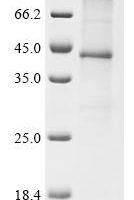
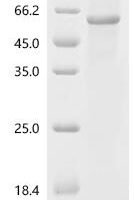
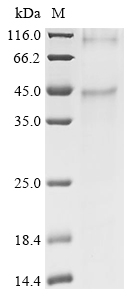
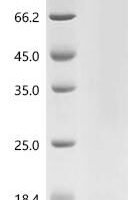
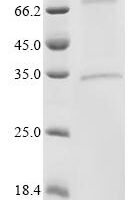
PurityGreater than 85% as determined by SDS-PAGE.
Expression Systemin vitro E.coli expression system
Expression Region1-364aa
SpeciesHomo sapiens (Human)
Tag InfoN-terminal 10xHis-tagged
Molecular weight46.6kDa
BufferIf the delivery form is liquid, the default storage buffer is Tris/PBS-based buffer, 5%-50% glycerol.If the delivery form is lyophilized powder, the buffer before lyophilization is Tris/PBS-based buffer, 6% Trehalose.
StorageStore at -20°C/-80°C upon receipt, aliquoting is necessary for mutiple use. Avoid repeated freeze-thaw cycles.

Function

G protein-coupled photoreceptor that selectively activates G(i) proteins in response to medium-wavelength (green) light, thereby decreasing intracellular cAMP levels. Activation occurs when the opsin-bound cis-retinal chromophore absorbs a photon and isomerizes to all-trans-retinal, inducing a conformational change in the opsin that triggers a G protein-mediated phototransduction cascade (Ref.6). Mediates visual perception of green light in cone photoreceptor cells.

Biological Context

Subcellular Location: Cell membrane (Multi-pass membrane protein); Photoreceptor outer segment membrane (Multi-pass membrane protein)
Tissue Specificity: The red (OPN1LW), green (OPN1MW), and blue (OPN1SW) photoreceptor pigments are found in cone cells
Disease Association: Colorblindness, partial, deutan series (CBD) : An X-linked color vision defect characterized by a dichromasy in which red and green are confused, without loss of luminance or shift or shortening of the spectrum. Dichromasy is due to the use of only two types of photoreceptors, blue plus red in deuteranopia and blue plus green in protanopia. [The disease is caused by variants affecting the gene represented in this entry] | Blue cone monochromacy (BCM) : A rare X-linked congenital stationary cone dysfunction syndrome characterized by the absence of functional long wavelength-sensitive and medium wavelength-sensitive cones in the retina. Color discrimination is severely impaired from birth, and vision is derived from the remaining preserved blue (S) cones and rod photoreceptors. BCM typically presents with reduced visual acuity, pendular nystagmus, and photophobia. Patients often have myopia. [The disease is caused by variants affecting the gene represented in this entry] | Cone dystrophy 5 (COD5) : An X-linked cone dystrophy. Cone dystrophies are retinal dystrophies characterized by progressive degeneration of the cone photoreceptors with preservation of rod function, as indicated by electroretinogram. However, some rod involvement may be present in some cone dystrophies, particularly at late stage. Affected individuals suffer from photophobia, loss of visual acuity, color vision and central visual field. Another sign is the absence of macular lesions for many years. Cone dystrophies are distinguished from the cone-rod dystrophies in which some loss of peripheral vision also occurs. [The disease is caused by variants affecting the gene represented in this entry]

Product Specifications

Recombinant Human Medium-wave-sensitive opsin 1 (OPN1MW) Protein is a recombinant protein from Homo sapiens (Human), expressed in in vitro E.coli expression system, covering amino acids 1-364aa, with N-terminal 10xHis-tagged tag, molecular weight 46.6kDa, purity Greater than 85% as determined by SDS-PAGE.. Suitable for ELISA and Western Blot applications.
Recommended applications depend on the target, product format, and product-specific validation data. Refer to the product datasheet or Certificate of Analysis (CoA), or contact BioCrest Sci for application guidance.

Biological Activity: Not implied unless activity data are explicitly listed on this product page, the datasheet, or the CoA.

Storage: Store at -20°C/-80°C upon receipt, aliquoting is necessary for mutiple use. Avoid repeated freeze-thaw cycles.

Shipping & Lead Time: Availability, shipping conditions, and estimated lead time are confirmed in the formal quotation or order confirmation based on the product format, destination, and order requirements.

Protein Biology

Function

G protein-coupled photoreceptor that selectively activates G(i) proteins in response to medium-wavelength (green) light, thereby decreasing intracellular cAMP levels (PubMed:2937147, PubMed:6140680, Ref.6). Activation occurs when the opsin-bound cis-retinal chromophore absorbs a photon and isomerizes to all-trans-retinal, inducing a conformational change in the opsin that triggers a G protein-mediated phototransduction cascade (Ref.6). Mediates visual perception of green light in cone photoreceptor cells (PubMed:12051694, PubMed:1302020, PubMed:8666378)

Subcellular Location

Cell membrane (Multi-pass membrane protein); Photoreceptor outer segment membrane (Multi-pass membrane protein)

Disease Association

Colorblindness, partial, deutan series (CBD) : An X-linked color vision defect characterized by a dichromasy in which red and green are confused, without loss of luminance or shift or shortening of the spectrum. Dichromasy is due to the use of only two types of photoreceptors, blue plus red in deuteranopia and blue plus green in protanopia. [The disease is caused by variants affecting the gene represented in this entry] | Blue cone monochromacy (BCM) : A rare X-linked congenital stationary cone dysfunction syndrome characterized by the absence of functional long wavelength-sensitive and medium wavelength-sensitive cones in the retina. Color discrimination is severely impaired from birth, and vision is derived from the remaining preserved blue (S) cones and rod photoreceptors. BCM typically presents with reduced visual acuity, pendular nystagmus, and photophobia. Patients often have myopia. [The disease is caused by variants affecting the gene represented in this entry] | Cone dystrophy 5 (COD5) : An X-linked cone dystrophy. Cone dystrophies are retinal dystrophies characterized by progressive degeneration of the cone photoreceptors with preservation of rod function, as indicated by electroretinogram. However, some rod involvement may be present in some cone dystrophies, particularly at late stage. Affected individuals suffer from photophobia, loss of visual acuity, color vision and central visual field. Another sign is the absence of macular lesions for many years. Cone dystrophies are distinguished from the cone-rod dystrophies in which some loss of peripheral vision also occurs. [The disease is caused by variants affecting the gene represented in this entry]

Tissue Specificity

The red (OPN1LW), green (OPN1MW), and blue (OPN1SW) photoreceptor pigments are found in cone cells

Subunit

Monomer. Homodimer. Homotetramer

Gene: OPN1MW  |  Organism: Homo sapiens  |  Synonyms: Green cone photoreceptor pigment; Green-sensitive opsin
Key Publications

Frequently Asked Questions

How do I order or inquire about this product?

Submit the Online Inquiry form with your required quantity and specifications, or email sales@biocrestsci.com. Available sizes, pricing, stock status, documentation, and estimated lead time are confirmed in the formal quotation.

What is the shipping and delivery time?

Availability, dispatch timing, shipping conditions, and delivery estimates depend on the product format, destination, and order requirements. These details are confirmed in the formal quotation or order confirmation.

How should this product be stored?

Follow the storage and handling instructions in the product-specific datasheet and Certificate of Analysis (CoA). Requirements may vary by product form and formulation; contact BioCrest Sci if product-specific guidance is needed.

What quality controls are performed on your products?

Quality-control data such as identity, purity, endotoxin level, or biological activity are provided only when specified on this product page, the datasheet, or Certificate of Analysis (CoA). Biological activity is not implied unless explicitly stated.

Shopping Cart
Scroll to Top