, ,

Recombinant Human Nucleoside diphosphate kinase B (NME2), partial

Recombinant Human Nucleoside diphosphate kinase B (NME2), partial — Catalyzes the transfer of a gamma-phosphoryl group from a nucleoside triphosphate, mainly ATP, to a nucleoside diphosphate via a ping-pong mechanism involving a phosphohistidine intermediate, there… Purity >85%.

SKU: BCRECP-001245 Categories: , ,

Product Specifications

Product SkuBCRECP-001245
Product DescriptionRecombinant Human Nucleoside diphosphate kinase B (NME2) Protein is expressed from E.coli with N-terminal 10xHis-tagged and C-terminal Myc-tagged. It contains 2-152aa. [Accession | P22392].
Uniprot No.P22392
Gene NamesNME2
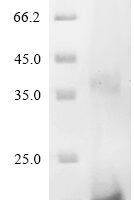
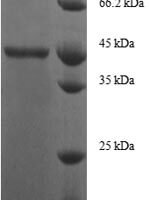
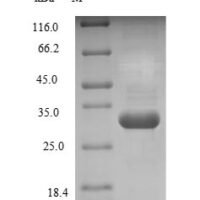
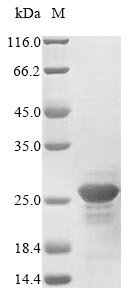
PurityGreater than 85% as determined by SDS-PAGE.
Expression SystemE.coli
Expression Region2-152aa
SpeciesHomo sapiens (Human)
Tag InfoN-terminal 10xHis-tagged and C-terminal Myc-tagged
Molecular weight24.2kDa
ActivityPlease contact us to obtain bioactivity data.
BufferIf the delivery form is liquid, the default storage buffer is Tris/PBS-based buffer, 5%-50% glycerol. If the delivery form is lyophilized powder, the buffer before lyophilization is Tris/PBS-based buffer, 6% Trehalose.
StorageStore at -20°C/-80°C upon receipt, aliquoting is necessary for mutiple use. Avoid repeated freeze-thaw cycles.
Research AreasNeuroscience

Function

Catalyzes the transfer of a gamma-phosphoryl group from a nucleoside triphosphate, mainly ATP, to a nucleoside diphosphate via a ping-pong mechanism involving a phosphohistidine intermediate, therefore contributing to the nucleoside triphosphate homeostasis. Also functions as a histidine protein kinase by transferring the phosphoryl group from the phosphohistidine intermediate to a histidine residue in target proteins. Phosphorylates the GNB1 subunit of heterotrimeric G proteins at 'His-266', generating a high-energy phosphate group that promotes GTP formation and enables receptor-independent activation of heterotrimeric G proteins.

Biological Context

Subcellular Location: Cytoplasm; Cytoplasm, perinuclear region; Nucleus
Tissue Specificity: Ubiquitously expressed

Product Specifications

Recombinant Human Nucleoside diphosphate kinase B (NME2), partial is a recombinant protein from Homo sapiens (Human), expressed in E.coli, covering amino acids 2-152aa, with N-terminal 10xHis-tagged and C-terminal Myc-tagged tag, molecular weight 24.2kDa, purity Greater than 85% as determined by SDS-PAGE.. Suitable for ELISA and Western Blot applications.

Recommended applications depend on the target, product format, and product-specific validation data. Refer to the product datasheet or Certificate of Analysis (CoA), or contact BioCrest Sci for application guidance.

Biological Activity: Please contact us to obtain bioactivity data.

Storage: Store at -20°C/-80°C upon receipt, aliquoting is necessary for mutiple use. Avoid repeated freeze-thaw cycles.

Shipping & Lead Time: Availability, shipping conditions, and estimated lead time are confirmed in the formal quotation or order confirmation based on the product format, destination, and order requirements.

Protein Biology

Function

Catalyzes the transfer of a gamma-phosphoryl group from a nucleoside triphosphate, mainly ATP, to a nucleoside diphosphate via a ping-pong mechanism involving a phosphohistidine intermediate, therefore contributing to the nucleoside triphosphate homeostasis (PubMed:11121025, PubMed:16313181, PubMed:1851158, PubMed:25679041). Also functions as a histidine protein kinase by transferring the phosphoryl group from the phosphohistidine intermediate to a histidine residue in target proteins (PubMed:17157250, PubMed:20946858). Phosphorylates the GNB1 subunit of heterotrimeric G proteins at 'His-266', generating a high-energy phosphate group that promotes GTP formation and enables receptor-independent activation of heterotrimeric G proteins (By similarity). Also phosphorylates KCNN4 at 'His-358', leading to activation of its intermediate conductance calcium-activated potassium channel activity, Ca(2+) influx, and subsequent activation of B and T cells (PubMed:17157250). Additionally involved in transcriptional regulation through direct DNA binding and chromatin remodeling (PubMed:11121025, PubMed:11694515, PubMed:19033359, PubMed:19435876, PubMed:25679041, PubMed:8392752). In this context, functions as a single-stranded DNA binding protein that binds and stabilizes the G-quadruplex (G4) structures within the nuclease hypersensitive element (NHE) III(1) region of the MYC gene promoter, facilitating recruitment of additional single-strand DNA binding proteins and activation of MYC transcription (PubMed:19033359, PubMed:19435876, PubMed:25679041, PubMed:8392752). G4 DNA-binding activity is independent of its nucleoside diphosphate kinase function and recognizes both folded and unfolded G4 structures (PubMed:25679041). With NME1, may regulate acetyl-CoA (AcCoA) usage between histone acetylation and fatty acid synthesis by targeting AcCoA release at ATP-rich, HAT-associated chromatin regions (By similarity). Also negatively regulates Rho activity by interacting with AKAP13/LBC (PubMed:15249197)

Subcellular Location

Cytoplasm; Cytoplasm, perinuclear region; Nucleus

Tissue Specificity

Ubiquitously expressed

Subunit

Homohexamer (PubMed:1851158, PubMed:19435876, PubMed:7658474, PubMed:8747457). Heterohexamer of two different chains: A/NME1 and B/NME2 (A5B or A4B2 or A3B3 or A2B4 or AB5) (PubMed:1851158). Interacts with CAPN8 (By similarity). Interacts with AKAP13 (PubMed:15249197). Interacts with ITGB1BP1 (via C-terminal domain region); this interaction leads to their recruitment to ITGB1-rich cell adhesion sites in cell spreading on FN1 (PubMed:11919189). Interacts with BCL2L10 (PubMed:17532299)

Gene: NME2  |  Organism: Homo sapiens  |  Synonyms: C-myc purine-binding transcription factor PUF; Histidine protein kinase NDKB; Nucleoside diphoshate kinase 2; nm23-H2
Key Publications

Frequently Asked Questions

How do I order or inquire about this product?

Submit the Online Inquiry form with your required quantity and specifications, or email sales@biocrestsci.com. Available sizes, pricing, stock status, documentation, and estimated lead time are confirmed in the formal quotation.

What is the shipping and delivery time?

Availability, dispatch timing, shipping conditions, and delivery estimates depend on the product format, destination, and order requirements. These details are confirmed in the formal quotation or order confirmation.

How should this product be stored?

Follow the storage and handling instructions in the product-specific datasheet and Certificate of Analysis (CoA). Requirements may vary by product form and formulation; contact BioCrest Sci if product-specific guidance is needed.

What quality controls are performed on your products?

Quality-control data such as identity, purity, endotoxin level, or biological activity are provided only when specified on this product page, the datasheet, or Certificate of Analysis (CoA). Biological activity is not implied unless explicitly stated.

Shopping Cart
Scroll to Top