Recombinant Human Opsin-3 (OPN3) Protein

Recombinant Human Opsin-3 (OPN3) Protein — G protein-coupled photoreceptor that selectively activates G(i/o) proteins in response to light, thereby decreasing intracellular cAMP levels. Purity >85%.

SKU: BCRECP-00170TM Category:

Product Specifications

Uniprot No.Q9H1Y3
Gene NamesOPN3
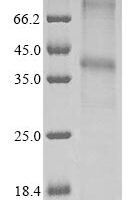
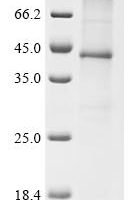
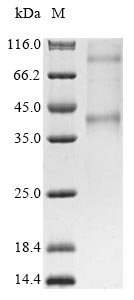
PurityGreater than 85% as determined by SDS-PAGE.
Expression Systemin vitro E.coli expression system
Expression Region1-402aa
SpeciesHomo sapiens (Human)
Tag InfoN-terminal 10xHis-tagged
Molecular weight47.7kDa
BufferIf the delivery form is liquid, the default storage buffer is Tris/PBS-based buffer, 5%-50% glycerol.If the delivery form is lyophilized powder, the buffer before lyophilization is Tris/PBS-based buffer, 6% Trehalose.
StorageStore at -20°C/-80°C upon receipt, aliquoting is necessary for mutiple use. Avoid repeated freeze-thaw cycles.

Function

G protein-coupled photoreceptor that selectively activates G(i/o) proteins in response to light, thereby decreasing intracellular cAMP levels. Activation occurs when the opsin-bound cis-retinal chromophore absorbs a photon and isomerizes to all-trans-retinal, inducing a conformational change in the opsin that triggers a G protein-mediated phototransduction cascade. Mediates blue light-induced pigmentation in melanocytes by activating calcium/CAMK2 signaling, followed by phosphorylation of CREB, p38, ERK and MITF.

Biological Context

Subcellular Location: Cell membrane (Multi-pass membrane protein); Cytoplasm
Tissue Specificity: Expressed throughout the epidermis and dermis, predominantly in the basal layer on the facial and abdominal skin (at protein level). Expressed in dermal fibroblasts (at protein level). Expressed in melanocytes (at protein level). Expressed in keratinocytes. Expressed in the retina. Expressed in tracheal airway smooth muscle (at protein level)

Product Specifications

Recombinant Human Opsin-3 (OPN3) Protein is a recombinant protein from Homo sapiens (Human), expressed in in vitro E.coli expression system, covering amino acids 1-402aa, with N-terminal 10xHis-tagged tag, molecular weight 47.7kDa, purity Greater than 85% as determined by SDS-PAGE.. Suitable for ELISA and Western Blot applications.
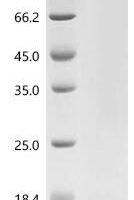
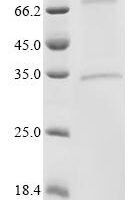
SDS-PAGE: Single band at expected molecular weight confirming purity.

ELISA: Suitable as coating antigen or detection standard.

Western Blot: Compatible with standard Western Blot protocols.

Protein Interaction: Validated for SPR (Surface Plasmon Resonance) and BLI (Bio-Layer Interferometry) studies.

Shipping: Shipped at ambient temperature. Lyophilized protein is stable during transit.

Storage: Store lyophilized protein at -20°C to -80°C. Reconstituted protein should be aliquoted and stored at -80°C. Avoid repeated freeze-thaw cycles.

Shelf Life: 12 months from date of receipt when stored as recommended.

Shipping Time: Orders placed before 2 PM EST ship same day. International orders typically deliver within 5-10 business days.

Protein Biology

Function

G protein-coupled photoreceptor that selectively activates G(i/o) proteins in response to light, thereby decreasing intracellular cAMP levels (PubMed:28842328, PubMed:30168605, PubMed:31380578, PubMed:36869204). Activation occurs when the opsin-bound cis-retinal chromophore absorbs a photon and isomerizes to all-trans-retinal, inducing a conformational change in the opsin that triggers a G protein-mediated phototransduction cascade (PubMed:36869204). Mediates blue light-induced pigmentation in melanocytes by activating calcium/CAMK2 signaling, followed by phosphorylation of CREB, p38, ERK and MITF. Required for TYR and DCT blue light-induced complex formation in melanocytes (PubMed:28842328). Involved in keratinocyte differentiation in response to blue-light (PubMed:30168605). Plays a role in melanocyte survival through regulation of intracellular calcium levels and subsequent BCL2/RAF1 signaling. Additionally, regulates apoptosis via cytochrome c release and subsequent activation of the caspase cascade (PubMed:31730232). Responsible for ultraviolet A (UVA)-induced keratinocytes supranuclear melanin cap formation via activating calcium/CAMK2, CREB, and Akt signal transduction, and ultimately increasing DYNC1I1 and DCTN1 expression levels, thereby playing a role in the skin response to UV radiation (PubMed:36869204). Required for the UVA-mediated induction of calcium and MAPK signaling resulting in the expression of MMP1, MMP2, MMP3, MMP9 and TIMP1 in dermal fibroblasts (PubMed:31380578). Also plays a role in light-mediated glucose uptake, mitochondrial respiration and fatty acid metabolism in brown adipocyte tissues. May be involved in photorelaxation of airway smooth muscle cells, via blue light-dependent GPCR signaling pathways (By similarity). Also inhibits melanogenesis in melanocytes by specifically inhibiting MC1R-evoked cAMP signaling in a constitutive, light-independent manner (PubMed:31097585). In the paraventricular nucleus of the hypothalamus, inhibits MC4R-mediated cAMP signaling and activates KCNJ13 channel opening in a constitutive manner, thereby promoting food intake and modulating spontaneous firing of neurons (PubMed:39951488)

Subcellular Location

Cell membrane (Multi-pass membrane protein); Cytoplasm

Tissue Specificity

Expressed throughout the epidermis and dermis, predominantly in the basal layer on the facial and abdominal skin (at protein level) (PubMed:30168605). Expressed in dermal fibroblasts (at protein level) (PubMed:31380578). Expressed in melanocytes (at protein level) (PubMed:28842328, PubMed:31097585, PubMed:31730232). Expressed in keratinocytes (PubMed:28842328). Expressed in the retina (PubMed:30284927). Expressed in tracheal airway smooth muscle (at protein level) (PubMed:30284927)

Subunit

Interacts with MC1R; the interaction results in a decrease in MC1R-mediated cAMP signaling and ultimately a decrease in melanin production in melanocytes (PubMed:31097585). Forms a complex with KCNJ13 and MC4R; OPN3 inhibits MC4R signaling and potentiates KCNJ13 (PubMed:39951488)

Gene: OPN3  |  Organism: Homo sapiens  |  Synonyms: Encephalopsin; Panopsin
Key Publications

Frequently Asked Questions

How do I order or inquire about this product?

Fill out the Online Inquiry form with your required quantity and specifications. You can also email sales@biocrestsci.com. Our team typically responds within 4 business hours with a quote and availability confirmation.

What is the shipping and delivery time?

Orders placed before 2 PM EST ship the same day. Domestic (US) delivery typically takes 2-3 business days. International orders deliver within 5-10 business days. All products are shipped at ambient temperature with appropriate packaging to ensure stability.

How should I store this recombinant protein?

Lyophilized proteins should be stored at -20°C to -80°C upon receipt. After reconstitution, aliquot and store at -80°C. Avoid repeated freeze-thaw cycles. Shelf life is 12 months from date of receipt when stored as recommended.

What quality controls are performed on your products?

Each product undergoes SDS-PAGE purity analysis (typically >85-95%), endotoxin testing, and bioactivity validation. Products are validated for ELISA, Western Blot, and SPR/BLI applications as specified on this product page. A Certificate of Analysis (CoA) is available upon request.

Shopping Cart
Scroll to Top