Recombinant Human p53 apoptosis effector related to PMP-22 (PERP) Protein

Recombinant Human p53 apoptosis effector related to PMP-22 (PERP) Protein — Component of intercellular desmosome junctions. Purity >85%.

SKU: BCRECP-00590TM Category:

Product Specifications

Uniprot No.Q96FX8
Gene NamesPERP
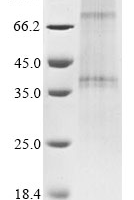
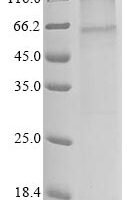
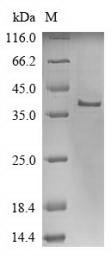
PurityGreater than 85% as determined by SDS-PAGE.
Expression Systemin vitro E.coli expression system
Expression Region1-193aa
SpeciesHomo sapiens (Human)
Tag InfoN-terminal 10xHis-SUMO-tagged and C-terminal Myc-tagged
Molecular weight41.4kDa
BufferIf the delivery form is liquid, the default storage buffer is Tris/PBS-based buffer, 5%-50% glycerol.If the delivery form is lyophilized powder, the buffer before lyophilization is Tris/PBS-based buffer, 6% Trehalose.
StorageStore at -20°C/-80°C upon receipt, aliquoting is necessary for mutiple use. Avoid repeated freeze-thaw cycles.

Function

Component of intercellular desmosome junctions. Plays a role in stratified epithelial integrity and cell-cell adhesion by promoting desmosome assembly. Thereby plays a role in barrier function of the skin against infection.

Biological Context

Subcellular Location: Cell junction, desmosome; Cell membrane (Multi-pass membrane protein); Cytoplasm
Tissue Specificity: Expressed in skin, heart, placental, liver, pancreas, keratinocytes and dermal fibroblasts. May translocate to the intestinal apical epithelial cell surface via sipA and sctB1/sipC-promoted exocytic translocation following infection by S. Typhimurium
Disease Association: Erythrokeratodermia variabilis et progressiva 7 (EKVP7) : A form of erythrokeratodermia variabilis et progressiva, a genodermatosis characterized by the coexistence of two independent skin lesions: transient erythema and hyperkeratosis that is usually localized but occasionally occurs in its generalized form. Clinical presentation varies significantly within a family and from one family to another. Palmoplantar keratoderma is present in around 50% of cases. EKVP7 is an autosomal recessive form characterized by palmoplantar keratoderma that extends to the dorsal surface of the hands and feet, as well as erythematous annular skin lesions. Pruritus, woolly hair, and dystrophic nails may also be present. [The disease is caused by variants affecting the gene represented in this entry] | Olmsted syndrome 2 (OLMS2) : A form of Olmsted syndrome, a rare congenital disorder characterized by bilateral mutilating palmoplantar keratoderma and periorificial keratotic plaques with severe itching at all lesions. Diffuse alopecia, constriction of digits, and onychodystrophy have also been reported. Infections and squamous cell carcinomas can arise on the keratotic areas. The digital constriction may progress to autoamputation of fingers and toes. OLMS2 is an autosomal dominant form with onset in the first months of life or in early childhood. [The disease is caused by variants affecting the gene represented in this entry]

Product Specifications

Recombinant Human p53 apoptosis effector related to PMP-22 (PERP) Protein is a recombinant protein from Homo sapiens (Human), expressed in in vitro E.coli expression system, covering amino acids 1-193aa, with N-terminal 10xHis-SUMO-tagged and C-terminal Myc-tagged tag, molecular weight 41.4kDa, purity Greater than 85% as determined by SDS-PAGE.. Suitable for ELISA and Western Blot applications.
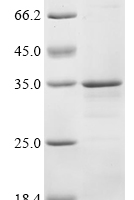
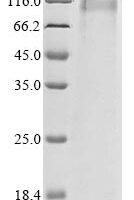
SDS-PAGE: Single band at expected molecular weight confirming purity.

ELISA: Suitable as coating antigen or detection standard.

Western Blot: Compatible with standard Western Blot protocols.

Protein Interaction: Validated for SPR (Surface Plasmon Resonance) and BLI (Bio-Layer Interferometry) studies.

Shipping: Shipped at ambient temperature. Lyophilized protein is stable during transit.

Storage: Store lyophilized protein at -20°C to -80°C. Reconstituted protein should be aliquoted and stored at -80°C. Avoid repeated freeze-thaw cycles.

Shelf Life: 12 months from date of receipt when stored as recommended.

Shipping Time: Orders placed before 2 PM EST ship same day. International orders typically deliver within 5-10 business days.

Protein Biology

Function

Component of intercellular desmosome junctions (By similarity). Plays a role in stratified epithelial integrity and cell-cell adhesion by promoting desmosome assembly (By similarity). Thereby plays a role in barrier function of the skin against infection (By similarity). Plays a role in mammary epithelial tissue homeostasis and remodeling during and after pregnancy, potentially via its involvement in desmosome cell-cell junctions (By similarity). Required for tooth enamel development via facilitating desmosome-mediated ameloblast adhesion to the stratum intermedium during the transitional stage of amelogenesis (By similarity). May also play a role in downstream transcriptional regulation of other genes involved in amelogenesis such as AMBN, ENAM, MMP20 and KLK4 (By similarity). Plays a role as an effector in the TP53-dependent apoptotic pathway (By similarity). Positively regulates apoptosis in T-helper 17 (Th17) cell populations via caspase-dependent signaling (By similarity). Promotes neutrophil transepithelial migration in response to chemoattractants such as hepoxilin A3 (HXA3), N-Formylmethionyl-leucyl-phenylalanine (fMLP) and CXCL8/IL-8 (PubMed:25486861). Required for neutrophil transepithelial migration in response to S.typhimurium infection (PubMed:25486861). May act as a positive regulator of endothelial cell apoptosis in response to blood flow-derived shear stress (By similarity)

Subcellular Location

Cell junction, desmosome; Cell membrane (Multi-pass membrane protein); Cytoplasm

Disease Association

Erythrokeratodermia variabilis et progressiva 7 (EKVP7) : A form of erythrokeratodermia variabilis et progressiva, a genodermatosis characterized by the coexistence of two independent skin lesions: transient erythema and hyperkeratosis that is usually localized but occasionally occurs in its generalized form. Clinical presentation varies significantly within a family and from one family to another. Palmoplantar keratoderma is present in around 50% of cases. EKVP7 is an autosomal recessive form characterized by palmoplantar keratoderma that extends to the dorsal surface of the hands and feet, as well as erythematous annular skin lesions. Pruritus, woolly hair, and dystrophic nails may also be present. [The disease is caused by variants affecting the gene represented in this entry] | Olmsted syndrome 2 (OLMS2) : A form of Olmsted syndrome, a rare congenital disorder characterized by bilateral mutilating palmoplantar keratoderma and periorificial keratotic plaques with severe itching at all lesions. Diffuse alopecia, constriction of digits, and onychodystrophy have also been reported. Infections and squamous cell carcinomas can arise on the keratotic areas. The digital constriction may progress to autoamputation of fingers and toes. OLMS2 is an autosomal dominant form with onset in the first months of life or in early childhood. [The disease is caused by variants affecting the gene represented in this entry]

Tissue Specificity

Expressed in skin, heart, placental, liver, pancreas, keratinocytes and dermal fibroblasts. May translocate to the intestinal apical epithelial cell surface via sipA and sctB1/sipC-promoted exocytic translocation following infection by S. Typhimurium (PubMed:25486861, PubMed:27078059)

Subunit

(Microbial infection) Interacts with S.typhimurium sipA and sctB1/sipC

Gene: PERP  |  Organism: Homo sapiens  |  Synonyms: Keratinocyte-associated protein 1; P53-induced protein PIGPC1; Transmembrane protein THW
Key Publications

Frequently Asked Questions

How do I order or inquire about this product?

Fill out the Online Inquiry form with your required quantity and specifications. You can also email sales@biocrestsci.com. Our team typically responds within 4 business hours with a quote and availability confirmation.

What is the shipping and delivery time?

Orders placed before 2 PM EST ship the same day. Domestic (US) delivery typically takes 2-3 business days. International orders deliver within 5-10 business days. All products are shipped at ambient temperature with appropriate packaging to ensure stability.

How should I store this recombinant protein?

Lyophilized proteins should be stored at -20°C to -80°C upon receipt. After reconstitution, aliquot and store at -80°C. Avoid repeated freeze-thaw cycles. Shelf life is 12 months from date of receipt when stored as recommended.

What quality controls are performed on your products?

Each product undergoes SDS-PAGE purity analysis (typically >85-95%), endotoxin testing, and bioactivity validation. Products are validated for ELISA, Western Blot, and SPR/BLI applications as specified on this product page. A Certificate of Analysis (CoA) is available upon request.

Shopping Cart
Scroll to Top