Recombinant Human Parkinson disease protein 7 (PARK7), partial

Recombinant Human Parkinson disease protein 7 (PARK7), partial — Multifunctional protein with controversial molecular function which plays an important role in cell protection against oxidative stress and cell death acting as oxidative stress sensor and redox-se… Purity >90%.

SKU: BCRECP-001326 Category:

Product Specifications

Product SkuBCRECP-001326
Product DescriptionRecombinant Human Parkinson disease protein 7 (PARK7) Protein is expressed from E.coli with N-terminal GST-tagged. It contains 1-188aa. [Accession | Q99497].
Uniprot No.Q99497
Gene NamesPARK7
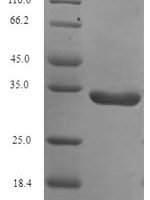
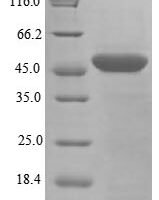
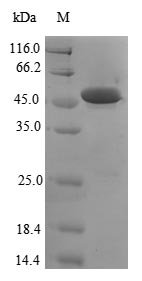
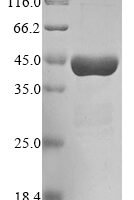
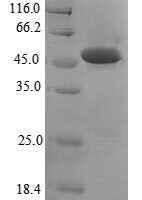
PurityGreater than 90% as determined by SDS-PAGE.
Expression SystemE.coli
Expression Region1-188aa
SpeciesHomo sapiens (Human)
Tag InfoN-terminal GST-tagged
Molecular weight46.8kDa
ActivityPlease contact us to obtain bioactivity data.
BufferIf the delivery form is liquid, the default storage buffer is Tris/PBS-based buffer, 5%-50% glycerol. If the delivery form is lyophilized powder, the buffer before lyophilization is Tris/PBS-based buffer, 6% Trehalose.
StorageStore at -20°C/-80°C upon receipt, aliquoting is necessary for mutiple use. Avoid repeated freeze-thaw cycles.
Research AreasApoptosis

Function

Multifunctional protein with controversial molecular function which plays an important role in cell protection against oxidative stress and cell death acting as oxidative stress sensor and redox-sensitive chaperone and protease. It is involved in neuroprotective mechanisms like the stabilization of NFE2L2 and PINK1 proteins, male fertility as a positive regulator of androgen signaling pathway as well as cell growth and transformation through, for instance, the modulation of NF-kappa-B signaling pathway. Has been described as a protein and nucleotide deglycase that catalyzes the deglycation of the Maillard adducts formed between amino groups of proteins or nucleotides and reactive carbonyl groups of glyoxals.

Biological Context

Subcellular Location: Cell membrane (Lipid-anchor); Cytoplasm; Nucleus; Membrane raft; Mitochondrion; Endoplasmic reticulum
Tissue Specificity: Highly expressed in pancreas, kidney, skeletal muscle, liver, testis and heart. Detected at slightly lower levels in placenta and brain (at protein level). Detected in astrocytes, Sertoli cells, spermatogonia, spermatids and spermatozoa. Expressed by pancreatic islets at higher levels than surrounding exocrine tissues
Disease Association: Parkinson disease 7 (PARK7) : A neurodegenerative disorder characterized by resting tremor, postural tremor, bradykinesia, muscular rigidity, anxiety and psychotic episodes. PARK7 has onset before 40 years, slow progression and initial good response to levodopa. Some patients may show traits reminiscent of amyotrophic lateral sclerosis-parkinsonism/dementia complex (Guam disease). [The disease is caused by variants affecting the gene represented in this entry]

Product Specifications

Recombinant Human Parkinson disease protein 7 (PARK7), partial is a recombinant protein from Homo sapiens (Human), expressed in E.coli, covering amino acids 1-188aa, with N-terminal GST-tagged tag, molecular weight 46.8kDa, purity Greater than 90% as determined by SDS-PAGE.. Suitable for ELISA and Western Blot applications.
Recommended applications depend on the target, product format, and product-specific validation data. Refer to the product datasheet or Certificate of Analysis (CoA), or contact BioCrest Sci for application guidance.

Biological Activity: Please contact us to obtain bioactivity data.

Storage: Store at -20°C/-80°C upon receipt, aliquoting is necessary for mutiple use. Avoid repeated freeze-thaw cycles.

Shipping & Lead Time: Availability, shipping conditions, and estimated lead time are confirmed in the formal quotation or order confirmation based on the product format, destination, and order requirements.

Protein Biology

Function

Multifunctional protein with controversial molecular function which plays an important role in cell protection against oxidative stress and cell death acting as oxidative stress sensor and redox-sensitive chaperone and protease (PubMed:12796482, PubMed:17015834, PubMed:18711745, PubMed:19229105, PubMed:20304780, PubMed:25416785, PubMed:26995087, PubMed:28993701). It is involved in neuroprotective mechanisms like the stabilization of NFE2L2 and PINK1 proteins, male fertility as a positive regulator of androgen signaling pathway as well as cell growth and transformation through, for instance, the modulation of NF-kappa-B signaling pathway (PubMed:12612053, PubMed:14749723, PubMed:15502874, PubMed:17015834, PubMed:18711745, PubMed:21097510). Has been described as a protein and nucleotide deglycase that catalyzes the deglycation of the Maillard adducts formed between amino groups of proteins or nucleotides and reactive carbonyl groups of glyoxals (PubMed:25416785, PubMed:28596309). But this function is rebuted by other works (PubMed:27903648, PubMed:31653696). As a protein deglycase, repairs methylglyoxal- and glyoxal-glycated proteins, and releases repaired proteins and lactate or glycolate, respectively. Deglycates cysteine, arginine and lysine residues in proteins, and thus reactivates these proteins by reversing glycation by glyoxals. Acts on early glycation intermediates (hemithioacetals and aminocarbinols), preventing the formation of advanced glycation endproducts (AGE) that cause irreversible damage (PubMed:25416785, PubMed:26995087, PubMed:28013050). Also functions as a nucleotide deglycase able to repair glycated guanine in the free nucleotide pool (GTP, GDP, GMP, dGTP) and in DNA and RNA. Is thus involved in a major nucleotide repair system named guanine glycation repair (GG repair), dedicated to reversing methylglyoxal and glyoxal damage via nucleotide sanitization and direct nucleic acid repair (PubMed:28596309). Protects histones from adduction by methylglyoxal, controls the levels of methylglyoxal-derived argininine modifications on chromatin (PubMed:30150385). Able to remove the glycations and restore histone 3, histone glycation disrupts both local and global chromatin architecture by altering histone-DNA interactions as well as histone acetylation and ubiquitination levels (PubMed:30150385, PubMed:30894531). Displays a very low glyoxalase activity that may reflect its deglycase activity (PubMed:22523093, PubMed:28993701, PubMed:31653696). Eliminates hydrogen peroxide and protects cells against hydrogen peroxide-induced cell death (PubMed:16390825). Required for correct mitochondrial morphology and function as well as for autophagy of dysfunctional mitochondria (PubMed:16632486, PubMed:19229105). Plays a role in regulating expression or stability of the mitochondrial uncoupling proteins SLC25A14 and SLC25A27 in dopaminergic neurons of the substantia nigra pars compacta and attenuates the oxidative stress induced by calcium entry into the neurons via L-type channels during pacemaking (PubMed:18711745). Regulates astrocyte inflammatory responses, may modulate lipid rafts-dependent endocytosis in astrocytes and neuronal cells (PubMed:23847046). In pancreatic islets, involved in the maintenance of mitochondrial reactive oxygen species (ROS) levels and glucose homeostasis in an age- and diet dependent manner. Protects pancreatic beta cells from cell death induced by inflammatory and cytotoxic setting (By similarity). Binds to a number of mRNAs containing multiple copies of GG or CC motifs and partially inhibits their translation but dissociates following oxidative stress (PubMed:18626009). Metal-binding protein able to bind copper as well as toxic mercury ions, enhances the cell protection mechanism against induced metal toxicity (PubMed:23792957). In macrophages, interacts with the NADPH oxidase subunit NCF1 to direct NADPH oxidase-dependent ROS production, and protects against sepsis (By similarity)

Subcellular Location

Cell membrane (Lipid-anchor); Cytoplasm; Nucleus; Membrane raft; Mitochondrion; Endoplasmic reticulum

Disease Association

Parkinson disease 7 (PARK7) : A neurodegenerative disorder characterized by resting tremor, postural tremor, bradykinesia, muscular rigidity, anxiety and psychotic episodes. PARK7 has onset before 40 years, slow progression and initial good response to levodopa. Some patients may show traits reminiscent of amyotrophic lateral sclerosis-parkinsonism/dementia complex (Guam disease). [The disease is caused by variants affecting the gene represented in this entry]

Tissue Specificity

Highly expressed in pancreas, kidney, skeletal muscle, liver, testis and heart. Detected at slightly lower levels in placenta and brain (at protein level). Detected in astrocytes, Sertoli cells, spermatogonia, spermatids and spermatozoa. Expressed by pancreatic islets at higher levels than surrounding exocrine tissues (PubMed:22611253)

Subunit

Homodimer (PubMed:12796482, PubMed:12851414, PubMed:12855764, PubMed:31653696). Binds EFCAB6/DJBP and PIAS2 (PubMed:11477070, PubMed:12612053, PubMed:12851414). Part of a ternary complex containing PARK7, EFCAB6/DJBP and AR (PubMed:12612053). Interacts (via N-terminus) with OTUD7B (PubMed:21097510). Interacts with BBS1, HIPK1, CLCF1 and MTERF (PubMed:16390825, PubMed:21097510). Forms a complex with PINK1 and PRKN (PubMed:19229105). Interacts (via C-terminus) with NCF1; the interaction is enhanced by LPS and modulates NCF1 phosphorylation and membrane translocation (By similarity). Interacts with NENF (PubMed:31536960)

Gene: PARK7  |  Organism: Homo sapiens  |  Synonyms: Maillard deglycase; Oncogene DJ1; Parkinsonism-associated deglycase; Protein DJ-1; Protein/nucleic acid deglycase DJ-1
Key Publications

Frequently Asked Questions

How do I order or inquire about this product?

Submit the Online Inquiry form with your required quantity and specifications, or email sales@biocrestsci.com. Available sizes, pricing, stock status, documentation, and estimated lead time are confirmed in the formal quotation.

What is the shipping and delivery time?

Availability, dispatch timing, shipping conditions, and delivery estimates depend on the product format, destination, and order requirements. These details are confirmed in the formal quotation or order confirmation.

How should this product be stored?

Follow the storage and handling instructions in the product-specific datasheet and Certificate of Analysis (CoA). Requirements may vary by product form and formulation; contact BioCrest Sci if product-specific guidance is needed.

What quality controls are performed on your products?

Quality-control data such as identity, purity, endotoxin level, or biological activity are provided only when specified on this product page, the datasheet, or Certificate of Analysis (CoA). Biological activity is not implied unless explicitly stated.

Shopping Cart
Scroll to Top