Function
Catalyzes one of the two ATP producing reactions in the glycolytic pathway via the reversible conversion of 1,3-diphosphoglycerate to 3-phosphoglycerate. Both L- and D- forms of purine and pyrimidine nucleotides can be used as substrates, but the activity is much lower on pyrimidines. In addition to its role as a glycolytic enzyme, it seems that PGK1 acts as a polymerase alpha cofactor protein (primer recognition protein).
Biological Context
Subcellular Location: Cytoplasm, cytosol; Mitochondrion matrix
Tissue Specificity: Mainly expressed in spermatogonia. Localized on the principle piece in the sperm (at protein level). Expression significantly decreased in the testis of elderly men
Disease Association: Phosphoglycerate kinase 1 deficiency (PGK1D) : A condition with a highly variable clinical phenotype that includes hemolytic anemia, rhabdomyolysis, myopathy and neurologic involvement. Patients can express one or more of these manifestations, and some affected individuals develop parkinsonian symptoms. [The disease is caused by variants affecting the gene represented in this entry]
Pathway: Carbohydrate degradation; glycolysis; pyruvate from D-glyceraldehyde 3-phosphate: step 2/5
Product Specifications
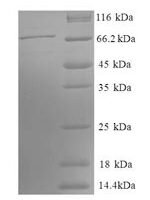
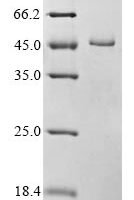
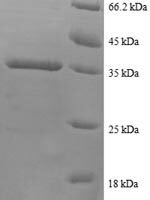
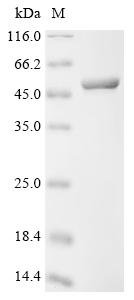
Recombinant Human Phosphoglycerate kinase 1 (PGK1) is a recombinant protein from Homo sapiens (Human), expressed in E.coli, covering amino acids 2-417aa, with C-terminal 6xHis-tagged tag, molecular weight 51.5kDa, purity Greater than 95% as determined by SDS-PAGE.. Suitable for ELISA and Western Blot applications. Explore more Kinase proteins →